












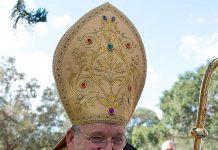
Bishop Erik Varden explores St. Bernard’s enduring humility, intellect, and passion in his Vatican Lenten reflection, “Bernard, the Idealist.”
Newsroom (23/02/2026 Gaudium Press ) In his second Lenten reflection for the Spiritual Exercises at the Vatican, Bishop Erik Varden turned his gaze toward one of medieval Christianity’s most magnetic figures: St. Bernard of Clairvaux. Addressing Pope Leo XIV, Cardinals in residence, and Dicastery heads, Bishop Varden spoke under the theme “Bernard, the Idealist,” uncovering the spirit of a man who shaped the twelfth-century Cistercian movement with equal parts zeal, intellect, and humanity.
The Man Who Did Not Found but Transformed
What sort of man was Bernard—and what drove him? History often mistakes him for the founder of the Cistercian Order. In truth, the monastery of Cîteaux predated his arrival by fifteen years, already a project of innovation as much as reform, built in 1098 as the novum monasterium—a “new monastery.” When Bernard arrived in 1113, only twenty-three years old and accompanied by thirty companions, he did more than join a reforming house; he infused it with a vision that would give the movement a new heart.
On the surface, the Cistercians sought a conservative return to simplicity. Yet, as Bishop Varden emphasized, their work was steeped in paradox: while preserving monastic tradition, they introduced novelties that proved deeply creative. That tension—the balance between fidelity and innovation—became Bernard’s lifelong challenge.
The Tensions of the Idealist
Bernard’s confidence in his judgment could make him both a reformer and, paradoxically, a conservative. His fierce clarity often bred partisanship, yet his integrity never wavered. Bishop Varden described him as a man of contradictions—at once rigid in principle and flexible in method, both passionate and profoundly humble.
He was not a hypocrite. His faith was authentic, his humility real. Bernard’s directness did not exclude tenderness; he was capable of genuine friendship, even with those he once opposed. That rare combination of steel and gentleness made him a compelling witness to divine love—and still makes him compelling today.
A Modern Parallel in the Monastery
Bishop Varden drew a sharp but meaningful comparison between Bernard and another monastic firebrand: the twentieth-century Trappist writer Thomas Merton. Merton’s abbot at Gethsemani, Dom James Fox, once complained in frustration, “His mind is so electrical!” Yet Fox confessed to loving his company, and even sought Merton’s guidance in confession.
To compare Bernard with Merton would be, as Varden put it, “daft”—they lived in vastly different worlds. But temperamentally, both shared an inner quicksilver, an energy perpetually caught between inspiration and discipline, intuition and obedience. Bernard’s restless mind was charged not with electricity but with the same spark of divine tension that drives all authentic seekers of truth.
Conversion as Continuous Struggle
At the heart of Bernard’s teaching, Bishop Varden noted, lies a theology born equally from Scripture and struggle. His understanding of conversion evolved not from abstract doctrine but from the bruises of experience. The more he lived, the more Bernard learned to doubt his own certainties, to see beyond the righteousness of his opinion toward the vast mercy of God.
For Bishop Varden, this makes Bernard a model guide for Lent—a “good, wise companion for anyone setting out on an exodus from selfishness and pride.” In a season dedicated to purification, Bernard’s voice reminds believers that authenticity comes not through perfection but through the long discipline of love.
The Enduring Light of an Idealist
St. Bernard of Clairvaux endures not because he founded an order, but because he animated it with conscience and imagination. In recalling his life, Bishop Varden offered not a medieval portrait but a mirror: the image of a man bound by tensions we still feel today—between conviction and charity, intellect and faith, self-belief and surrender.
Through this portrait of “Bernard, the Idealist,” Bishop Varden invites today’s faithful to rediscover an ancient fire that continues to illuminate the path toward divine love.
- Raju Hasmukh with files from Vatican News
Related Images: