

















USCCB to revise Ethical and Religious Directives at Nov 2025 plenary, incorporating 2023 ban on gender-transition procedures and updating beginning- and end-of-life guidance.
Newsroom (11/11/2025 Gaudium Press ) The U.S. Conference of Catholic Bishops will vote this week on proposed revisions to the seventh edition of the Ethical and Religious Directives for Catholic Health Care Services (ERD), with a particular focus on explicitly prohibiting surgical or chemical gender-transition interventions in Catholic facilities.
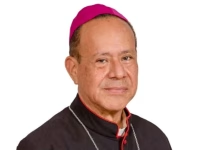
In an exclusive interview with OSV News ahead of the bishops’ Nov. 10-13 fall plenary assembly in Baltimore, Auxiliary Bishop James S. Massa of Brooklyn, chairman of the USCCB Committee on Doctrine, outlined the scope of the updates and their significance amid rapid cultural and medical shifts.
The most substantial changes will appear in Part Three of the ERD, which governs the professional-patient relationship.
“We have new material in response to the emergence of ‘gender care’ taking place across health care,” Bishop Massa said. “Our hospitals are facing decisions about what interventions can or should be performed within our own Catholic facilities, so we responded to that.”
The revisions formally incorporate the Committee on Doctrine’s 2023 doctrinal note that prohibited any surgical or chemical interventions intended to exchange or simulate the sex characteristics of one sex for those of the other.
Additional amendments will refine language in Part One (social responsibility of Catholic health care services), Part Four (issues in care for the beginning of life), and Part Five (care for the seriously ill and dying), reinforcing the Church’s absolute rejection of euthanasia and assisted suicide.
Any changes to the ERD require a two-thirds majority of the USCCB membership. Even if approved, individual bishops retain authority to promulgate the revised directives as particular law in their own dioceses.
Asked how Catholic anthropology can be articulated in an increasingly hostile medical environment, Bishop Massa pointed to the unified understanding of the human person as an inseparable unity of body and soul.
“The person is body and soul,” he stressed, citing the 2024 Vatican declaration Dignitas Infinita. Paragraphs 59 and 60, he noted, explicitly reject “all attempts to obscure reference to the ineliminable sexual difference between man and woman.”
While acknowledging rare disorders of sexual development that may warrant medically sound intervention, Bishop Massa rejected the notion that gender can be changed at will.
“This idea that we can change our gender because it better corresponds to our desires — that’s really a false notion of what it means to be a human being,” he said.
On the dramatic rise in transgender identification among young people — a 422% increase among 18- to 24-year-olds between 2014 and 2023, according to recent studies — Bishop Massa attributed the surge to cultural currents of “expressive individualism” and a broader secular rejection of the givenness of the body.
“The modernist heresy that really lies at the root of this opposition to a Christian, Catholic, biblical perspective is the idea that we are self-creating beings,” he said. “The alternative is to say, ‘No, you are a gift. Life is a gift.’”
He emphasized the Church’s call to accompany those experiencing gender dysphoria with deep compassion, listening for underlying wounds and family dynamics.
The bishop also highlighted the ERD’s role in religious freedom litigation, noting that consistent national standards strengthen defenses for Catholic health care workers and institutions facing pressure to perform morally impermissible procedures.
“The landscape changes. There are forces in the culture that are very hostile to the Church’s positions on moral issues,” Bishop Massa observed. “Having the ERDs as the standard for the particular churches in the U.S. is of great help for individuals who, in conscience, refuse to perform certain procedures.”
If approved this week, the seventh edition will mark the latest effort by the U.S. bishops to ensure Catholic health care remains faithfully anchored to Church teaching in an era of rapid technological and ideological change.
- Raju Hasmukh with files from OSV News