























The move, coupled with a proposal to enshrine abortion as a constitutional right, has ignited a heated debate over conscientious objection and women’s healthcare access.
Newsroom (09/10/2025, Gaudium Press ) Spain’s socialist government, led by Prime Minister Pedro Sánchez, is pressing regional authorities to create registries of doctors who refuse to perform abortions, prompting fierce opposition from medical professionals and Catholic leaders. The move, coupled with a proposal to enshrine abortion as a constitutional right, has ignited a heated debate over conscientious objection and women’s healthcare access.
In a letter to the conservative-led regions of Asturias, Aragon, Madrid, and the Balearic Islands, Sánchez demanded the creation of lists identifying healthcare workers who opt out of performing abortions due to personal or moral convictions. The government has given these regions a three-month deadline to comply, threatening legal action if they fail to produce the registries.
Conscientious Objection Under Fire
The proposed registries have drawn sharp criticism from groups like the National Association for the Defense of the Right to Conscientious Objection (ANDOC). José Antonio Díez, ANDOC’s general coordinator, told Catholic outlet Alpha y Omega that the right to conscientious objection is constitutionally protected and cannot be contingent on registration. “No one can be forced to exercise their right to conscientious objection if they are not registered,” Díez said. “Who can order private citizens to register in a registry that not even the Constitutional Court requires as a condition? From that point on, everything is just gimmicks and tricks.”
Eva Martín, ANDOC’s president, went further, labeling the registries as “blacklists” designed to marginalize doctors who exercise their constitutional rights. “Why don’t they create a list of doctors who want to perform abortions and euthanasia, which would be the most practical option?” Martín asked, as quoted by Alpha y Omega. She argued that the registries aim to professionally exclude objecting doctors, undermining their freedom of conscience.
According to the Spanish newspaper ABC, the registries would include the full names of professionals who decline to perform abortions, even if their medical specialty is relevant to the procedure. A new national regulation also mandates that public clinics guarantee access to abortions, placing additional pressure on regional governments to comply.
Rising Abortion Rates
The controversy comes amid a steady rise in Spain’s abortion rates. According to the Health Ministry, 103,097 abortions were performed in 2023, a 4.8% increase from 98,316 in 2022 and an 8.7% rise since 2014. Alpha y Omega reported that the 2023 rate equates to 12.22 abortions per 1,000 women aged 15 to 44, nearing the record high of 2011. “We are talking about a rate worryingly close to the all-time high,” the outlet noted in a 2024 editorial.
Catholic Leaders and Post-Abortion Syndrome
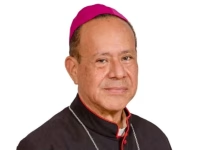
Catholic leaders have also weighed in, with Bishop César García Magán of Toledo, secretary general of Spain’s bishops’ conference, condemning abortion as “an attack on human life in the womb.” Speaking on October 2, Magán praised a recent Madrid City Council decision requiring municipal medical centers to inform women about post-abortion syndrome, a condition he said is real and deeply impactful. “The church’s initiatives to support women who have had abortions confirm that it certainly exists,” he told reporters, citing a personal anecdote of a mother who “suffered terribly” after an abortion.
Magán emphasized the church’s stance that life begins at conception: “A mother is aware that there is someone in her womb, not something. The debate is whether it is human life or not, which it is. Abortion is the elimination of a human life, and that cannot be a right.”
Constitutional Ambitions and Legal Battles
Sánchez’s push to constitutionalize abortion rights follows France’s lead, which in March 2024 became the first country to enshrine abortion in its constitution. However, experts note that achieving a three-fifths majority in Spain’s parliament for such an amendment is unlikely, given strong opposition from the conservative Partido Popular and Vox parties.
Spain’s abortion laws, liberalized in 2010 under former socialist Prime Minister José Luis Rodríguez Zapatero, allow abortions on demand until the 14th week of pregnancy, with extensions to 22 weeks in cases of health risks or fetal abnormalities. In 2023, the Constitutional Court upheld the law’s legality, and 16-year-olds were granted the right to seek abortions without parental consent.
A Divisive Path Forward
The government’s registry proposal and constitutional ambitions have deepened Spain’s cultural and political divide over abortion. While Sánchez insists that respecting medical professionals’ consciences must not hinder women’s healthcare, critics argue that the measures infringe on personal freedoms and stigmatize dissent. As the three-month deadline looms, the clash between individual rights and state mandates is set to intensify, with regional governments and medical professionals bracing for a contentious legal and ethical battle.
- Raju Hasmukh with files from OSV news
Related Images: