









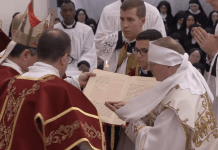
Determined to break with his life of sin, Brentano laid down in the confessional the heavy burden that oppressed him. After Sacramental Absolution, his face reflected the happiness of a soul in which God’s grace had returned. And God had further plans for him …
Newsdesk (13/10/2025 14:22, Gaudium Press) At the age of thirty-eight, Clemens Brentano was a prominent poet in German literary circles. By worldly standards, he had everything it takes to be a happy man: good health, a comfortable financial situation, a carefree life, a wide circle of friends, and the ability to enjoy all lawful and unlawful pleasures. However, happiness did not dwell in his soul.
Two tremendous disappointments
Brentano had received little religious training in his childhood and soon embraced customs contrary to the Commandments of God’s Law. As a result, the light of faith gradually faded in him. At a certain point, however, the voice of his conscience caused him a wholesome uneasiness. He then explained his situation to some of his best ‘friends,’ hoping to receive encouragement to change his life.
What a tremendous disappointment: he received only contempt and mockery in response.
He was in this pitiful state when, in 1816, he became friends with the poet Luísa Hensel. The daughter of a Lutheran pastor, she was only eighteen years old, but she had already become accustomed to scrutinizing the grand horizons of the Gospel with a clear gaze and was halfway to converting to Catholicism. Thus, upon coming into contact with Brentano, the renowned and brilliant Catholic scholar, the aspiration to be instructed by him in the doctrine of the Holy Church was kindled in her soul.
Luísa also suffered a terrible disappointment: Brentano knew as little about the Catholic religion as she did, or perhaps even less!
Go to confession! Go to confession!”
There remained in Brentano’s soul enough threads of faith to arouse remorse for his misconduct and, perhaps, nostalgia for his lost innocence. That is why he enjoyed talking to that young poetess, whose righteousness and firmness of character greatly impressed him.
Despite the great age difference between them, one day he confided in her about the sad moral situation he found himself in, hoping to receive some words of encouragement from her. Imagine his surprise when he heard this reply:
— Why say this to me, a young and inexperienced girl and, moreover, a Lutheran? You are a Catholic and, as such, you have the good fortune to be able to confess. Go, then, and unburden your heart at the feet of your confessor!
Stunned by such an unexpected reply, Brentano reasoned: ‘My friends mock my misery, and the daughter of a Lutheran pastor gives me this good advice!…’
‘There is no other recourse,’ insisted the young woman. ‘If I were Catholic and had the Sacrament of Penance at my disposal, how happy I would be!’
Brentano had no doubt that this was the only solution to his problem, but he had to fight hard to make up his mind. And Luisa helped him, repeating to him often:
‘Go to confession! Go to confession!’
Sincere and radical conversion
Finally, he emerged victorious: he made a firm resolution to break definitively with his life of sin.
In February 1817, after careful preparation, he sought out the Cistercian priest Johannes Ambrosius Taube, to whom he made a General Confession, laying at his feet the heavy burden that had oppressed his soul for so many years. After giving him Sacramental Absolution, the confessor rose and embraced the penitent, whose radiant face reflected the happiness of a soul in which God’s grace had returned.
The next day, he received the Holy Eucharist. He had never felt so happy!
The news of Brentano’s conversion was received with vitriol in anti-Catholic intellectual circles in Germany. However, like the Bedouins who calmly move forward while the dogs bark, he limited himself to giving abundant proof that it was a radical conversion: the romantic poet was dead; from then on, all his talent would be put at the service of the Church.
He adopted a penitent lifestyle, attending Mass daily and receiving the Sacraments assiduously. In addition, he distributed the considerable proceeds from the sale of his works to the needy.
Greater still, however, was his concern for the welfare of souls. He never missed an opportunity to do apostolate. He played a special role in the conversion of Luisa Hensel and, later, that of the painter Emilie Linder. And he spared no effort to promote the rebirth of religious spirit in his homeland.
Disciple and Secretary of a Blessed
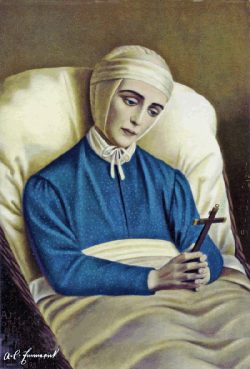
However, his life’s great work was to transcribe and organize the accounts of supernatural revelations received by Blessed Anne Catherine Emmerich, the well-known stigmatist nun who lived in poverty in a house in Dülmen, Germany.
He visited her for the first time on September 24th, 1818. For him, this encounter was an emotional surprise. Catherine Emmerich, on the other hand, had been expecting him for a long time, as she knew that the writer had a mission to fulfil with her.
She welcomed him as if she were seeing an old friend and invited him to return every day. In addition to instructing him on important points of Catholic doctrine, the holy visionary guided him in his spiritual life, increasing Brentano’s admiration and enthusiasm for her every day. ‘Now I see, understand, feel and know what the Church is,’ he wrote in a letter to Luisa Hensel.
After a few months, he moved to Dülmen, staying in an uncomfortable little hotel where he lived until his teacher’s death. Every day, he took notes on her visions. He would then read these notes in his hotel room, filling in from memory various details he had not had time to record, and finally rewriting everything. The next day, he would present his work to the visionary. She would approve some passages and correct others. Brentano would then revise his writing once, twice, as many times as necessary until she approved it.
After Catherine Emmerich’s death, Brentano spent the rest of his life in the enormous task of organizing and publishing that large mass of manuscripts. He was unable to finish the work. He published only the first volume: The Painful Passion of Our Lord Jesus Christ. The second volume – The Life of the Blessed Virgin Mary – was prepared, but unpublished, when he died on July 28th, 1842.
The precious records passed into the hands of other writers, including Luísa Hensel, who took on the task of publishing them.
Thus, it is above all to Clemens Brentano that we owe the publication of the visions and revelations of Blessed Anne Catherine Emmerich, which have done so much good and will continue to do so throughout the world.
Text taken from the Heralds of the Gospel Magazine, March 2020. By Fr. Francisco Teixeira de Araújo, EP
The post ‘Secretary’ to a Mystic … because he was Willing to Convert! appeared first on Gaudium Press.
Compiled by Roberta MacEwan
Related Images: