





Five years after Beirut port explosion killed 200+, Pope Leo XIV prays at memorial, meets victims’ families and blesses child holding father’s photo.
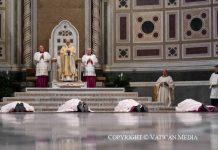
Newsroom (02/12/2025 Gaudium Press )In a moment of profound silence and shared grief, Pope Leo XIV knelt in prayer Monday before the memorial monument at Beirut’s port, where the names of more than 200 victims of the August 4, 2020 explosion are inscribed. The pontiff’s stop at the still-scarred site – marked by twisted metal and gutted grain silos – was the emotional climax of his four-day apostolic visit to Lebanon.
The blast, caused by 2,750 tons of improperly stored ammonium nitrate that had languished in Hangar 12 since 2014, remains one of the largest non-nuclear explosions ever recorded. It claimed at least 218 lives, wounded more than 7,000 people, and rendered 300,000 residents homeless in a matter of seconds.
Five years on, no one has been held accountable. Political interference, widely linked to Hezbollah and its allies, has repeatedly derailed the judicial investigation. Proceedings were frozen for years until Judge Tarek Bitar was finally allowed to resume work in February 2025. Yet senior officials continue to refuse summons, and some have filed lawsuits against the judge himself.
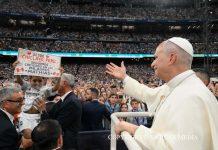
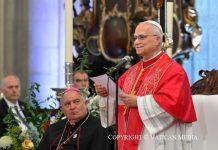
After laying a wreath of red roses at the monument, Pope Leo XIV spent several minutes in silent prayer. He then approached families holding framed photographs of their lost loved ones. In one particularly moving encounter, the Pope knelt before a young child clutching a portrait of his father to his chest, blessing the boy and clasping his hands.
“I’m happy,” said Antonella Hitti, whose relative was among the dead, speaking to Vatican News. “The Pope’s presence is a small dose of hope. We pray with him – and we pray for justice, truth, and accountability.”
The Beirut port stands as both a wound and a symbol of Lebanese resilience, a theme Pope Leo XIV returned to throughout his visit. That resilience is vividly embodied just a few kilometers away in Achrafieh, at Nation Station – a community kitchen born in the immediate aftermath of the explosion.
Josephine Abou Abdo, 35, a food designer and one of the project’s founders, recalled how neighbors spontaneously converged on an abandoned gas station hours after the blast. “We had no plan,” she said. “We just wanted to do something together for the neighborhood.” Within days, the former car wash was distributing 200–300 hot meals daily.
Today, Nation Station provides three food distributions per week, with long queues forming beneath its colorful signage as Lebanon’s economic crisis deepens. Supported by donations, grants, and crowdfunding, the initiative has also responded to every subsequent emergency, including last year’s mass displacement caused by the war with Israel.
Yet the project has deliberately evolved beyond emergency relief. “We hire local residents to cook for their own neighbors,” Abou Abdo explained. “We want people to understand this place belongs to them. Food was the starting point, but the real goal is dialogue and community growth.” The team hopes to replicate the model in other Lebanese neighborhoods.
As Pope Leo XIV departed Lebanon Monday afternoon, the images of his silent prayer amid the port’s ruins – and of a child holding his father’s photograph – served as a poignant reminder that, five years later, both grief and hope endure in equal measure.
- Raju Hasmukh with files from Asianews.it
Related Images: