Pope Leo XIV calls for compassion and safe migration in Gran Canaria, insisting human dignity transcends borders and condemning trafficking.
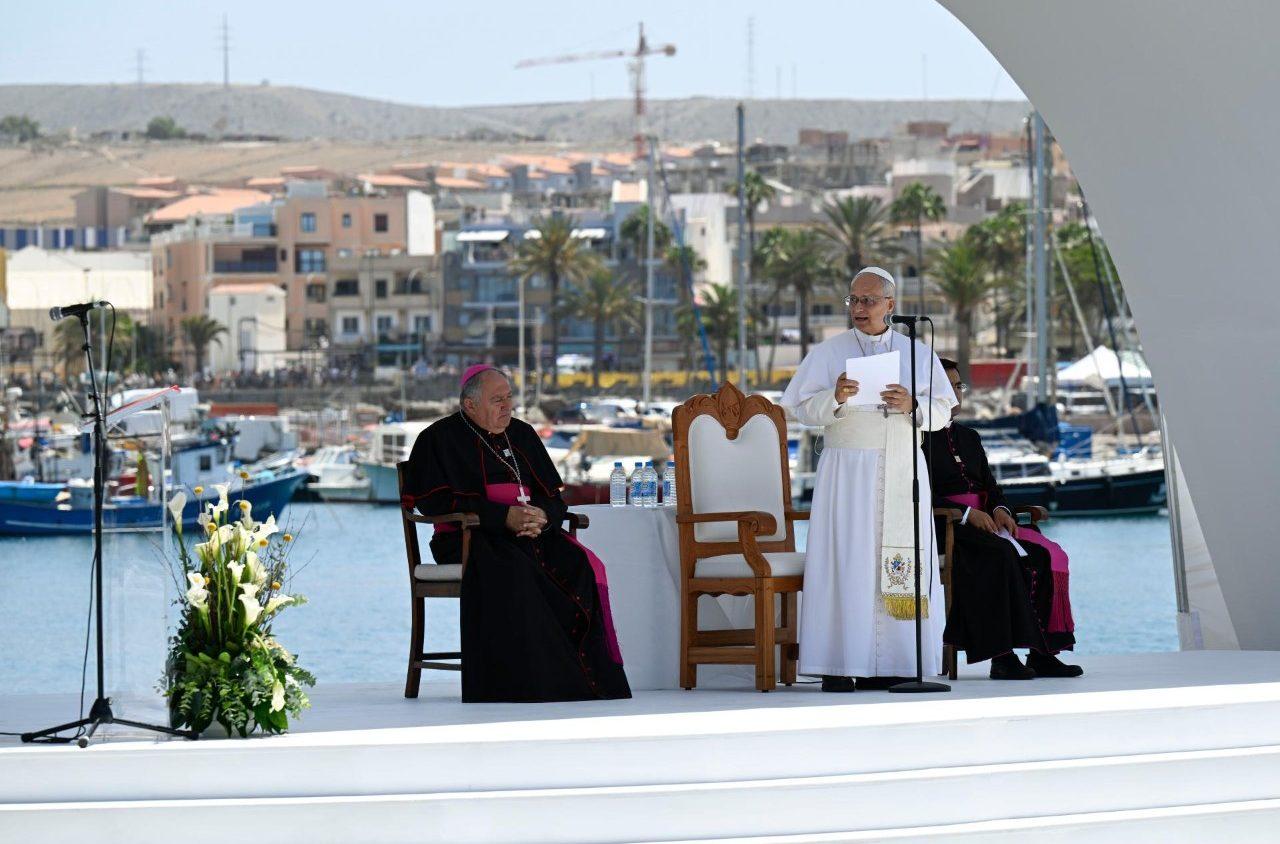
Newsroom (11/06/2026 Gaudium Press ) Standing on the docks of Arguineguín in Gran Canaria—one of Europe’s most emblematic migration entry points—Pope Leo XIV delivered a powerful call for compassion, solidarity and accountability, declaring that “human dignity has no passport and does not lose its value when crossing a border.”
The visit, part of the sixth day of his Apostolic Journey to Spain, brought the Pope face to face with migrants and the organisations that rescue and support them along one of the world’s most dangerous migratory routes. Arguineguín, sometimes called the “Port of Shame,” gained global attention in 2020 when thousands of migrants arrived within days during the COVID‑19 pandemic, exposing the fragility of Europe’s migration systems.
For many escaping violence, poverty and exploitation in West Africa, the Canary Islands represent a gateway to Europe, reached only after perilous journeys across the Atlantic in precarious boats.
Where the Gospel Meets Reality
Framing his remarks through the Gospel of Matthew (25), Pope Leo emphasized that faith is not abstract but lived in places like Arguineguín, where new arrivals often disembark with nothing.
“Here the Gospel pulls us out of our comfortable position as spectators,” he said, “and places before us a brother or a sister.”
The Pope urged listeners to recognize Christ in migrants marked by fear, hunger and suffering—people who have survived deserts, night crossings and the open sea. He also invoked the symbolism of the Fisherman’s Ring, reflecting on the Church’s duty to respond to human suffering.
“People are rescued from the sea, and lifeless bodies are recovered from the waters,” he said. “The Church cannot ignore these waters.”
Danger, Exploitation and the “Monsters” of the Sea
Using biblical imagery, Pope Leo described the sea as both a source of hope and a place of profound danger. He warned of modern “monsters” lurking in migration routes: human traffickers, criminal networks and systemic indifference.
“Mafias profit from despair, traffickers enslave women and children, and indifference allows the poor to be swallowed by exploitation,” he cautioned.
Despite these realities, the Pope insisted that fear must not lead to silence. “If Christ commands the sea to be still, the Church cannot remain silent,” he said, underscoring a moral obligation to confront injustice.
From Statistics to Human Faces
A central theme of the gathering was the need to humanise migration. Testimonies from rescuers and volunteers illustrated how individuals often become reduced to numbers.
Maritime Rescue captain Tito Villarmea, who has helped save more than 20,000 people, recounted a poignant story of a woman travelling with a child initially presumed to be a boy. Once safe, the mother revealed the child’s identity as a girl, placing earrings in her ears—a moment that left both in tears.
Such accounts, the Pope said, reveal how “the migrant ceases to be ‘just one more.’”
“Only then can we understand that that little girl could be our daughter,” he added.
He also praised grassroots compassion, highlighting simple acts—offering shoes, clothing or even companionship—as the foundation of meaningful solidarity. “Mercy begins with small gestures,” he said.
A Voice for Victims of Trafficking
One of the most emotional moments came through the testimony of “Blessing,” a Nigerian woman trafficked into sexual exploitation. Her story, read aloud for safety reasons, detailed coercion, abuse and forced prostitution after a dangerous journey to Europe.
Addressing her directly, Pope Leo delivered a message of affirmation: “If others have put a price on your body, know that God has never ceased to recognise your inestimable worth.”
He reaffirmed that dignity endures even amid extreme violence. “Your life belongs to God,” he said, insisting that exploitation can never erase intrinsic human value.
A Call to Europe and the International Community
Expanding his message beyond the local context, Pope Leo issued a broad appeal to governments and global institutions. He stressed that migration is a shared responsibility requiring action at multiple levels—from countries of origin to destination regions like Europe.
He warned against complacency in the face of rising deaths at sea, urging leaders not to accept the Mediterranean and Atlantic as “unmarked graves.”
“It is not enough to manage arrivals or reinforce borders,” he said. “Every boat that arrives brings a question: what kind of world have we built?”
The Pope called for concrete measures, including legal and safe migration pathways, stronger protections for trafficking victims, coordinated efforts against smugglers, and more effective systems of reception and integration.
The Right Not to Migrate
While affirming the right to seek refuge, Pope Leo highlighted a principle often absent from public debate: the right to remain in one’s homeland.
“There is also the right not to have to migrate,” he said, pointing to the root causes of displacement—war, hunger, corruption and environmental degradation.
Addressing these structural issues, he suggested, is essential to reducing forced migration.
A Final Warning on Humanity’s Future
The gathering concluded with a moment of silence for those who died attempting perilous sea crossings. The Pope later blessed a cross made from migrant boat wood at a local shrine, symbolising both suffering and hope.
As he departed, his closing words served as both a warning and a moral challenge:
“Every individual that arrives asks us what remains of our humanity. Sooner or later, it will be known whether we protected life or whether we yielded to indifference.”
In a place shaped by tragedy and resilience, Pope Leo’s message was unequivocal: migration is not merely a policy issue but a test of collective conscience.

- Raju Hasmukh with files from Vatican News