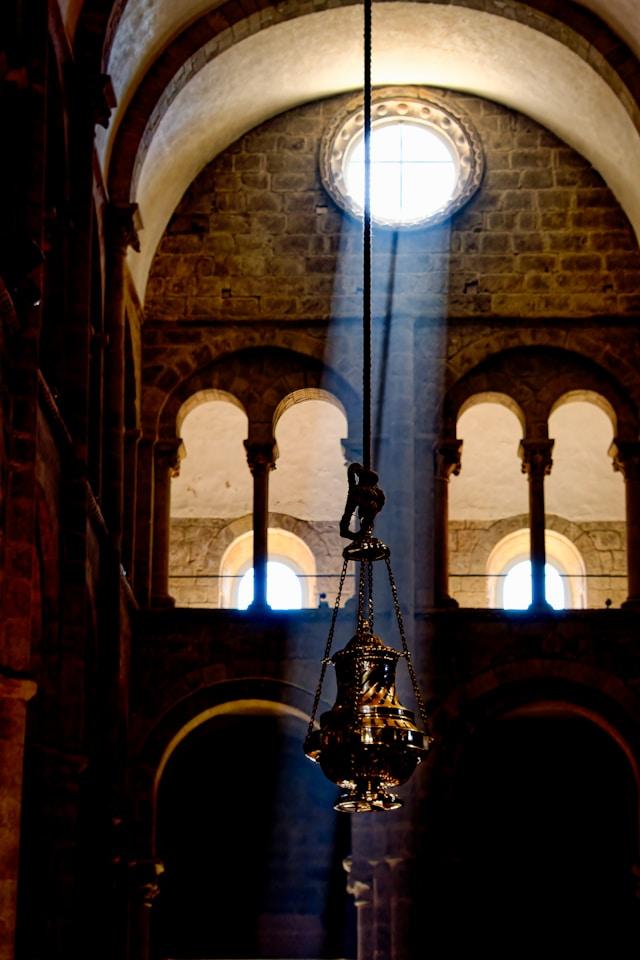
Discover the history, symbolism, and spectacle of Santiago de Compostela’s Botafumeiro, an eight-century-old tradition honoring Saint James.
Newsroom (27/07/2026 Gaudium Press ) For more than eight centuries, one of Christendom’s most remarkable religious traditions has unfolded beneath the soaring vaults of Santiago de Compostela Cathedral. The swinging of the Botafumeiro, the massive incense censer that has become synonymous with the shrine of Saint James the Greater, continues to captivate pilgrims and visitors from across the globe, combining breathtaking spectacle with profound spiritual symbolism.
Each year, the Feast of Saint James on July 25 marks the pinnacle of religious life in Santiago de Compostela, the historic destination of one of Christianity’s most famous pilgrimage routes. Thousands of pilgrims arrive in the Galician city to honor the Apostle Saint James, whose tomb has been venerated for more than a thousand years and who remains the patron saint of Spain.
Among the many ceremonies associated with the feast, none attracts greater attention than the ceremonial swinging of the Botafumeiro. Images and videos of the immense censer soaring through the cathedral often circulate widely after the celebrations, drawing admiration from worshippers and observers alike. Yet while the spectacle is visually extraordinary, the tradition itself represents far more than a tourist attraction. It stands as one of the oldest liturgical practices still maintained within the Catholic Church.
Documented since at least the 13th century, the Botafumeiro has endured through centuries of religious, cultural, and social change. Its name originates from the Galician language and literally means “to spread smoke,” a fitting description for a vessel whose historic purpose was closely tied to the experience of medieval pilgrimage.
The censer itself is imposing. Measuring approximately 1.60 meters in height and weighing more than 50 kilograms when empty, it hangs from a rope nearly twenty meters long beneath the cathedral’s ceiling. During solemn celebrations, eight specially trained men known as tiraboleiros work together to bring the enormous vessel into motion.
What begins as a slow, deliberate movement gradually becomes a dramatic display of precision and coordination. The tiraboleiros propel the Botafumeiro across the cathedral’s transept in a sweeping arc that stretches from one side of the sacred space to the other. At full momentum, the censer can reach speeds approaching 70 kilometers per hour while ascending more than twenty meters into the air, creating one of the most striking visual moments in Christian liturgy.
🔴À Compostelle, le spectaculaire Botafumeiro a de nouveau traversé la cathédrale pour la fête de saint Jacques
➡️ Vieille de plus de huit siècles, cette tradition demeure l’un des rites les plus impressionnants de toute la chrétienté et continue d’émerveiller les pèlerins du… pic.twitter.com/alGBrehZ78
— Tribune Chrétienne (@tribuchretienne) July 26, 2026
Behind the grandeur of the ritual lies a distinctly practical origin. During the Middle Ages, pilgrims often arrived in Santiago after weeks or even months of travel on foot. The cathedral welcomed vast numbers of weary travelers who had journeyed across Europe to reach the shrine of Saint James. Incense served an important function by helping to purify the air inside the crowded church while simultaneously enhancing the solemnity of worship.
Over time, however, the practical necessity of the practice diminished. What remained was the deeper spiritual meaning attached to the use of incense within Christian worship. In biblical tradition, incense symbolizes prayer rising toward God. The fragrant smoke ascending through the cathedral serves as a visible expression of the faithful’s petitions, while the majestic movement of the Botafumeiro reinforces the sense of mystery and reverence central to the liturgy.
The ceremony is therefore more than an impressive display of tradition and craftsmanship. It is a symbolic act in which movement, fragrance, sacred music, and prayer converge to communicate the spiritual realities of the Christian faith. The sight of the censer sweeping through the cathedral reminds worshippers that prayer transcends the earthly realm and is directed toward heaven.
Despite its fame, the Botafumeiro is not a daily feature of worship in Santiago de Compostela. Contrary to common belief, the censer is reserved for major solemnities, including the Feast of Saint James, exceptional religious celebrations, and Holy Years of Saint James. Its limited use only enhances the significance of each appearance, transforming every ceremony into a memorable moment for those present.
In an era when many ancient religious customs have disappeared or survive only as historical memories, the Botafumeiro remains a living tradition. More than eight hundred years after its establishment, it continues to unite generations of pilgrims in a shared experience of faith, history, and devotion.
For countless visitors arriving from five continents, witnessing the Botafumeiro is one of the defining moments of a pilgrimage to Santiago de Compostela. Yet its enduring appeal rests not merely in its scale or spectacle. Rather, it serves as a powerful reminder of the deeper meaning of the Camino de Santiago itself. Beyond its cultural significance and physical challenge, the pilgrimage remains, above all, a spiritual journey, one that leads believers toward a closer encounter with Christ through the intercession of the Apostle Saint James.
As the great censer sweeps through the cathedral and clouds of incense rise beneath the ancient stone vaults, a tradition preserved across eight centuries continues to speak to the modern world. It is a testament to the enduring power of faith, ritual, and pilgrimage, and to the unique place Santiago de Compostela holds in the Christian imagination.
- Raju Hasmukh with files from Tribune Chretienne