Mont-Saint-Michel receives its first canonical statutes, reinforcing its spiritual mission as a sanctuary and pilgrimage destination.
Newsroom (27/07/2026 Gaudium Press ) Mont-Saint-Michel, one of France’s most renowned pilgrimage destinations and one of the world’s most iconic shrines dedicated to the Archangel Saint Michael, has entered a new chapter in its history. On July 23, the Bishop of Coutances, Monsignor Grégoire Cador, promulgated the sanctuary’s first-ever canonical statutes, providing an official framework for its mission, organization, and spiritual life.
The move is unprecedented since the sanctuary’s foundation in the eighth century. While it may appear administrative in nature, Church leaders emphasize that the decision is primarily intended to strengthen and clarify the spiritual identity of a site that welcomes nearly three million visitors each year.
According to Father Pierre Doat, rector of the sanctuary, the initiative seeks to remind visitors and pilgrims alike that Mont-Saint-Michel’s significance extends far beyond its status as a celebrated historical monument.
For more than thirteen centuries, he said, the site has existed above all as a place dedicated to leading souls to Christ.
A Canonical Framework for a Long-Standing Mission
The newly promulgated statutes bring Mont-Saint-Michel into alignment with the provisions of the 1983 Code of Canon Law, which requires officially recognized sanctuaries to possess governing texts that define their mission, administration, and operation.
In practical terms, the statutes do not establish a new sanctuary. Rather, they formally codify a pastoral reality that has existed for centuries. The mission of welcoming pilgrims, fostering prayer, and promoting devotion at Mont-Saint-Michel has long been firmly rooted in the site’s history. Until now, however, those activities had never been gathered into a single canonical document.
The statutes define the responsibilities of the rector, clarify the sanctuary’s relationship with the Diocese of Coutances and Avranches, and outline organizational structures intended to support its religious mission.
They also provide an important clarification regarding the sanctuary’s scope. The spiritual reality of Mont-Saint-Michel extends beyond the famous abbey itself. It encompasses the Church of Saint Peter, the Ardevon Priory dedicated to pilgrim hospitality, and the abbey, which remains the property of the French state while continuing to play a central role in the sanctuary’s religious life.
More Than a Monument
For Church leaders, the most significant aspect of the new statutes lies not in legal governance but in the reaffirmation of Mont-Saint-Michel’s religious identity.
Father Doat has stressed that the purpose of the document is to reinforce awareness that Mont-Saint-Michel is fundamentally a sanctuary. While millions of visitors are drawn annually by its architecture, history, and cultural importance, the Church seeks to ensure that its spiritual vocation remains at the forefront.
The sanctuary’s mission, according to the rector, is to guide pilgrims toward Christ through the unique grace associated with a place dedicated from its origins to Saint Michael the Archangel.
This emphasis reflects a broader vision of Mont-Saint-Michel as a living center of faith rather than a static historical attraction. The sanctuary’s identity has been shaped through centuries of devotion, prayer, and pilgrimage, creating a distinct spiritual heritage linked to the figure of Saint Michael.
The Spiritual Message of Saint Michael
Father Doat notes that Mont-Saint-Michel carries a unique spiritual message developed over generations of faithful pilgrims.
Within that tradition, Saint Michael is venerated as a witness to divine mercy, a protector in spiritual struggles, a guardian of the deceased, and a sign of the nearness of the angelic world. These themes have long defined the sanctuary’s spiritual character and continue to attract pilgrims seeking a deeper encounter with faith.
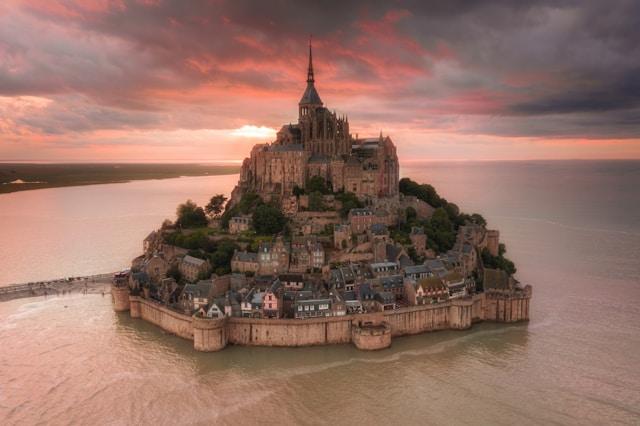
According to the rector, the very landscape of Mont-Saint-Michel points toward this reality. The dramatic rock rising from the sea has become a visible symbol of an invisible spiritual presence associated with angels and with Saint Michael himself.
For centuries, believers have viewed the sanctuary as a place where the proximity of the heavenly realm is made tangible through prayer, devotion, and pilgrimage.
Pilgrimage at the Heart of Evangelization
The promulgation of the statutes took place during the traditional Marsh Pilgrimage, one of the sanctuary’s most distinctive religious events. During this pilgrimage, hundreds of faithful cross the bay on foot to reach Mont-Saint-Michel, following the ancient tradition of the miquelots.
For diocesan leaders, this pilgrimage dimension remains central to the sanctuary’s evangelizing mission.
The challenge is especially significant because the overwhelming majority of those who arrive at Mont-Saint-Michel come as tourists rather than pilgrims. Yet Father Doat believes that authentic expressions of faith often have the greatest impact on visitors.
He argues that what most captures people’s attention is not organized programming but the sight of pilgrims gathered in prayer. Such encounters, he suggests, create opportunities for visitors to discover the deeper meaning of the site beyond its architectural and historical significance.
This conviction has inspired new efforts aimed at welcoming and engaging those who arrive at the sanctuary.
A New Welcome for Visitors
This summer, Mont-Saint-Michel launched a team of approximately fifteen volunteers dedicated to greeting visitors on the abbey esplanade.
The initiative marks a new step in the sanctuary’s outreach efforts. Volunteers are tasked with answering questions, offering guidance, and providing an initial proclamation of the Christian faith to those interested in learning more about the site’s religious significance.
The project reflects the broader objective behind the statutes: ensuring that the millions who pass through Mont-Saint-Michel encounter not only a remarkable monument but also a living Christian community.
A Shared Mission Among Religious Communities
The introduction of the statutes is accompanied by the unveiling of a new visual identity and a website designed to present the sanctuary’s various ministries and communities within a unified framework.
Several religious communities continue to play essential roles in sustaining the spiritual life of Mont-Saint-Michel.
Among them are the Monastic Fraternities of Jerusalem, which oversee liturgical prayer at the abbey. As part of a broader reorganization within the congregation, the male branch of the community is expected to conclude its presence at the sanctuary in 2027. The sisters, however, will remain and continue their mission of prayer and worship.
Pastoral care of the sanctuary and the Church of Saint Peter will continue to be entrusted to priests of the Community of Saint Martin. They work closely with the Ardevon Priory, where retreats, conferences, pilgrim hospitality programs, and spiritual formation activities are organized throughout the year.
Preserving a Living Religious Heritage
By approving the sanctuary’s first canonical statutes, the Diocese of Coutances and Avranches has sought to articulate clearly what Mont-Saint-Michel represents in the twenty-first century.
While internationally recognized as one of Europe’s most remarkable monuments, the site remains, in the eyes of the Church, a living sanctuary whose central purpose has not changed since its foundation more than thirteen centuries ago.
Through prayer, pilgrimage, hospitality, and evangelization, Mont-Saint-Michel continues to pursue the mission that first drew generations of pilgrims to the rocky island. The new statutes provide a formal framework for that work, reaffirming that beneath its global fame and extraordinary architectural heritage lies an enduring spiritual vocation: the proclamation of the Gospel under the protection of Saint Michael the Archangel, Prince of the Heavenly Hosts.
- Raju Hasmukh with files from INfovaticana