Pope Leo XIV urges unity, faith, and compassion in a powerful Sagrada Família homily, highlighting hope, peace, and the Church as a living work.
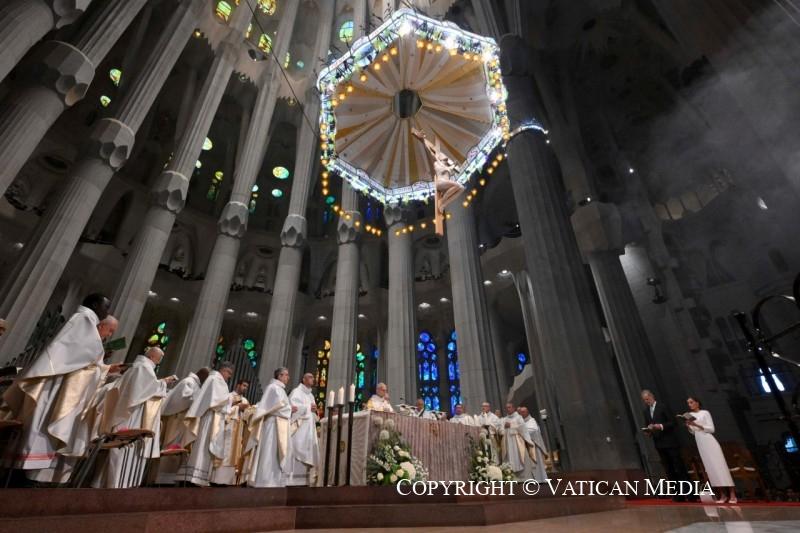
Newsroom (11/06/2026 Gaudium Press ) In a deeply symbolic homily delivered at the Basilica of the Sagrada Família in Barcelona on June 10, 2026, Pope Leo XIV framed the iconic structure not merely as an architectural masterpiece but as a living testament to faith, unity, and divine purpose. Addressing a broad assembly that included clergy, public officials, and representatives from other Christian communities and religions, the Pope opened with the words of Psalm 8—“Lord, our Lord, how glorious is your name over all the earth”—setting a tone of reverence and wonder.
The pontiff highlighted the basilica as both a physical and spiritual space, welcoming worshippers as “arms” extended toward humanity. He emphasized its role as a gathering point for Catalonia and beyond, where believers are nourished by the Word of God and unified in the Eucharist.

Completing the Incomplete
Central to Pope Leo XIV’s reflection was the unfinished nature of the Sagrada Família itself. Rather than viewing this as a flaw, he described it as a sign of promise and intentionality. “We do not dwell in an unfinished work,” he said, “but in a temple still under construction.” This metaphor extended to Christian life, which he characterized as an ongoing collaboration with God.
The faithful, he explained, are “living stones” in a spiritual edifice grounded in Christ, who is both “foundation and crowning glory.” In this vision, incompletion does not signal deficiency but rather expresses a commitment to growth and fidelity to God’s plan.
God Builds the True Dwelling
Drawing from Scripture, particularly the story of King David, the Pope underscored a theological paradox: humanity does not construct a dwelling for God; instead, God makes a home for humanity. This “place,” he said, is found in the very heart of God—offered freely through Jesus Christ.
This message anchored a strong appeal to faith in Christ as the path to salvation and freedom. The Pope’s words were direct: belief in Jesus is essential not only for personal redemption but for the well-being of others. Rejecting any separation between faith and ethical responsibility, he declared, “We cannot believe in Jesus and promote war… and abandon those who suffer.”
The Cross as a Beacon of Hope
A central visual and spiritual motif of the homily was the towering cross of the basilica—soon to crown its highest spire dedicated to Christ. The Pope blessed this tower as a luminous symbol of transformation, where suffering becomes hope and death gives way to eternal life.
By day, he noted, the cross reflects sunlight; by night, it illuminates the city like a lighthouse. This dual imagery reinforced a central Christian paradox: that the cross, an instrument of death, becomes the ultimate sign of divine love and salvation.
Art as Evangelization
Pope Leo XIV also honored Antoni Gaudí, the visionary architect of the Sagrada Família, on the centenary of his death. He described Gaudí’s work as a “spiritual pilgrimage” in stone, designed to narrate the life of Christ through architecture, light, and color.
In doing so, the Pope highlighted the enduring role of art and beauty in religious life, calling them “privileged channels of evangelization.” The basilica itself, he said, stands as a modern continuation of the Biblia pauperum—the visual catechesis of medieval cathedrals.
Faith in Action
Concluding his homily, Pope Leo XIV urged believers to translate faith into action. Inspired by the beauty of the basilica and the example of Christ, he called on the faithful to “lift up those who lie in the dust,” reinforcing a message of compassion and social responsibility.
The towering Sagrada Família, he insisted, should not inspire worldly pride but guide the faithful on their spiritual journey. Its height is not for prestige, but for illumination—symbolizing the Church’s role as a light in the world, leading humanity toward hope and redemption.
In this way, the Pope’s message intertwined architecture, theology, and moral urgency, leaving a lasting impression on a city gathered under the soaring spires of one of Christianity’s most iconic sanctuaries.

- Raju Hasmukh with files from Vatican News