






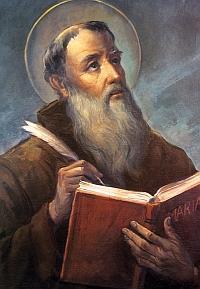
Saint Lawrence of Brindisi loving son of the Virgin. His reputation as a miracle worker preceded him, and even during his lifetime people acclaimed him along the roads.
Editorial Staff (07/23/2026, Gaudium Press) The life of today’s Saint is like a diamond with many facets. We will speak of Saint Lawrence of Brindisi, or of Brindis, if one prefers to call him that.
From childhood, his aptitude for study was evident
His surname derives from the city where he was born, Brindisi, in the Kingdom of Naples. His baptismal name was Julius Caesar.
He possessed a remarkable memory, which manifested itself from childhood: he could recall entire pages and later recite them, astonishing everyone.
He first attended a Franciscan school in his native city. He then went to the College of Saint Mark in Venice, where he studied under the guidance of an uncle who encouraged him toward the religious life. At the age of sixteen he entered the Capuchin convent in Verona.
The Capuchin superior wished to test him and told him that life in the community was hard and full of sacrifice.
“Father, will there be a crucifix in my cell?” the candidate asked.
“Yes, there will be,” replied the superior.
“Then that is enough for me. By looking at Christ Crucified I shall have the strength to suffer, out of love for Him, whatever hardships may come.”
He went on to study philosophy and theology at the University of Padua, where he easily learned Greek, Hebrew, German, Bohemian, French, and Spanish, and where he deepened his study of Sacred Scripture. Today he would be called a “genius.”
Though he was not yet a priest but merely a deacon, he had already distinguished himself as a great preacher, and he was asked to preach throughout the forty days of Lent in the Cathedral of Venice, and this for two consecutive years.
Once ordained, the cities of northern Italy competed for the opportunity to hear his sermons: Padua, Verona, and Vicenza.
He arrived in Rome in 1596 and was appointed a definitor of the Capuchin Order. There, Pope Clement VIII urged him to labor for the conversion of the Jews, a task facilitated by his knowledge of Hebrew.
His secret in preaching
One day a priest asked him what his “secret” was for obtaining such good results in preaching.
Saint Lawrence replied:
“To a great extent it is due to my good memory. To another great extent, to the many hours I devote to preparation. But the principal reason is that I commend my preaching greatly to God, and when I begin to preach I forget the entire plan I had prepared and begin speaking as though I were reading from a mysterious book that had come down from heaven.”
His life was austere. He fled honors and cultivated charity toward everyone.
Military strategist
He was Vicar General of the Order when Emperor Rudolph II asked him to secure the help of the German princes in fighting the Turks, who were already at the gates of Hungary.
The saint accomplished what had been requested, while at the same time combating Protestantism and spreading the faith, and he was appointed General Chaplain of the army that had been assembled.
At times, however, he was truly a military strategist, as before the Battle of Székesfehérvár in 1601, when the generals consulted him regarding the course of action they should take. Saint Lawrence advised an attack, personally rallied the troops, and placed himself at the head of the assault forces carrying nothing but his crucifix.
Everyone said that the brilliant victory had been won by Saint Lawrence.
It was also said that the enemy recognized the prominent role played by the Capuchin friar in the battle and attempted to wound him and strike him down, but that an invisible hand deflected every blow directed against him, and that the Christian soldiers themselves took refuge behind him as though he were a wall.
Mystic
He composed a perfect refutation of Lutheran doctrines, making use of his knowledge of Greek and Hebrew in the Sacred Scriptures. To write this refutation, Saint Lawrence studied Luther’s own works.
He was a great wonder-worker: through Saint Lawrence, the blind saw, the paralyzed walked, and the mute recovered their voices. His fame spread widely, and in every village the holy friar was received with tremendous acclaim.
His love for the Virgin was extraordinary. He said that he had “received everything from Mary and through Mary.”
He also said:
“If Mary did not exist, we would not exist, nor would there be a world.”
He taught:
“God grant that all, all, all people, and from their earliest childhood, may quickly learn this truth well: whoever entrusts himself to Mary, whoever gives himself to Mary, will never be abandoned, neither in this world nor in the next.”
It is said that, upon returning from a campaign, he stopped at the convent of Gorizia, where Christ Himself, in the choir, gave him Holy Communion.
One day the people asked him to intercede with King Philip of Spain to replace the Viceroy, the Duke of Osuna, who was a tyrant. Despite being ill, Saint Lawrence traveled to Madrid and then to Lisbon, where he succeeded in persuading the king to appoint a different representative in the Kingdom of Naples.
He returned to the convent and died there on July 22, 1619. He was buried in the cemetery of the Poor Clares of Villafranca.
Leo XIII canonized him in 1881. John XXIII declared him a Doctor of the Church in 1959 and bestowed upon him the title of “Evangelical Doctor.”
The post “Saint Lawrence of Brindisi, Capuchin: One Day God Willed Him to Be a Military Strategist” appeared first on Gaudium Press Español.
Related Images:


