






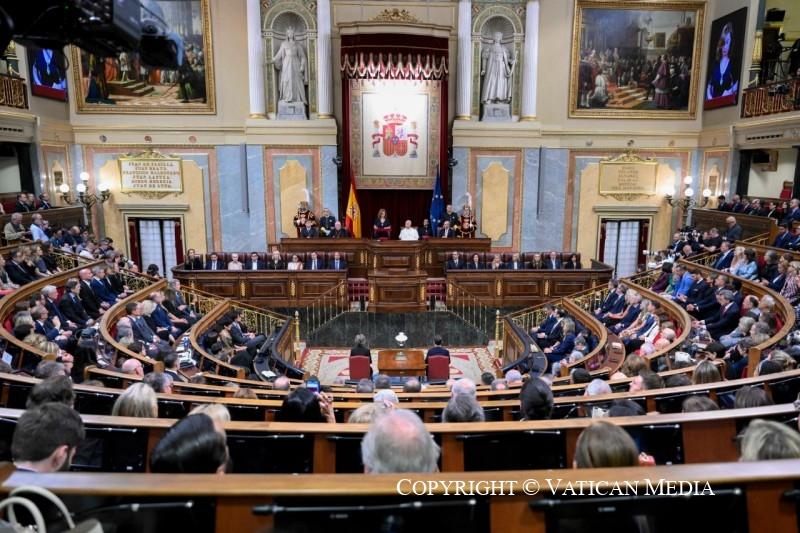
Pope addresses Spain’s Parliament, urging human dignity, ethical governance, migration compassion, and peace in a time of global crisis.
Newsroom (08/06/2026 Gaudium Press) In a wide-ranging and reflective address before Spain’s Congress of Deputies on Monday, the Pope called on lawmakers to anchor public policy in the dignity of the human person, warning against cultural fragmentation, technological misuse, and political polarization in an increasingly unstable global climate.Speaking before senior political and judicial leaders, including the Prime Minister and heads of Spain’s highest courts, the pontiff framed his visit as both a gesture of closeness to the Spanish people and an appeal to lawmakers’ moral responsibility. He emphasized that the Church’s engagement with public life does not seek to interfere with political autonomy, but rather to contribute to the common good through ethical reflection rooted in human experience.
Human Dignity at the Core of Lawmaking
At the heart of the address was a fundamental question directed to legislators: what vision of the human person underpins the laws they create? The Pope argued that every legal and political system must ultimately be judged by how it respects and protects human dignity, which he described as inherent and inviolable. He cautioned that this dignity cannot be subordinated to shifting majorities or political expediency. Instead, it must serve as the guiding principle for governance. When this standard is upheld, he noted, the law becomes a safeguard for all citizens rather than a tool of competing interests. Drawing on Spain’s intellectual and cultural heritage — from Cervantes’ celebration of freedom to the philosophical reflections of Unamuno — he highlighted a long-standing national tradition of viewing the human being as more than a mere component of economic or political systems.
The Legacy of Salamanca and Global Responsibility
The Pope placed particular emphasis on the historical contributions of the School of Salamanca, a 16th-century intellectual movement that helped shape early concepts of human rights and international law. He described its thinkers, including Francisco de Vitoria, as pioneers who insisted that power must be restrained by moral limits and that every individual possesses rights and duties. This legacy, he argued, remains deeply relevant in today’s interconnected world. The “Salamanca Question” — how to reconcile power with ethical responsibility — continues to resonate amid modern challenges such as globalization, technological transformation, and geopolitical instability.
Technology, AI, and Ethical Decision-Making
Turning to contemporary issues, the Pope addressed the rapid rise of artificial intelligence and new technologies. While acknowledging their potential benefits, he warned that technology is not neutral and reflects the intentions of those who design and deploy it. He called for careful ethical oversight, particularly in areas affecting human life and social structures. Decisions involving life and death, he insisted, must never be delegated to automated systems, especially in military contexts. The broader challenge, he said, is ensuring that technological progress serves humanity rather than undermines it — a task that requires constant moral discernment.
Migration as a Moral and Political Test
The Pope also highlighted migration as one of the defining ethical issues of the present era. He described the plight of migrants and refugees as not merely a demographic or economic concern, but a profound moral challenge. He urged governments to adopt policies that prioritize human dignity, including safe and legal migration pathways, meaningful integration, and efforts to address the root causes forcing people to flee their homes. At the same time, he emphasized the importance of ensuring that individuals have the right to remain in their countries under conditions of peace and security. “No nation can face this challenge on its own,” he said, calling for coordinated international cooperation. He also warned of exploitation by traffickers, urging stronger protections for vulnerable populations.
Defense of Life and the Role of the Family
In a particularly pointed segment, the Pope warned against what he described as a “throwaway culture” that marginalizes the most vulnerable, including the unborn, the elderly, and the seriously ill. He framed the defense of human life as a foundational principle of any just society, rather than a partisan issue. He also underscored the central role of the family as the “primary human reality” and the first space where values such as care, forgiveness, and solidarity are learned. Supporting families, he argued, contributes directly to the social stability of nations. Education was cited as another critical pillar, with a call to respect parents’ rights to guide their children’s moral and cultural formation.
Peace, Dialogue, and Political Responsibility
Against the backdrop of rising global tensions, the Pope delivered a strong appeal for peace, warning that rearmament risks becoming an accepted norm. True security, he argued, is built not on weapons, but on justice, dialogue, and respect for international law. He stressed that war represents a failure of human and political responsibility, noting that while weapons may silence conflict temporarily, they cannot establish lasting peace.Domestically, he urged political leaders to foster a culture of respectful dialogue, cautioning against the degradation of public discourse. “Firmness does not require contempt,” he said, emphasizing that disagreement should not lead to humiliation or hostility.
Freedom, Religion, and Public Life
The Pope also addressed the importance of protecting freedom of thought, conscience, and religion. He argued that authentic democratic systems must recognize and safeguard the spiritual dimension of human life. Faith, he said, should neither dominate the political sphere nor be excluded from it. Instead, it should be allowed to contribute freely to societal development. He specifically highlighted the importance of protecting the confidentiality of religious practices, such as the sacramental seal of confession, as part of broader religious freedom protections.
A Call for Moral Renewal
Concluding his speech, the Pope called for a renewed commitment to ethical leadership, urging lawmakers to consider the real human impact of every decision they make — particularly on those with the least power. He praised Spain’s cultural and historical role as a bridge between traditions and peoples, expressing hope that it would continue to foster unity in diversity and serve as a model of dialogue and solidarity. “May Spain continue to be a land of encounter, of culture, of solidarity and of hope,” he said, invoking blessings of peace and justice for the nation and the wider world.
The address, rich in philosophical reflection and practical challenges, underscored a central message: that politics, at its best, must remain rooted in the service of the human person, especially in a time marked by uncertainty and profound transformation.

- Raju Hasmukh with files from Vatican News
Related Images:


