






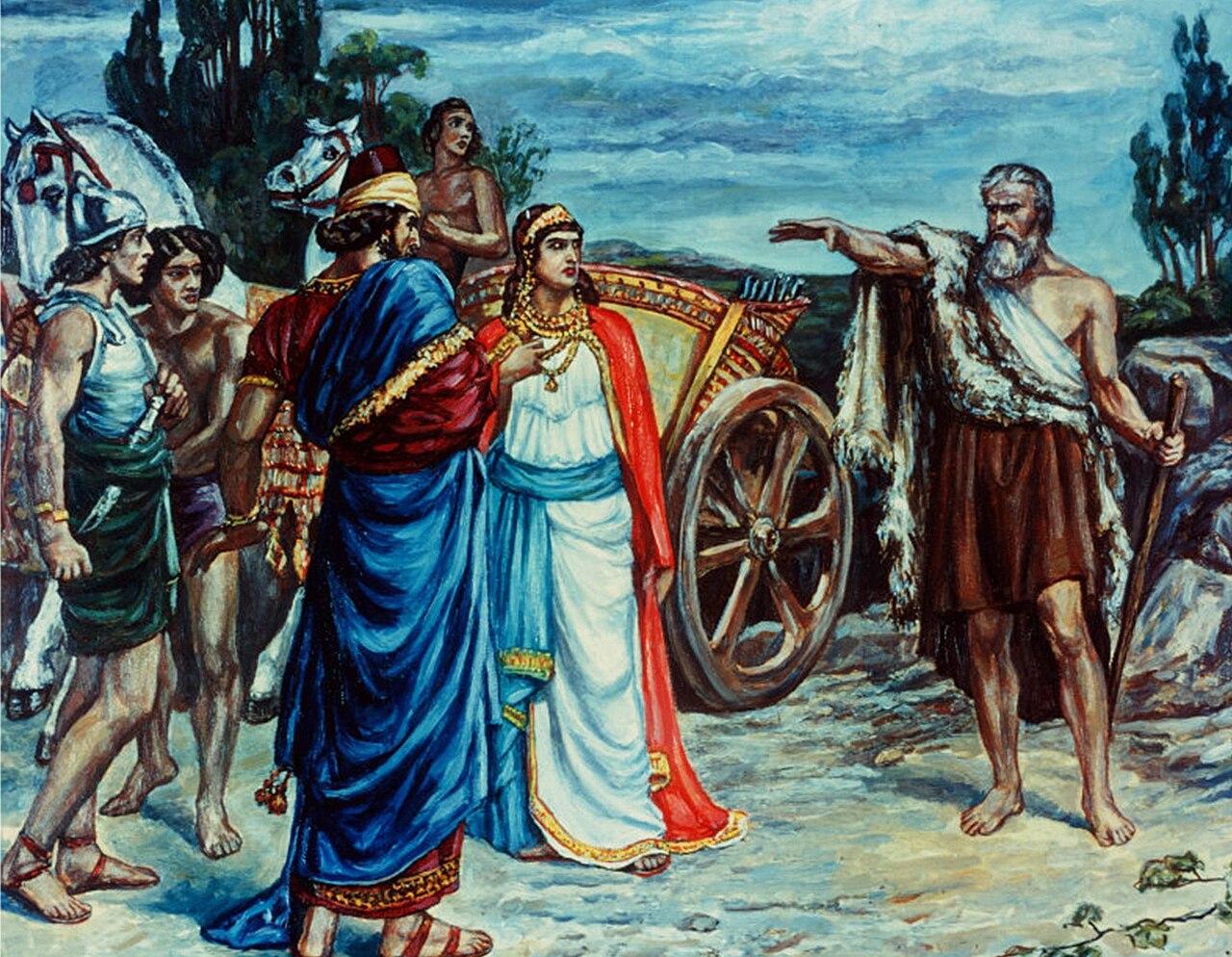
The Tishbite, whom God sends so that the faith of the people may not perish. He confronts the king and his wicked wife. He brings drought, but also rain.
Editorial Staff (07/20/2026, Gaudium Press) Today the Church celebrates the memorial of the prophet Elijah, the one who confronted King Ahab and his impious wife, the Tyrian Jezebel. Elijah lived in the 9th century before Christ, and it is not well known whether he was from Tishbe of Gilead or Tishbe of Naphtali; but in any case he bears the title of the Tishbite.
Ahab, who is known by both names Ajab and Acab, was king of Israel, a monarch already ruling vast, well-organized territories, and who had the very bad idea of marrying the Phoenician princess Jezebel, through whose influence a temple was erected to the pagan god Baal, in the Phoenician manner. According to what the Apostle Paul said, that all pagan gods are demons, then the king of the chosen people had built a house of prayer to a demon. That was his great sin.
Jezebel Corrupts Israel
But this corrupting woman, a paradigm of wickedness, not content with that, persecuted the true prophets of God and introduced many pagan priests who were corrupting the beliefs and customs of the Israelite people, to such an extent that it could be said that the chosen people were becoming an apostate people from the true faith.
It is in that dark setting that God does not abandon His flock and one day sends the prophet Elijah, whose name itself is a proclamation of fidelity, for it means “My God is Yahweh.” He presents himself before Ahab and announces to him that God would punish the apostasy of the people and of the king, and that a long drought would come upon their lands. Indeed, for 36 months it did not rain in Israel, and pasturelands, livestock, and men died.
The prophet, fulfilling the divine design, went to live in a cave where there was a spring of water, a place where ravens brought him bread in the morning and meat in the evening. But the spring dried up, and God ordered him to go to Zarephath, a Phoenician city.
In Zarephath he found a widow to whom he asked for a little water and some bread. The poor widow replied that she only had a little flour and oil left, with which she would make a loaf for herself and her son, and then die of hunger. But the prophet answered her: “Make a loaf for me, and then you will see that the flour will not run out in your jar, nor the oil in your vessel, until the day when it rains again upon the earth.” The woman did as the Prophet ordered, and the prophecy was fulfilled, for food did not fail her, nor her son.
One day the son of this widow died, and she was left inconsolable. But the prophet brought him back to life, causing the widow to exclaim: “Now I know that you are a man of God and that truly Yahweh speaks through your lips.” This is the first resurrection recorded in Scripture.
Meanwhile, Ahab strove to find the one who had prophesied the drought to him, but without finding him. Then one day the prophet himself went to seek him out, and Ahab blamed him for Israel’s misfortune, to which the prophet replied: “I am not the scourge of Israel, but you and your father’s house, because you have abandoned Yahweh and followed the Baals,” and he told him to summon his priests of Satan to see who had greater power, Baal or Yahweh.
God Manifests His Power – The Priests of Baal Die
It was then that the great encounter took place between the prophet of the Lord and the prophets of the demon, on Mount Carmel.
The worshipers of Baal had erected an altar and placed a sacrifice upon it. The more powerful god was to consume the sacrifice. Throughout the day the priests of Baal shouted, danced, and scourged themselves, but their god did not reveal himself. The holy prophet even mocked them, telling them that they should shout louder, that perhaps he could not hear them.
When Saint Elijah’s turn came, at an altar of Yahweh that was there and which he had repaired, he prepared his sacrifice. He prayed to the Lord, urging Him to demonstrate His power, and then “the fire of Yahweh fell and consumed the burnt offering and the wood and licked up the water in the trenches.” The people, inflamed and under Elijah’s leadership, carried out justice upon the priests of Baal and slaughtered them all, 450 of them. That same afternoon a downpour testified that God the Lord was with His Prophet, and the drought came to an end.
But the sinister Jezebel, instead of recognizing God’s design for His prophet, upon learning what had happened swore to take Elijah’s life, which caused the Prophet to flee to Mount Sinai, far from Israel and Judah.
While on that Mount Horeb, God strengthened him in his discouragement and gave him three missions: to anoint Hazael as king of Syria, Jehu as king of Israel, and Saint Elisha as his successor.
Announcement of Misfortunes to Ahab – Death of Jezebel
One day the wicked King Ahab began to covet a beautiful vineyard neighboring his palace, the vineyard of Naboth, but Naboth refused to sell it to him. Jezebel, upon learning this, plotted a conspiracy against Naboth and had him killed, leaving Ahab in infamous possession of that property. Then the prophet Elijah suddenly appeared, accused the king of murder, and told him on God’s behalf that “in the very place where the dogs licked the blood of Naboth, they shall also lick your own blood.” He also announced that God would extinguish his descendants and that his iniquitous wife Jezebel “the dogs shall eat by the wall of Jezreel,” which happened exactly so, to the letter. “Any descendant of yours who dies in the city shall be eaten by the dogs, and whoever dies in the field shall be eaten by the birds of prey,” the Lord also announced to Ahab.
When he found himself thus confronted by the Prophet of God, Ahab became afraid, did penance, and fasted, so God told Elijah that He would not send upon him the calamity He had announced, but that his descendants would indeed suffer it.
Ahab’s son Ahaziah, also a worshiper of Baal, received Elijah’s message of punishment, as did Jehoram, king of Judah, whom the prophet warned that those of his household would be afflicted with a plague and that he was destined for an untimely death.
While with his disciple Elisha, Elijah was taken up by a chariot of fire, not before leaving to his disciple his gifts and spirit.
- With information from Catholic.net and the Catholic Encyclopedia
- The post “Saint Elijah the prophet, fire of God, destroys the priests of Baal, raises a child and a people to life” appeared first on Gaudium Press Español.
Related Images:


