






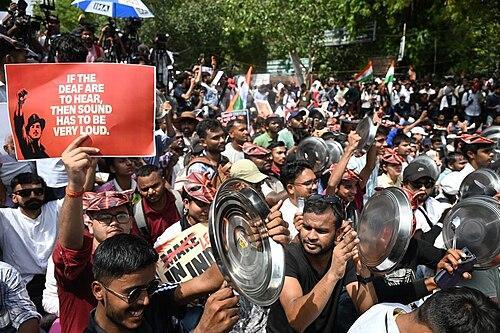
Christian leaders condemn police crackdown on student protesters in New Delhi, urging education reforms, accountability, and dialogue.
Newsroom (23/07/2026 Gaudium Press) Thousands of students protesting for sweeping reforms in India’s education system have faced a forceful police response in New Delhi, drawing sharp criticism from Christian leaders and religious organizations across the country.
Since demonstrations began on July 20, at least 178 people, including students and police personnel, have reportedly been injured as security forces used batons and tear gas to disperse crowds. The protests intensified after authorities blocked demonstrators from marching toward Parliament, alleging that some participants were throwing bricks and stones.
The movement is being led by the social media-driven Cockroach Janta Party (CJP), which is demanding the resignation of Education Minister Dharmendra Pradhan, a senior member of Prime Minister Narendra Modi’s ruling Bharatiya Janata Party (BJP).
The demonstrations stem from growing public dissatisfaction with India’s education system following a series of controversies that have shaken confidence in examination processes. Among the most significant was the leak of a medical entrance examination paper, an incident that forced more than two million candidates to retake the test. Public frustration was further heightened by concerns surrounding the online marking of examinations taken by nearly two million high school students.
Momentum behind the protests increased dramatically after police removed noted engineer, educator, and climate activist Sonam Wangchuk from the Jantar Mantar protest site in New Delhi. Wangchuk had been conducting a 20-day hunger strike before being hospitalized. He continues his indefinite fast from the hospital and has emerged as a prominent symbol of the students’ movement.
Christian organizations have responded with strong statements condemning the use of force against demonstrators while calling on authorities to address the concerns that brought students into the streets.
In a statement issued on July 21, the Catholic Bishops’ Conference of India said it was “deeply anguished” by the police action and expressed solidarity with students who were injured or otherwise affected during the protests.
The bishops said that the students were raising legitimate concerns centered on accountability and urgently needed reforms within the education system. They described the use of force against peaceful demonstrators as “a heartbreaking assault on the very soul of our democracy.”
The conference emphasized its support for demands for a transparent, fair, and accountable education system. It also expressed solidarity with Wangchuk, who remains on an indefinite hunger strike while receiving medical care.
The Conference of Religious India (CRI), which represents Catholic religious congregations throughout the country, echoed those concerns in a statement released on July 23. The organization described the police response as “unprovoked and unwarranted” and voiced support for both Wangchuk and the student protesters.
Calling for meaningful reform, the CRI urged the government to address longstanding concerns about the education system and undertake corrective measures. The organization noted that many of the protesters are students who attended Church-run educational institutions.
“They work very hard to achieve their goals; their angst is ours too; we stand in solidarity with them,” the statement said.
At the same time, the CRI encouraged demonstrators to remain committed to Mahatma Gandhi’s principles of ahimsa (non-violence) and satyagraha (peaceful resistance). It called on authorities to establish an independent investigation into allegations of police brutality and urged both sides to pursue dialogue rather than confrontation.
Similar concerns were raised by the Malankara Orthodox Syrian Church, which urged the government to create space for peaceful engagement with young people.
“A democratic society must always provide space for peaceful protest and sincerely listen to the concerns of its young people,” the church said in a statement, calling for meaningful dialogue instead of conflict.
As criticism of the government’s handling of the protests grows, Christian leaders have united around a common message: the concerns of students deserve to be heard, educational shortcomings must be addressed through reform, and democratic dissent should be met with dialogue rather than force. The ongoing unrest has transformed what began as a protest over examination controversies into a broader national debate about accountability, governance, and the future of education in India.
- Raju Hasmukh with files from UCA News
Related Images:


