






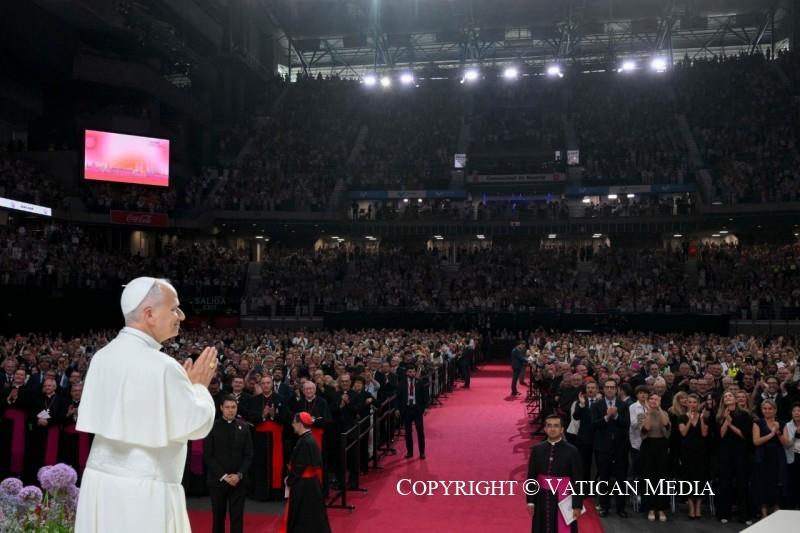
At Madrid’s Movistar Arena, the Pope urges dialogue, dignity, and unity across culture, economy, and sport to shape a more humane future.
Newsroom (08/06/2026 Gaudium Press ) At Madrid’s Movistar Arena on June 7, 2026, the Pope delivered a wide-ranging address centered on a compelling theme: the urgent need to “build networks” that connect culture, art, economy, and sport in service of a more humane society. Speaking to an audience representing diverse sectors, he framed the gathering as more than a formal encounter, describing the venue as a space where “the deepest emotions of human beings” converge—joy, hope, admiration, but also frustration and sorrow.
From the outset, the Pope rooted his reflections in Spain’s historical identity, praising its enduring creative spirit visible in its cities, monuments, universities, and artistic traditions. This legacy, forged by generations, served as a point of departure for a central question that shaped the address: what kind of legacy are we leaving for the future, and what kind of community are we building?
A Society That Produces—but Must Reflect
Acknowledging the modern world’s extraordinary capacity to innovate and communicate, the Pope cautioned that society risks losing sight of deeper meaning. He warned that humanity could become efficient producers and communicators while remaining uncertain about purpose—“why, for what purpose, with whom and for whom we produce.”
In this context, he positioned the Church as a participant in dialogue rather than an observer, emphasizing its vocation as an “expert in humanity.” He stressed that openness to dialogue is not optional but intrinsic, especially when confronting the enduring question: what does it mean to be truly human?
Human Dignity at the Center
Central to the address was the affirmation that the desire for goodness, beauty, and truth lies at the heart of human nature. From this perspective, the Pope presented human dignity as the foundation of any meaningful social dialogue. He underscored that every person is created “with threads of love” and bears an inalienable dignity that must guide institutions and structures alike.
He extended this principle across multiple sectors, calling for a reorientation of priorities:
- Universities must not detach from truth or ignore the realities of work.
- Businesses must not treat employees as mere economic factors.
- Art must not be confined to elites.
- Sports must not be reduced to spectacle or profit.
- Technology must include the elderly, the poor, and the voiceless.
These examples illustrated his broader insistence that progress devoid of human-centered values risks undermining the very society it seeks to advance.
The Art of Dialogue and “Building Networks”
The Pope described social dialogue as an “art of building networks,” one that requires listening, respect, and meaningful engagement among institutions. Communication, he noted, is never neutral: it can divide or unite, wound or heal, diminish or inspire.
“Building networks,” he explained, entails more than interaction—it requires cultivating shared values and mutual responsibility. He returned to the linguistic roots of “culture” as something to be cultivated, urging reflection on what society is nurturing and what it is allowing to fade. These questions, he said, are “profound and necessary” and must not be ignored.
Creativity, Faith, and Beauty
Another dimension of his address highlighted the transformative power of beauty and creativity. Drawing on reflections from Pope Benedict XVI, he described faith as a source of poetry, music, and joy—capable of generating beauty that changes individuals from within.
Referencing Spain’s rich literary and spiritual heritage—including figures such as Saint Teresa of Ávila, Saint John of the Cross, and Lope de Vega—he pointed to the enduring connection between the material and the spiritual. Artistic expression, he suggested, reveals a deeper unity within human experience, one that transcends purely functional or utilitarian approaches to life.
Service, Solidarity, and Europe’s Identity
The Pope also emphasized selfless service as a defining element of authentic “network-building.” He pointed to historical contributions inspired by faith, including hospitals, schools, and initiatives of solidarity. This legacy, he suggested, raises a broader question about Europe’s identity and whether it can be understood apart from its spiritual roots.
Rather than presenting this as a critique, he framed it as an invitation to reflection: can eternity—introduced into history through the incarnation of Christ—still find a place in modern daily life? He echoed a familiar call not to fear this integration, insisting that faith enriches rather than diminishes human existence.
At the same time, he highlighted persistent social inequalities, asking pointedly who remains excluded despite their abilities. The condition of the poor, he said, continues to challenge societies, institutions, and the Church itself. True justice, he added, depends on structures that promote integral human development and participation for all.
Sport as a School of Humanity
Turning to the world of sport, the Pope offered a more personal reflection, describing it as a powerful teacher of values. On the field, he noted, individuals learn respect, resilience, and humility—lessons often more effective than formal instruction.
Quoting Saint John Paul II, he emphasized the role of athletes in promoting cohesion, peace, and unity. In a world marked by divisions and violence, sport can model “knowing how to be together,” offering a tangible example of harmony and mutual respect.
A Call to Become Protagonists of Renewal
In closing, the Pope issued a call to action, urging those present to become “new protagonists” in shaping a renewed society. This vision included:
- A culture that preserves memory and fosters dialogue
- Education that seeks truth with critical thinking
- Art that awakens wonder and noble emotions
- Business that honors human dignity
- Work that remains a source of hope
He concluded with an appeal drawn from Saint Paul’s teachings, encouraging empathy, humility, and peaceful coexistence. These values, he suggested, will determine whether humanity continues to shine “in all its grandeur.”
The message was clear: building networks is not merely a structural or institutional task—it is a deeply human endeavor rooted in dignity, creativity, and shared responsibility.

- Raju Hasmukh with files from Gaudium Press
Related Images:


