








Six Catholic activists detained after attempting to block a Nuit Blanche art installation in a Paris church; case later dropped amid dispute over events.
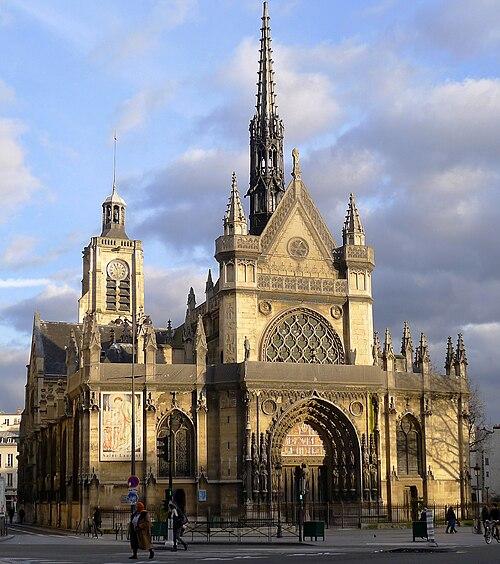
Newsroom (11/06/2026 Gaudium Press ) Six Catholic activists linked to the traditionalist network Civitas were detained by French police for nearly 48 hours after attempting to block a contemporary art installation inside the Church of Saint-Laurent in Paris, in an incident that has reignited tensions over religion, public space, and artistic expression in France.
The confrontation took place on the evening of June 6, during the opening night of the capital’s 25th annual Nuit Blanche festival, a citywide celebration of contemporary art. Authorities confirmed that the activists were released on June 8, after being held in connection with disturbances involving approximately 30 individuals inside and outside the church on boulevard Magenta in the 10th arrondissement.
According to the Paris prosecutor’s office, two of those detained were suspected of committing acts of voluntary violence against Alexandra Cordebard, the Socialist mayor of the 10th arrondissement, and Pouria Amirshahi, an Ecologist member of the National Assembly. Both officials reported being jostled during the incident and indicated their intention to file complaints. The remaining four individuals were detained for participating in an unlawful assembly after refusing to disperse despite police warnings.
City officials reacted swiftly, with the City of Paris announcing it would file its own legal complaint, accusing what it described as “far-right fundamentalist militants” of attempting to obstruct the presentation of an artwork. The installation in question, titled Sous la peau du ciel (“Under the Skin of the Sky”), was created by artist Marie-Luce Nadal and presented as an immersive sound experience within the church space.
The work consisted of recorded wishes collected anonymously from people around the world, layered with atmospheric sounds such as thunder and lightning, then played throughout the interior of the church. Among the messages were expressions of political hope, personal aspirations, and everyday desires, including statements such as “I hope the true left comes to power,” “I hope to be happy and in love all the time,” and “more pasta in the school cafeteria.”
The use of Saint-Laurent Church as a venue had been formally approved by both the parish and the Archdiocese of Paris, in collaboration with the association Art, Culture et Foi, which regularly organizes cultural events within churches. However, this decision drew opposition from certain Catholic groups who argue that sacred spaces should not host secular or artistic programming unrelated to worship.
The broader controversy surrounding the event cannot be separated from the figure of Barbara Butch, the artistic director of the 2026 Nuit Blanche. A French DJ and LGBT activist, Butch had already become a polarizing public figure following her participation in a widely debated tableau during the opening ceremony of the 2024 Paris Olympics. That performance, featuring drag artists seated at a long table, was interpreted by some observers as a reinterpretation—or parody—of Leonardo da Vinci’s The Last Supper. Butch later compounded the controversy with a social media caption referencing a “New Gay Testament.”
Her appointment to lead Nuit Blanche, which included programming inside several Parisian churches, triggered organized opposition in the weeks leading up to the festival. Civitas International, along with the Knights of Our Lady (Militia Sanctae Mariae), publicly called on Catholics to protest the use of church buildings for such events. Civitas International clarified that it is separate from the French political party Civitas, which was dissolved in 2023, although it remains active elsewhere in Europe.
In a statement issued on June 7, Civitas International president Alain Escada denied that the group had orchestrated any collective action and rejected allegations of violence. He challenged authorities to produce evidence of aggression, accusing officials of attempting to “intimidate, stigmatize, or even criminalize” Catholics.
Supporters of the protest also raised legal arguments, citing interpretations from jurist Grégor Puppinck, director of the European Centre for Law and Justice. According to this view, the use of a place of worship for non-religious purposes may contravene both France’s 1905 law on the separation of church and state and Canon 1210 of the Code of Canon Law, which governs the use of sacred spaces.
Accounts of the physical altercation remain sharply disputed. Mayor Cordebard stated publicly that she “personally received blows” from individuals attempting to block access to the church. In contrast, one of the detained activists, Mathieu Goyer, president of the Sainte-Geneviève Paris association, claimed that surveillance footage contradicts the allegations. Goyer, who said he was held for 44 hours in multiple police stations, argued that the mayor was not physically confronted in the manner described.
The legal case took an unexpected turn on June 9, when the Paris Public Prosecutor’s Office announced that it had closed the investigation, citing insufficient evidence of any offense. The decision effectively cleared the six activists of wrongdoing, raising questions about the initial arrests and the handling of the case.
Notably, the Archdiocese of Paris has remained silent on the incident, declining to issue any public statement. This absence of comment has drawn criticism from some conservative Catholic commentators, who have questioned both the decision to host the festival within church premises and the lack of response following the controversy.
The episode underscores ongoing tensions in France over the boundaries between religious tradition and contemporary cultural expression. It also highlights how public events like Nuit Blanche, designed to promote artistic experimentation, can become flashpoints in broader debates about identity, secularism, and the role of religion in public life.
- Raju Hasmukh with files from CNA