

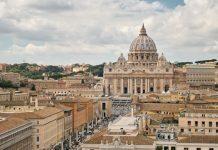

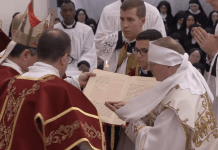
The Jubilee of the Eastern Churches, part of the 2025 jubilee year, concluded on May 14 with a Divine Liturgy in the Byzantine Rite in St. Peter’s Basilica.
Newsdesk (16/05/2025 08:20, Gaudium Press) Five Eastern traditions, 7 rites and 24 Churches “sui juris” that are in full communion with the Pope and the Church of Rome despite having their own liturgical, theological, spiritual and canonical traditions.
This is the varied panorama of the Eastern Churches that in recent days have brought to Rome for their Jubilee the rich treasure of their rites, celebrated in the papal Basilicas, in the presence of their respective patriarchs and pastors.
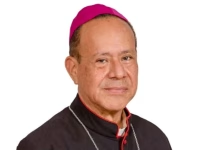
Among these is the Byzantine rite at the center of the celebration in the early afternoon May 14, in St. Peter’s Basilica, with the Divine Liturgy presided over by the patriarch of the Melkite Greek-Catholic Church Joseph Absi and concelebrated with other heads of Churches. It was the last act of the Jubilee pilgrimage, which took place shortly after the meeting with Leo XIV.
A peculiarity of the Divine Liturgy in the Byzantine rite is that it is sung in its entirety. At the Afternoon Divine Liturgy in the Vatican Basilica the various parts were sung in different languages including Greek, Church Slavonic, Ukrainian, Romanian, Hungarian, English. The homily was given by the head of the Ukrainian Greek-Catholic Church, Major Archbishop Sviatoslav Shevchuk, who referred to the papal audience in the Paul VI Hall. “We felt embraced by the Holy Father, consoled in our sufferings and anguish today, appreciated in our ancient Christian traditions and encouraged in our evangelizing mission that we carry out in the contemporary world,” he emphasized.
Reiterating the words of the Pontiff, His Beatitude Shevchuk noted that the faithful of the Eastern Catholic Churches today are almost all living “a painful and tragic experience of war.” “It seems to us,” he observed, “that we are fulfilling our vocation to live as Christians precisely on the threshold between life and death. But we discover every day within us, as the fruit of our birth from water and the Spirit in the Holy Mysteries of the Church, a mysterious seed of immortal life”. A seed of eternal life that, the Major Archbishop explained, “is the object of our hope” and that, according to Saint Basil, “will develop within our hearts and awaits only its full realization”. In faith in God the Father, in the hope announced in his Son and in the regenerating love of the Holy Spirit there is, the head of the Ukrainian Greek-Catholic Church affirmed, “the secret of our mysterious capacity to be reborn after every great tribulation and persecution, the capacity to be heralds of the sanctity of life in today’s kingdom of death”. And as recalled several times at the beginning of this pontificate by Leo XIV, “we can announce from the highest chair in the world to all peoples: ‘Peace be with you’!”.
At the end of the liturgy, the Greek-Melkite Patriarch Joseph Absi thanked all those present, recalling the 1700th anniversary of the Ecumenical Council of Nicaea, which “gave us,” he said, “the common creed and the unity of the Easter date, concrete signs of our unity in faith.”
The latter, “the most precious thing that Christians have,” which “is not only a spiritual ideal” but the “living and powerful testimony of the Gospel in the world.”
Cardinal Claudio Gugerotti, Prefect of the Dicastery for the Oriental Churches, also brought his greetings, recalling at the end of the ceremony that “the Church is one because it is varied” and “it is not one because it is uniform. And it is in this variety and in respect of the rights of this variety,” he emphasized, “that we want to accomplish what the Holy Father has entrusted to us as a Dicastery, to support, defend, protect the Oriental Churches both in their territories and where they have been brought by the violence of wars, oppression and persecution.”
– Raju Hasmukh with files from L’Osservatore Romano (Italian)
Related Images: