












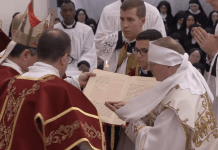
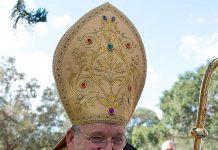
Bishop Heiner Wilmer presents Synodal Conference statutes to Vatican, marking a decisive step in Germany’s ongoing Church reform process.
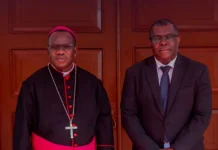
Newsroom (01/04/2026 Gaudium Press ) In a milestone moment for Church reform in Germany, Bishop Heiner Wilmer, chairman of the German Bishops’ Conference (DBK), has formally presented the statutes of the forthcoming Synodal Conference to Vatican authorities in Rome. The submission marks a decisive step in the continuation of the country’s Synodal Path, a multi-year process seeking to embed shared deliberation between bishops and laypeople in the governance of the Catholic Church.
Bishop Wilmer met with Archbishop Filippo Iannone, Prefect of the Dicastery for Bishops, to present the document, according to a DBK press release issued Tuesday. His move, he said, followed the line of his predecessors—Bishop Georg Bätzing and Bishop Franz-Josef Overbeck—both of whom engaged the Vatican in preliminary dialogues on the subject. “Recognition is requested so that we can apply the statutes and implement a Synodal Conference for the Church in Germany,” Wilmer stated.
Accompanied by DBK General Secretary Beate Gilles and Press Spokesperson Matthias Kopp, Wilmer described the moment as “another step on the long journey of the Synodal Path,” emphasizing the integration of the German initiative within the wider global synodal process underway under the guidance of Pope Leo XIV.
Hope for Swift Vatican Recognition
Irme Stetter-Karp, president of the Central Committee of German Catholics (ZdK), welcomed the handover as an encouraging sign of progress. “The Catholic Church in Germany has worked with great commitment toward this Synodal Conference on its Synodal Path, where bishops and laypeople will meet regularly to deliberate and make decisions,” she said. Stetter-Karp expressed hope that the Vatican’s formal recognitio—the necessary canonical approval—would come soon, enabling the inaugural assembly later this year.
The Synodal Conference is envisioned as a permanent deliberative body succeeding the Synodal Path Assembly, the temporary structure that has guided reform discussions in recent years. In November, the Synodal Committee voted to adopt the statutes, which were subsequently approved by both the ZdK and the DBK. The first official meeting of the body is tentatively scheduled for November 6–7.
A Turning Point in the Synodal Journey
Observers have described the delivery of the statutes to the Holy See as a decisive step in Germany’s effort to institutionalize its synodal experiment. According to journalist Michael Haynes, Bishop Wilmer’s presentation coincided with a private audience with Pope Leo XIV in his capacity as head of the German bishops’ conference.
Yet the move also highlights a delicate balance between innovation and tradition. The Vatican has repeatedly voiced concerns that certain structural reforms proposed by the German Church—particularly those expanding the role of laypeople in decision-making—could challenge established boundaries of episcopal authority or fragment unity within the universal Church.
Tensions Within the German Episcopate
The internal debate surrounding the statutes underscores the complexity of the German synodal process. Their approval during the bishops’ plenary assembly was reportedly accompanied by visible tensions and a fragile consensus. Some bishops remain uneasy with proposals perceived to erode the distinction between ordained and lay ministries.
Supporters argue that the Synodal Conference offers a path toward credible reform and renewed trust in the Church’s institutional life. Critics warn that without Vatican recognition, the initiative risks deepening existing divisions between the German Church and Rome.
Awaiting Rome’s Decision
The Vatican now faces the task of assessing whether the proposed structure aligns with the broader ecclesiology of the Catholic Church. The recognitio decision will have far-reaching consequences—not only for the German reform effort but also for the relationship between national churches and central Church authority.
For many in Germany, that judgment may determine whether the momentum for synodal reform continues to grow—or reaches a painful pause.
- Raju Hasmukh with files from Infocatholica
Related Images: