













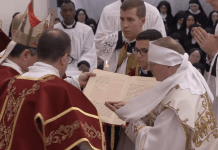
Florida Chief Justice Muñiz lauds Scalia’s ‘Two Thomases’ speech at Red Mass, hailing St. Thomas More as model of faith and reason in law.
Newsroom (30/10/2025, Gaudium Press ) Florida Supreme Court Chief Justice Carlos Muñiz invoked the late U.S. Supreme Court Justice Antonin Scalia’s famed “Two Thomases” address to celebrate St. Thomas More as the embodiment of principled Catholic jurisprudence during the St. Thomas More Society of South Florida’s 33rd annual Red Mass on Oct. 15.
Speaking to an assembly of lawyers, judges and public officials at the historic liturgy — which dates to 13th-century Europe and derives its name from the red vestments worn by presiding clergy — Muñiz described Scalia’s decades-long series of speeches, first delivered in the 1990s, as a compelling witness to faith through the lens of the English martyr.
“Thinking of St. Thomas More in the context of events like this inevitably calls to mind Justice Antonin Scalia’s well-known ‘Two Thomases’ speech,” Muñiz said. The chief justice, appointed by Gov. Ron DeSantis on Jan. 22, 2019, recounted hearing Scalia deliver the address at a Knights of Columbus dinner before beginning his legal studies at Yale.
“It was inspiring and exhilarating to hear one of my heroes, Justice Scalia, witness to our faith through a compelling and thought-provoking account of another even greater hero, St. Thomas More,” he said.
Jefferson as the ‘Bad Thomas’
Muñiz, a University of Virginia alumnus, noted with chagrin that Scalia cast Thomas Jefferson as the speech’s foil — the “bad Thomas.” The justice critiqued Jefferson’s The Life and Morals of Jesus of Nazareth, a work that stripped the Gospels of miracles, including the Virgin Birth and Resurrection, to portray Christ as merely an exemplary moral teacher.
In Scalia’s phrasing, Jefferson crafted “a Gospel fit for the Age of Reason, or indeed for the wise of any age, including our own,” Muñiz quoted.
By contrast, St. Thomas More (1478-1535) — the lawyer, statesman and chancellor beheaded by King Henry VIII for refusing to transfer allegiance from the pope to the crown — emerged as Scalia’s archetype of the “intelligent Christian appearing stupid to the world — a fool for Christ.”
Scalia observed that More died “unsupported by intelligent society, by his friends and even by his own wife,” who viewed his stand on papal authority over Henry’s marriage as foolish, Muñiz recounted.
A Lifelong Devotion
Muñiz revealed a personal bond with the saint, chosen as his confirmation patron in youth. “I have an embarrassing number of Thomas More portraits, prints and statues in my office,” he admitted. “He has been a huge spiritual guide for me over my entire life.”
Before ascending the bench, Muñiz served as general counsel to U.S. Education Secretary Betsy DeVos, deputy attorney general under Florida Attorney General Pam Bondi, and in senior roles under Gov. Jeb Bush and the Florida House speaker. A Northern Virginia native, he attended Catholic schools in the Arlington Diocese and now resides in Tallahassee with his wife, Katie, and their three children.
Faith and Reason Intertwined
Echoing Scalia, Muñiz rejected any notion that religious belief requires abandoning reason. “A faith that has no rational basis is a false faith,” he said, quoting the late justice. He urged reflection on More’s example for all citizens, not just legal professionals.
Muñiz also invoked St. Thomas Aquinas, arguing that while Scalia famously insisted there is “no Catholic way of being a judge,” a distinctly Catholic approach to legal philosophy — rooted in Aquinas — merits consideration by Americans of all faiths.
Society’s Mission
Founded in 1989, the St. Thomas More Society of South Florida unites the region’s Catholic legal community to advance the martyr’s principles. The area’s first Red Mass was celebrated Feb. 10, 1990, by then-Miami Archbishop Edward A. McCarthy at St. Anthony Catholic Church in Fort Lauderdale.
- Raju Hasmukh with files from OSV News
Related Images: