










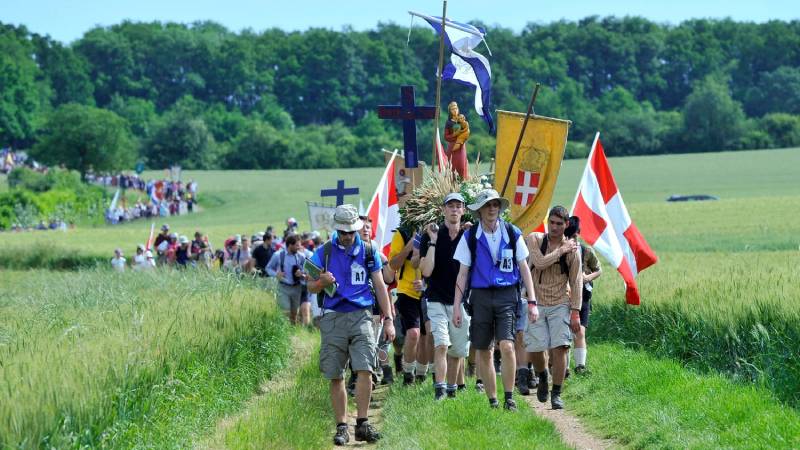
Chartres pilgrimage sees steady growth, drawing 20,000 faithful as organizers highlight mission, conversions, and global appeal.
Newsroom (11/05/2026 Gaudium Press ) Philippe Darantière, president of Notre-Dame de Chrétienté, has offered a detailed reflection on the continued expansion of the traditional pilgrimage to Chartres, describing it as both a logistical undertaking and a deeply spiritual response to contemporary challenges within the Church.
Founded in 1983, the pilgrimage has experienced what Darantière characterizes as “slow and steady growth,” with a notable acceleration in recent years. While the 2007 motu proprio Summorum Pontificum had only a moderate effect, participation surged following Pope Francis’s election in 2013 and increased further after the 2021 apostolic letter Traditionis Custodes. Even after the disruptions of the Covid-19 pandemic, the upward trend has continued, with 2026 registrations rising by approximately 4 percent.
Darantière interprets this growth as a response from the faithful to criticism directed at communities attached to the Tridentine Rite. He suggests that participants have chosen to demonstrate their unity with the Church by joining the pilgrimage in large numbers, countering accusations of division.
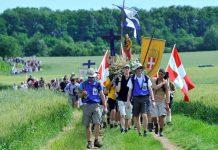
With attendance now exceeding 20,000 pilgrims, the scale of the event presents significant logistical challenges. Organizers must coordinate food, shelter, and care for a population comparable to that of a small city traveling on foot over three days. Yet Darantière emphasizes that numerical growth is secondary to spiritual impact, noting that millions of prayers are offered during the pilgrimage and that even a single confession can carry eternal significance.
The 2026 theme, “You will be my witnesses to the ends of the earth,” underscores the missionary dimension of the event. Darantière stresses the urgency of evangelization, framing the pilgrimage as a call for Catholics to proclaim their faith in a secularizing world. He points to the increasing presence of unbaptized participants and recent converts, including several who have taken on leadership roles, as evidence of the pilgrimage’s evangelizing effect.
Beyond visible conversions, he highlights quieter but enduring outcomes. Many participants use the pilgrimage as a moment of discernment and commitment: engaged couples prepare for marriage, families seek spiritual graces, and vocations to priesthood and religious life continue to emerge. Darantière also underscores the indispensable role of volunteers, whose sustained dedication over more than four decades has enabled the pilgrimage to grow.
International participation has become a defining feature, with approximately 1,700 pilgrims arriving from more than 20 countries. This year marks the first attendance of a Vietnamese group, while pilgrims from North America, including Canada and the United States, continue to make the journey annually. According to Darantière, this global dimension reinforces the distinctive identity of the pilgrimage and its appeal across cultural boundaries.
In response to the evolving needs of participants, organizers have also introduced adaptations such as the “Jerusalem route,” designed for families and older pilgrims who may not be able to complete the full 100-kilometer journey. This initiative reflects an effort to preserve the pilgrimage’s accessibility while maintaining its spiritual focus.
At its core, Darantière describes the Chartres pilgrimage as an experience of penance, fraternity, and formation. Participants endure physical hardship while engaging in communal prayer, sacramental life, and spiritual instruction. Built on the pillars of Tradition, Christianity, and Mission, the pilgrimage is presented as both a public witness of faith and a form of spiritual resistance in a Europe increasingly distant from its Christian roots.
Drawing inspiration from the Polish pilgrimage to Czestochowa during the communist era, Darantière concludes that the mission today is no longer distant but domestic: the re-evangelization of Western societies themselves.
- Raju Hasmukh with files from Infocatholica
Related Images: