









Archbishop Paolo Pezzi resigns in Moscow, triggering a delicate transition for Russia’s Catholic Church amid health concerns, divisions, and succession questions.
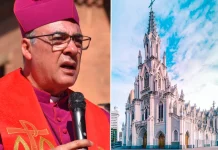
Newsroom (11/05/2026 Gaudium Press ) The resignation of Archbishop Paolo Pezzi from the Archdiocese of the Mother of God at Moscow marks a pivotal moment for Russia’s Catholic community, ending nearly two decades of leadership and opening a sensitive succession process. The move, accepted by the Vatican on 2 May, comes as the Church faces internal tensions, pressure from Russian political and ecclesiastical authorities, and uncertainty over its future direction.
Pezzi, 65, said he stepped down for health reasons that now prevent him from properly administering the vast diocese. In a homily after the announcement, he dismissed speculation and false rumors, stressing that his request was motivated by illness and not by any hidden conflict, while calling for unity and reconciliation within the Church.
A difficult transition
The transition matters far beyond Moscow itself. The archbishop of Moscow is the central figure in a Catholic hierarchy that also includes dioceses in Saratov, Novosibirsk and Irkutsk, making the choice of successor a decision with consequences for the entire Catholic presence in Russia.
For now, auxiliary bishop Nikolai Dubinin has been named apostolic administrator sede vacante et ad nutum Sanctae Sedis. Dubinin, a Russian Conventual Friar, has already been responsible for the northern sector of the archdiocese from St Petersburg, and his appointment signals continuity during an unsettled period.
Health, criticism and strain
Although still well below the canonical retirement age of 75, Pezzi’s resignation was not entirely unexpected. He underwent complex surgery two years ago, and for years he had struggled to sustain the demands of leading a diocese stretching across nearly 80 parishes, including communities as far away as Kaliningrad.
His ministry also unfolded under criticism. He faced attacks over the management of church buildings returned to Catholic use in Moscow, the departure of several priests from the local clergy, and his refusal earlier this year to sign a pro-Moscow appeal on persecuted Christians in Ukraine. Church officials said his position reflected canonical limits on making statements about other countries, but the decision likely did little to ease relations with Russian officials.
Church and state
Pezzi’s departure also raises questions about how the Catholic Church will navigate its relationship with President Vladimir Putin’s government and with Patriarch Kirill of the Russian Orthodox Church. The article frames this as a broader issue of authority and symbolism, since Catholicism in Russia remains small, visible, and often politically sensitive.
The resignation closes an important phase in the post-Soviet revival of Catholic life in Russia. That revival began with the reconstruction and reopening of church structures after the Soviet era, then shifted to preserving and defending what had been rebuilt under Pezzi’s long tenure.
A fragile Catholic revival
The Catholic renaissance in Russia took shape during the liberal religious climate of the 1990s, when nearly 300 communities were reopened across the country. These included parishes, chapels and convents serving a community estimated at around one million people, though the number of active worshippers is much lower and no reliable statistics exist.
Russian Catholics are a diverse group. They include immigrants from Africa, Latin America and Asia, Armenian Catholics who arrived after conflicts in the Caucasus, and ethnic Russians drawn to Latin Rite Catholicism for spiritual and cultural reasons. Many priests are foreign-born, though newer generations of clergy, including Dubinin, emerged after the reopening of the St Petersburg seminary.
What comes next
The succession question is now central. One possibility is appointing a Russian bishop in Moscow, which would symbolize that Russians themselves can become Catholic. Another is to bring an ethnic German to the capital, reinforcing the long-standing perception that Catholicism in Russia stands apart from the dominant Orthodox identity.
The uncertainty extends to other dioceses as well, especially Novosibirsk, where Bishop Joseph Werth has led since 1991 and may also be nearing retirement. His auxiliary, Jesuit Father Stephan Lipke, has added another layer to the Church’s future leadership map in Siberia.
Restored but unsettled
Despite the pressures, Pezzi’s years in office were also a period of growth, consolidation and patient rebuilding. Catholic communities expanded quietly, even amid war, social division and ideological tensions, and his final pastoral visit in Nizhny Novgorod was presented as a sign of hope for future reconciliation.
That hope now depends on how the Church handles the succession in Moscow and whether it can preserve unity while managing its relations with both Russian civil authorities and the Orthodox hierarchy. For Russia’s Catholics, the end of Pezzi’s tenure is not only the close of an era, but the beginning of a more uncertain one.
- Raju Hasmukh with files from Asianews.it
Related Images: