






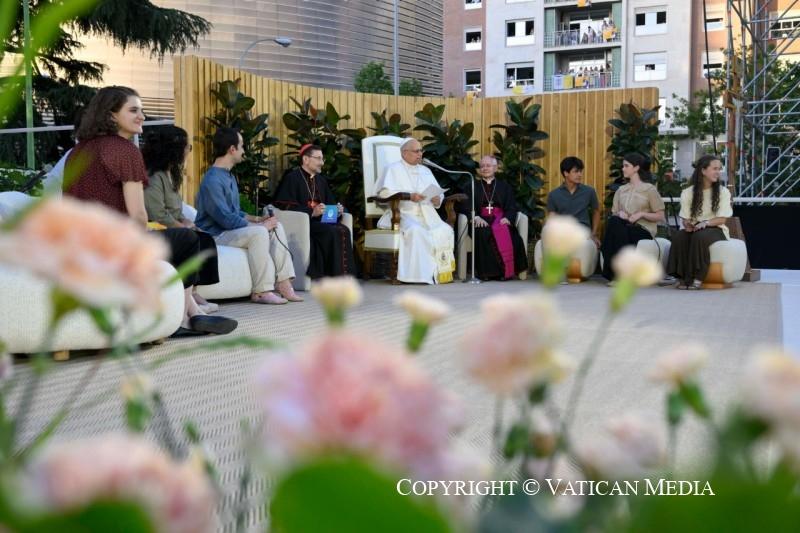
Pope calls young people to embrace faith, silence, truth, and service during Madrid vigil, inspiring mission, vocation, and hope in modern society.
Newsroom (08/06/2026 Gaudium Press ) At a vibrant prayer vigil held in Madrid’s Plaza de Lima on June 6, 2026, the Pope delivered a deeply reflective and pastoral address to young people, urging them to embrace silence, seek truth, and commit to lives of service in an increasingly complex world.
The gathering, marked by prayer, testimony, and dialogue, presented an opportunity for youth to engage directly with questions of vocation, faith, and identity. In his remarks, the Pope emphasized that authentic Christian life is not shaped by trends or fleeting ideologies, but by enduring truth and lived witness.
Saints as Living Models of Faith and Courage
Responding to a question about role models, the Pope highlighted several saints who shaped his spiritual journey beyond Saint Augustine. Among them was Saint John Chrysostom, an early Church Father known for his “golden” preaching and fearless commitment to justice.
He described Chrysostom as a man whose authority came not from eloquence alone, but from the coherence between his words and life. “He was able to preach because he first lived that message,” the Pope noted, underscoring the importance of authenticity in faith.
The Pope also cited Saint Thomas of Villanueva, a Spanish Augustinian bishop renowned for reform and charity. Known as the “Bishop of the Poor,” his life exemplified deep compassion and dedication to the marginalized.
A third figure, Saint Toribius de Mogrovejo, a missionary bishop in 16th-century Peru, was praised for his commitment to evangelization, justice, and cultural understanding, including learning local languages to better serve indigenous communities.
Reflecting on these examples, the Pope echoed Saint Augustine’s question: “If they were able to do it, why not me?”—a challenge he extended to all young people seeking purpose.
A Missionary Experience Shaped by the Poor
Turning to his years as a missionary and bishop in Peru, the Pope recalled the profound impact of witnessing faith among people facing hardship. Despite material poverty, he described communities rich in spiritual resilience and hope.
“It was precisely my encounter with the people’s hardships and also their joys that helped me grow,” he said, noting how the lived faith of others can become transformative.
He emphasized that the Gospel is not merely preached but experienced, capable of turning conflict into peace and fostering reconciliation and justice.
Silence as the Path to God’s Voice
A central theme of the address was the necessity of silence in discerning God’s voice. In a world filled with distractions—particularly digital noise—the Pope warned that many voices mislead or manipulate.
“In silence, we choose what not to listen to,” he said, encouraging young people to cultivate interior stillness. It is within that silence, he added, that truth becomes clear and God’s voice can be recognized.
He also cautioned against misinformation, particularly on social media, urging a steadfast commitment to truth: “God is truth. If it leads you away from God, it is not the truth.”
Prayer, he taught, is the natural expression of the heart directed toward God, a space where individuals are heard and transformed.
Faith Shared Through Authentic Witness
Addressing how young people can accompany others in their spiritual journey, the Pope stressed that authentic witness outweighs instruction.
“None of us was born a teacher… before the Lord we are all disciples,” he said. Faith, he explained, is communicated through lived experience—through joy, perseverance, and love, especially in times of difficulty.
He encouraged young people to nurture community through families, friendships, and youth groups, reminding them that belief is never a solitary endeavor.
Living Faith in Modern Society
The Pope called on young Christians to engage society actively while remaining rooted in faith. Drawing from early Christian writings, he described believers as “the soul of the world”—present within culture, yet not bound by it.
“Jesus’ disciples are always people of their time, but never prisoners of a passing era,” he said, emphasizing freedom grounded in Christ.
He challenged youth to be agents of change in everyday contexts—at home, in education, workplaces, and digital spaces—by embodying the values of the Gospel.
A Mission Entrusted to the Next Generation
Concluding his address, the Pope issued a direct and powerful invitation: to be “the salt of the earth and the light of the world.”
He called on young people to embrace their humanity fully—to be truthful, compassionate, and just. In a world marked by indifference, conflict, and misinformation, he urged them to become “sparks of a new humanity.”
“Be human as Christ is human,” he said, framing this mission not as abstraction, but as daily lived charity.
He closed with a message of hope and empowerment: history can be changed through love—and young people are capable of leading that transformation.
“You can change history. Do it with love.”

- Raju Hasmukh with files from Vatican News
Related Images:


