Pope Leo XIV’s France visit highlights Lourdes as a sanctuary of healing, abuse survivor support, and a powerful witness to human dignity.
Newsroom (27/07/2026 Gaudium Press ) As Pope Leo XIV prepares for his Sept. 25-28 visit to France, much of the international attention is expected to focus on what he may say about a Europe increasingly marked by political division and recent legislation that many Catholics believe undermines the dignity of human life.
Yet the most significant message of the trip may not emerge from Paris, its political institutions, or even the restored grandeur of Notre Dame Cathedral. Instead, it could come from Lourdes, the world-renowned Marian sanctuary that has long welcomed the sick, the suffering, and those searching for spiritual healing, including survivors of clerical sexual abuse.
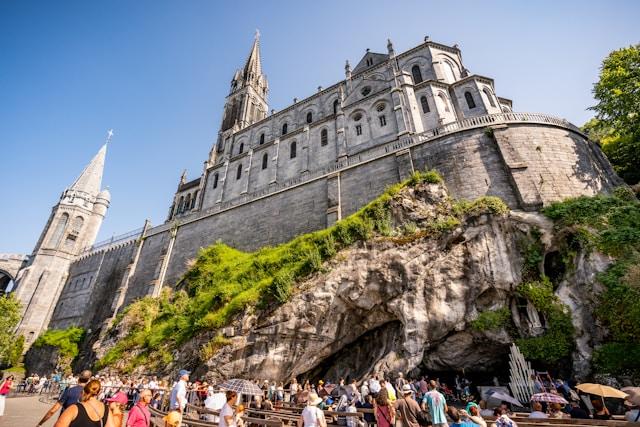
For Bishop Jean-Marc Micas of Tarbes and Lourdes, Pope Leo’s decision to include Lourdes in his itinerary carries profound significance. The pope will arrive there from Paris on Sept. 26 and is scheduled to concelebrate Mass on Sept. 27 on the vast meadow facing the grotto where the Virgin Mary appeared to St. Bernadette Soubirous in 1858. His visit will mark the first papal pilgrimage to Lourdes in 18 years.
A Pilgrimage Centered on People
Speaking ahead of the visit, Bishop Micas described the anticipation in Lourdes as extraordinary.
“It’s a very big emotion to welcome the pope here in the sanctuary of Lourdes,” he said, noting that Pope Leo will become only the third pope to be welcomed at the shrine. Despite the considerable logistical challenges of organizing the visit within a relatively short timeframe, he emphasized the enthusiasm of those involved.
The sanctuary is capable of accommodating approximately 170,000 pilgrims during the papal celebrations. Preparations are centered not simply on hosting a major ecclesiastical event but on facilitating an encounter between the pope and the realities that have defined Lourdes for generations.
Those realities include the sick, who have always occupied a central place in the identity of the shrine. Lourdes emerged as a global pilgrimage destination following the Marian apparitions witnessed by St. Bernadette beginning on Feb. 11, 1858. Reports of physical and spiritual healings associated with the spring discovered during the apparitions have drawn millions of pilgrims over the decades.
According to Bishop Micas, Pope Leo’s schedule will begin with an early morning visit to the grotto. The centerpiece of the day will be Mass celebrated before the apparition site, followed in the evening by a candlelit rosary procession.
The pope is also expected to spend time with pilgrims seeking healing.
“Of course,” Bishop Micas said when asked whether Pope Leo would meet the sick. “He will meet the realities of Lourdes, and sick people are among the most important of them.”
Lourdes and the Question of Abuse Survivors
While Lourdes has traditionally been associated with healing from illness, Bishop Micas believes it has acquired another crucial role in recent years: serving as a place of consolation for victims of clerical sexual abuse.
That conviction became especially visible in March 2025 when the bishop ordered portions of the sanctuary’s large mosaics created by former Jesuit Father Marko Rupnik to be covered. The decision attracted international attention and made Lourdes one of the few major Catholic sites worldwide to take such a public step.
The mosaics adorn the facade of the Basilica of Our Lady of the Rosary and were commissioned in 2008, years before allegations against Rupnik became public. They depict the luminous mysteries of the rosary introduced by St. John Paul II.
Despite widespread discussion surrounding the controversy, Bishop Micas insisted that Pope Leo’s pilgrimage is not connected to the Rupnik issue.
“He didn’t choose Lourdes for that reason,” the bishop explained. The pope, he said, saw the visit primarily as an opportunity to make a pilgrimage and participate in the life of a sanctuary that occupies a unique place in Catholic spirituality.
Still, Bishop Micas made clear that the presence of abuse survivors remains central to his understanding of Lourdes.
“Lourdes is considered as a very important place by victims of sexual abuse,” he said. Through devotion to the Immaculate Conception, many survivors find consolation and, in some cases, a pathway toward healing.
Encounters That Changed a Bishop
The bishop’s decision to cover the mosaics was not driven by legal developments or public pressure. Instead, he points to personal encounters with survivors.
One of the most defining moments occurred on Feb. 12, 2023. He met an English woman who had experienced sexual abuse and who served in Lourdes’ baths ministry. She explained that many abuse survivors come to Lourdes seeking healing but that allegations surrounding Rupnik had made visits to the sanctuary emotionally impossible for some.
The conversation left a lasting impression.
“She wasn’t angry,” Bishop Micas recalled. “But she was very serious.”
A second decisive experience came months later when he met individuals who alleged they had personally been abused by Rupnik. During a day spent listening to their experiences, they described the alleged abuse and the circumstances under which it occurred.
Those testimonies transformed how he viewed the Lourdes mosaics.
“This gave me a new look on our mosaics in Lourdes,” he said.
The bishop ultimately concluded that his responsibility was to ensure no one felt prevented from approaching the grotto or entering the basilica because of the artwork.
“My mission is to allow anyone to get into the sanctuary and to go to the grotto,” he said. Covering portions of the mosaics, while controversial, became in his view a necessary expression of pastoral care.
Listening Before Speaking
Bishop Micas believes that meaningful change in the Church’s response to abuse requires a cultural transformation that will take years, perhaps decades.
Although some criticized his decision, he says many initial opponents later reconsidered their positions. He remains convinced that patient, compassionate engagement is the only path forward.
The bishop repeatedly emphasized the importance of listening.
He believes Church leaders must meet survivors without immediately offering explanations or defenses. Victims, he said, often direct anger toward the Church because they feel unheard by the institution that failed them.
“Now they can talk, so just listen to them,” he said.
His advice extends beyond policy into personal accompaniment.
“If you want to cry, just cry with them,” he said. Compassion, he argued, is not weakness but evidence of authentic humanity.
Asked whether he himself had cried alongside survivors, his answer was immediate.
“Oh, yes. Several times.”
A Message About Life
Pope Leo’s visit comes at a particularly sensitive moment in France following the National Assembly’s July 15 vote legalizing assisted dying, including euthanasia and assisted suicide under certain circumstances.
For Bishop Micas, the pope’s response will not primarily be political, even if commentators interpret it that way.
“The Gospel speaks about life,” he said.
He expects Pope Leo to address questions of human dignity through the lens of Christian teaching rather than political ideology. According to the bishop, believers are called to receive God’s understanding of human life rather than define its value according to shifting political consensus.
The setting in which that message is delivered may prove critical.
In Paris, comments about assisted dying could easily be framed as intervention in a political debate. In Lourdes, Bishop Micas believes the same words would be received differently.
“If he speaks and says exactly the same thing in Lourdes, it will be the word of a pastor and of a believer,” he said.
That distinction may ultimately define the significance of the visit. Lourdes stands as both a sanctuary of healing and a symbol of human dignity amid suffering. It welcomes the sick, the vulnerable, and those wounded by abuse. It is a place where questions of life, pain, compassion, and hope are encountered not in theory but in deeply personal ways.
As France awaits Pope Leo XIV’s arrival, Bishop Micas expects the enthusiasm witnessed during the pontiff’s June visit to Spain to be repeated in Lourdes. But beyond the crowds and ceremonies, the bishop believes the enduring message will be rooted in the sanctuary’s fundamental mission: welcoming all who seek healing, consolation, and renewed hope.
- Raju Hasmukh with files from OSV News