








Pope Leo XIV defuses Catalan language tensions during Barcelona visit, blending diplomacy, history and identity at Sagrada Familia.
Newsroom (12/06/2026 Gaudium Press ) In the days leading up to Pope Leo XIV’s highly anticipated visit to Spain, a linguistic controversy in Catalonia threatened to overshadow the trip. At the center of the dispute was the Vatican’s release of a missal for the inauguration of the Tower of Jesus Christ at Barcelona’s iconic Sagrada Familia—published exclusively in Spanish, with no Catalan version included.
For many in Catalonia, the omission struck a nerve far deeper than a simple translation oversight. It touched on centuries of cultural tension and the enduring significance of language as a symbol of identity. The backlash was swift, invoking not only modern sensitivities but also the legacy of Antoni Gaudí, the visionary architect of the Sagrada Familia, who was famously—and defiantly—proud of his Catalan heritage.
Gaudí’s commitment to his language remains a powerful symbol. In 1924, he was arrested for speaking Catalan to Spanish authorities and refusing to switch to Castilian Spanish. The anecdote has become emblematic of Catalonia’s broader struggle for linguistic recognition, particularly during periods such as Francisco Franco’s dictatorship, when the Catalan language was suppressed.
It was against this fraught historical backdrop that Pope Leo XIV arrived in Barcelona, fully aware of the potential pitfalls. According to Salvador Illa, president of the Catalonian government, the pontiff was “perfectly informed” about the sensitivities surrounding language and identity in the region. Speaking after a private meeting with the pope, Illa revealed that his intention to brief Leo on Catalonia’s situation proved unnecessary—the pope had already been well briefed.
“I have never had any doubt about the sensitivity that Pope Leo XIV and the Vatican have towards the reality of Catalonia,” Illa said, offering a strong endorsement of the pope’s diplomatic instincts.
Yet the issue resurfaced in Madrid even before Leo addressed the Spanish parliament. Miriam Nogueras, spokesperson for the pro-independence Junts party, revealed she had used a one-on-one meeting with the pope to urge him to speak Catalan during his visit. Notably, she addressed Leo in English, framing the choice as a deliberate act of respect and a symbolic gesture.
“Speaking the language of the land that welcomes you is a beautiful act of respect and love,” she reportedly told the pontiff. Later, she defended her intervention publicly, emphasizing her commitment to putting Catalan identity “at the center” without apology.
Her comments sparked unease in more conservative sectors of the Spanish press. Some interpreted the pope’s praise of Spanish as a “language that unites continents”—alongside his repeated calls for unity—as an implicit rebuke of such appeals. However, Illa rejected that reading, instead describing Leo’s message as one rooted in “respect for diversity” and a call to find common ground without fear of difference.
As tensions peaked, Cardinal Juan José Omella, Archbishop of Barcelona, sought to calm the situation. He assured the public that the pope would indeed incorporate Catalan into his visit, warning against those who might seek to inflame controversy.
The reassurance proved well-founded. Throughout his time in Barcelona, Pope Leo made a visible and consistent effort to engage with the Catalan language. At the city’s cathedral, he opened midday prayer in Catalan, greeting the faithful with warmth and deliberate care. During a youth vigil at the Lluis Companys Olympic Stadium, he seamlessly alternated between Catalan and Spanish, reflecting the linguistic diversity of those present.
The pope’s itinerary extended beyond ceremonial appearances. He visited the historic Montserrat monastery, home to the revered Black Madonna, and the San Agustin parish in the El Raval district, where outreach programs for the homeless serve some of the city’s most vulnerable communities. These stops reinforced the pastoral dimension of his visit, complementing its political and cultural significance.
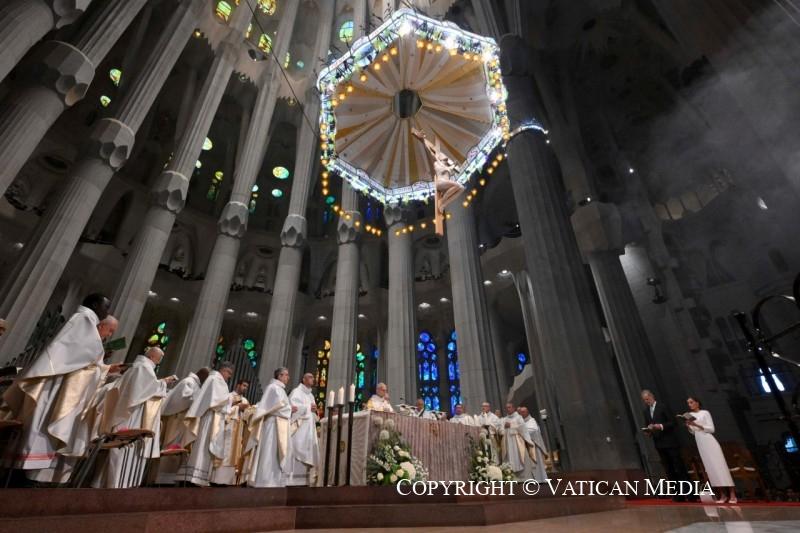
The defining moment came at the Sagrada Familia itself. As Pope Leo XIV blessed the Tower of Jesus Christ—a milestone in the basilica’s long construction—he did so in both Catalan and Spanish, a symbolic gesture that resonated widely.
Reaction from Catalan leaders was swift and largely positive. Carles Puigdemont, president of Junts, expressed satisfaction with the pope’s approach, praising his sensitivity to “our country and our language.” Even Nogueras, who had initially pressed the issue, acknowledged the effort—while using it as a political lever against Spain’s national leaders.
“That the Holy Father has spoken more Catalan in one hour than Mr. Feijóo and you together throughout your entire political career explains very well how much you all care about Catalonia,” she said in parliament, criticizing both Prime Minister Pedro Sánchez and opposition leader Alberto Núñez Feijóo.
Despite being drawn into Spain’s political crossfire, Pope Leo’s broader message appeared to transcend such divisions. His consistent emphasis on unity without uniformity—and his willingness to engage linguistically with local culture—allowed him to navigate a potentially divisive issue with notable dexterity.
Though it is always difficult to infer intent, Leo’s approach suggests a deliberate effort to avoid becoming entangled in partisan disputes. His tenure so far indicates a preference for dialogue over confrontation and symbolism over spectacle.
In Spain, as elsewhere, the pope’s voice often operates on a different register from that of political leaders. During his visit to Catalonia, that distinction proved crucial—turning a brewing controversy into an opportunity for quiet reconciliation.
- Raju Hasmukh with files from Crux Now