














Christchurch unveils plans for a new Cathedral of the Blessed Sacrament, rebuilding on its historic site 16 years after the earthquakes.
Newsroom (27/07/2026 Gaudium Press ) Christchurch has taken a major step toward restoring one of its most significant Catholic landmarks. On July 26, 2026, the Diocese of Christchurch officially unveiled plans for the future Cathedral of the Blessed Sacrament, marking a historic milestone sixteen years after the earthquakes that devastated the city and led to the loss of the cathedral that had stood as a symbol of Catholic faith since the early twentieth century.
The announcement represents the culmination of years of consultation, planning, and discernment. For the Catholic Church in New Zealand, the project signals not only the rebuilding of a church but also the renewal of a spiritual and cultural presence deeply tied to the history of Christchurch.
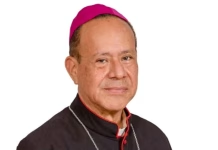
The original Cathedral of the Blessed Sacrament suffered severe damage during the earthquakes of 2010 and 2011. The destruction left the diocese facing difficult decisions about the future of its cathedral and broader pastoral mission. In the years that followed, various options were considered, including the possibility of relocating the cathedral to another part of the city. Ultimately, Bishop Michael Gielen chose a different course: rebuilding on the cathedral’s historic site on Barbadoes Street.
That decision ensures the continuation of a legacy that dates back to 1905, when the iconic cathedral designed by renowned New Zealand architect Francis Petre first opened its doors. By returning to the original location, diocesan leaders hope to maintain a tangible connection between Christchurch’s Catholic past and its future.
The first architectural plans reveal a building that embraces classical elegance and simplicity. Rather than pursuing highly experimental contemporary forms, the design aims to create a cathedral that is both timeless and enduring. The respected architectural firm Warren and Mahoney has been commissioned to lead the project, with a focus on producing a structure capable of serving generations while meeting the highest modern earthquake-resistance standards.
The new cathedral will provide seating for approximately 800 worshippers, a capacity intended to accommodate major diocesan celebrations and liturgical events. Among its most significant features will be a chapel of perpetual adoration, allowing the faithful to pray before the Blessed Sacrament throughout the day. The inclusion of this dedicated chapel reflects the central place the Eucharist will hold within the cathedral’s mission and identity.
The development extends well beyond the construction of the cathedral itself. Diocese officials have envisioned an integrated complex designed to support both spiritual and community life. Plans include a parish centre with seating for 300 people, intended for meetings, conferences, and pastoral activities. Additional meeting rooms and training spaces will provide venues for formation programs and community gatherings.
The site will also house diocesan offices, creating a central hub for church administration and ministry. Landscaped gardens and public open spaces are planned to welcome residents, pilgrims, and visitors alike, while parking and visitor facilities will help ensure accessibility for those attending events and celebrations.
Financially, the project represents one of the most ambitious undertakings in the recent history of the Catholic Church in New Zealand. The overall cost is estimated at NZ$80 million, approximately €41 million. Significant progress has already been made toward that goal. Through insurance compensation and the sale of certain diocesan properties, the diocese has secured NZ$45 million.
A fundraising campaign is now focused on obtaining the remaining NZ$35 million required to bring the project to completion. According to the diocese, donor support has already generated commitments exceeding NZ$19 million. As a result, approximately NZ$16 million remains to be raised before construction can fully proceed.
Alongside the architectural announcement, diocesan leaders confirmed that the future church will retain its historic name, Cathedral of the Blessed Sacrament. The decision follows a consultation process conducted with parishioners in 2024. Maintaining the name was seen as an important affirmation of the cathedral’s spiritual heritage and its enduring mission within the diocese.
The emphasis on the Blessed Sacrament is particularly evident in the planned perpetual adoration chapel, which has emerged as one of the most distinctive elements of the project. Church leaders view the chapel as a visible expression of the cathedral’s purpose and a testament to the centrality of Eucharistic devotion in diocesan life.
At the official unveiling, Bishop Michael Gielen described the vision behind the undertaking in clear terms. “We want to build a beacon of faith for future generations,” he said. The bishop expressed his hope that the new cathedral would serve not only as a place of worship but also as a centre for evangelization, prayer, and encounter for the wider Christchurch community.
For many Catholics, the project carries significance that extends beyond architecture. The long period between the earthquakes and the unveiling of the new plans reflects years of uncertainty, loss, and careful planning. The cathedral’s return to its historic site represents a visible sign of continuity and resilience after one of the most challenging chapters in the city’s history.
The project also comes at a time when many churches across the Western world face declining attendance, closure, or conversion to civic and commercial uses. Against that backdrop, Christchurch’s decision to invest in a new cathedral dedicated to the Blessed Sacrament and centred on perpetual Eucharistic adoration stands out as an expression of confidence in the future of Catholic life.
More than a reconstruction effort, the Diocese of Christchurch presents the new Cathedral of the Blessed Sacrament as a statement of hope. By rebuilding on sacred ground, preserving its historic identity, and creating a space dedicated to worship, prayer, and community life, the diocese aims to establish a landmark that will serve both the Church and the city for generations to come.
- Raju Hasmukh with files from Tribune Chretienne