







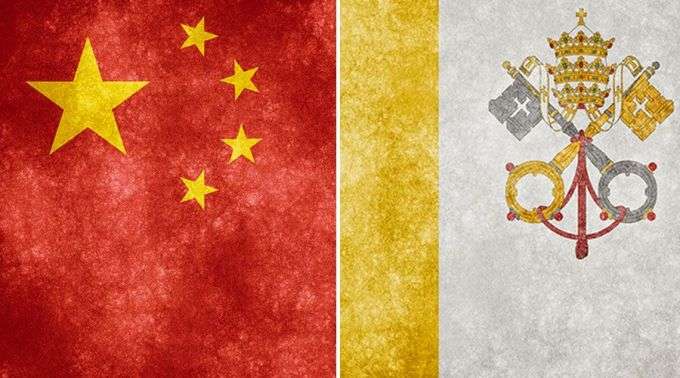
As Jimmy Lai faces 20 years in prison, the Church must confront its uneasy silence on China’s repression and its hidden pact with Beijing.
Newsroom (17/02/2026 Gaudium Press )The pontificate of Pope Leo XIV enters 2026 surrounded by formidable challenges that will shape not only the future of his papacy but the life of the global Church. The specter of schism haunts the ecclesial landscape from two directions: a progressive rift from the German Synodal Way, and a traditionalist one from the Society of Saint Pius X (SSPX). Yet alongside these internal questions, a third and arguably more fateful crisis has re-emerged on the international stage—relations between the Holy See and the People’s Republic of China.
This issue has moved back to the center of global Catholic consciousness through the dramatic case of Jimmy Lai, the 78‑year‑old Catholic entrepreneur and democracy activist sentenced in Hong Kong to twenty years in prison. The sentence, rendered under the broad scope of China’s National Security Law, has been presented as lenient out of respect for Lai’s age and health. In truth, after five years of solitary confinement, the ruling amounts to a slow and bureaucratic execution.
Why Beijing Fears Catholicism
Five religions—Taoism, Buddhism, Islam, Protestantism, and Catholicism—are formally recognized by Beijing, but none truly enjoys religious freedom. The guiding ideology of “Sinicization,” introduced by Xi Jinping, dictates that spiritual life must serve the interests of the Communist Party. Religion may exist, but only insofar as it strengthens national unity and ideological conformity.
Within that framework, Catholicism is the most suspect faith. Unlike Taoism or some schools of Buddhism, it cannot be easily absorbed into China’s national narrative. Its universal structure, centered on a foreign authority—the Bishop of Rome—cannot be reconciled with state control. Since the Cold War, when the Vatican adopted an anti-Communist stance under Pius XII and John Paul II, the CCP has viewed the Church not merely as a spiritual rival but as a potential political threat.
The result has been a dual Catholicism in China: an “official” Church sanctioned by the regime and an “underground” Church loyal to Rome. This division, tolerated and managed for decades, resurfaced sharply in recent years as the clandestine Church came under new persecution even amid diplomatic engagement with the Holy See.
The Parallel Trials of Jimmy Lai and the Church
Jimmy Lai’s life mirrors the contradictions of this history. Born on the mainland, he fled to Hong Kong as a child and rose from factory labor to found a successful company and later Apple Daily, one of the most outspoken voices of Chinese dissent. After the Tiananmen massacre, Lai transformed his fortune into a platform for truth. His conversion to Catholicism in the 1990s gave a sacramental shape to his commitment to human dignity and freedom under the principle “one country, two systems.”
While Lai’s public witness grew, the Vatican was quietly advancing along its own diplomatic path toward Beijing. Through figures such as Cardinal Theodore McCarrick and Jesuit Bishop Aloysius Jin Luxian, informal lines of dialogue opened between Rome and the Party. Despite tensions over the canonizations of Chinese martyrs in 2000, these discreet exchanges culminated under Pope Francis with the secret 2018 agreement on episcopal appointments—renewed in 2020, 2022, and most recently in 2024, extending until 2028.
As these accords deepened, the repression of Hong Kong’s freedoms intensified. Lai’s imprisonment under vaguely defined charges of “collusion with foreign forces” coincided, tragically, with the Vatican’s growing silence toward China’s human rights record.
The Vatican’s Calculated Silence
Why would the Holy See hold fast to an agreement so morally ambiguous? Part of the answer lies in a convergence of worldviews. Xi’s regime and the post-Francis Vatican share, to a degree, a critique of Western capitalism, a preference for multipolar diplomacy, and sympathy for the language of inculturation and “people-centered” participation.
This ideological resonance has shaped theological justifications within China itself. Bishop Jin Luxian once argued that early Christian communities elected their bishops by the people’s acclamation—an idea conveniently aligned with Communist notions of “popular” legitimacy. He also promoted greater cultural adaptation in the liturgy, echoing trends encouraged under Francis.
For Beijing, the Vatican represents unparalleled “soft power,” capable of moral influence across continents. Securing Rome’s diplomatic caution offers legitimacy and limits criticism. It is widely assumed that one of the confidential clauses of the Sino‑Vatican agreement precludes the Holy See from openly condemning China’s internal policies or acts of repression.
This would explain the guarded silence surrounding Jimmy Lai’s imprisonment and other human rights abuses. Even recent magisterial writings, such as Dilexi te, exhibit sharp moral critique of the West but studiously avoid mentioning China’s abuses or systemic pollution—an omission that is itself eloquent.
The Test of Prophetic Freedom
For Pope Leo XIV, the challenge is stark: whether the Church can maintain diplomatic realism without surrendering its prophetic voice. The quiet suffering of Jimmy Lai poses a direct question to Catholic conscience. Can a Church that once produced martyrs under totalitarian regimes now remain silent before one of the most repressive governments of our time?
The answer will reveal whether the Holy See’s strategy is prudence or compromise. Jimmy Lai’s chains have become emblematic not only of China’s fear of faith but of the Vatican’s own entanglement with worldly power. His endurance stands as a mirror to the universal Church—a reminder that truth cannot be negotiated, even in the name of diplomacy.
- Raju Hasmukh with files from European Conservative
Related Images:


