









Mozambique’s Catholic Church condemns Bishop Afonso’s killing and urges national action to end violence and restore moral conscience.
Newsroom (15/06/2026 Gaudium Press ) The President of the Episcopal Conference of Mozambique (CEM) has issued a strong condemnation of the killing of Bishop Osório Citora Afonso, urging the nation to confront and end the persistent cycle of violence that continues to afflict the country.
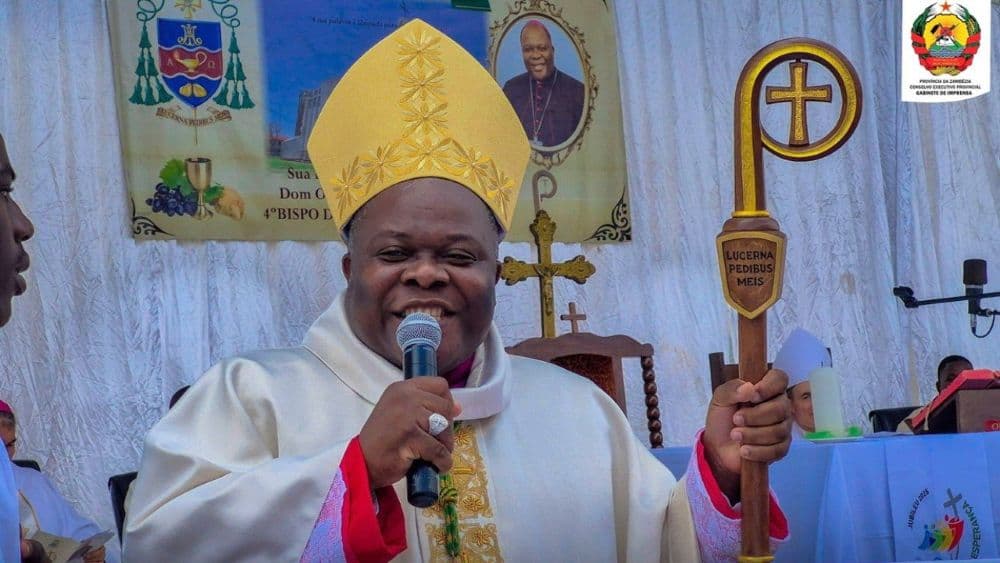
Bishop Afonso of the Catholic Diocese of Quelimane was found dead in his residence following a gunshot incident in the early hours of June 6. His funeral Mass was held on June 13 at the Our Lady of Fatima Cathedral in the Archdiocese of Nampula, after which he was laid to rest at the Clergy cemetery of the same archdiocese.
During the Eucharistic celebration, Archbishop Inácio Saúre delivered a somber and impassioned homily, expressing deep sorrow over the bishop’s death while calling for a decisive national response to the violence that claimed his life.
“May this assassination be the final chapter of this repugnant practice,” Archbishop Saúre said, urging Mozambicans to reject violence in all its forms. “Stop immediately killing men and women of goodness and peace.”
The Archbishop emphasized that Bishop Afonso’s killing was not an isolated incident, but part of a broader and troubling pattern of violence. He described the murder as reflective of a “sad and shameful scenario” that has brought suffering to many families and tarnished the image of Mozambique.
“The assassination of Bishop Afonso is not an isolated case. It is written into the sad and shameful scenario of the wave of violence and murders of peaceful and good people in Mozambique,” he said.
In his homily, Archbishop Saúre sharply criticized those responsible for the killing, suggesting that they acted out of misguided ambition and moral blindness. He stressed that no cause or objective can ever justify the taking of human life.
“By assassinating Bishop Afonso, those who only know how to kill the body and cannot kill the soul believed they were doing something good for their unconfessable ambitions and satanic whims,” he said.
The Archbishop, a Mozambican-born member of the Institute of Consolata Missionaries, also warned of the broader societal implications of repeated acts of violence. He cautioned that ongoing brutality risks eroding moral values and dulling the collective conscience.
“That attitude belongs to those who have killed their conscience and therefore call evil good,” he said. “Frequent abuses of the same crime dry up the conscience, and what was once considered sin becomes a virtue.”
Archbishop Saúre stressed that solving the case of Bishop Afonso’s assassination alone would not be sufficient. Instead, he called for a deeper examination of the root causes of violence in Mozambique.
“It will not be enough merely to solve the case of Bishop Afonso’s assassination. It is imperative to solve the problem at its roots,” he said.
Rejecting any attempt to reduce victims to statistics, the Archbishop underscored the intrinsic dignity of every human life. “I do not want to speak about statistics of murders in Mozambique because people are not numbers,” he stated.
He further argued that the response to violence must extend beyond punishment and encompass a broader transformation of society—one in which violence is no longer seen as a legitimate means of resolving conflicts or advancing personal interests.
According to Archbishop Saúre, Bishop Afonso’s life and ministry should serve as a lasting inspiration for peace and commitment to the common good.
“The example of Bishop Afonso needs to be immortalized. Not through more assassinations, please, but through authentic faith and through the commitment of all men and women of goodwill,” he said.
Remembering the late bishop’s pastoral dedication, the Archbishop highlighted his selflessness and unwavering commitment to his vocation.
“He had understood that being a shepherd meant giving one’s life. And he gave it,” he said.
In a broader appeal, Archbishop Saúre called for national mobilization against violence and for the defense of human life, urging citizens to allow Bishop Afonso’s death to awaken a renewed moral conscience across the country.
Central to his message was the belief in the inviolable dignity of every human person, rooted in their creation in the image and likeness of God.
“Each person is truly a creature made in the image and likeness of God and therefore whose life is inviolable because it is a gift from the Creator,” he said. “To take the life of a human person is a denial of our humanity, a grave offense against God and an insult to the Creator.”
He concluded with a stark reflection on the moral state of those who commit acts of violence, asserting that wrongdoing enslaves rather than liberates.
“Whoever does evil is not a free man. He is a slave,” Archbishop Saúre said. “It was not a truly free man who killed Dom Osório. It was a slave of evil who killed him.”
- Raju Hasmukh with files from ACI Africa
Related Images: