












A Jerusalem abbot warns of a 63% rise in anti-Christian attacks in Israel, blaming extremist ideology and a government he says includes “notorious Christian haters.”
Newsroom (08/05/2026 Gaudium Press ) A French nun beaten and kicked to the ground near the Cenacle. A cross struck with a sledgehammer by an Israeli soldier in southern Lebanon. A settler spitting at the entrance to an Armenian cathedral before raising a defiant middle finger to security cameras. A statue of the Virgin Mary desecrated with a cigarette.
These are not isolated incidents. According to religious leaders and documented data, they are part of a mounting and systematic wave of anti-Christian hostility in the Holy Land — one that a prominent Jerusalem clergyman says has now reached the corridors of power.
A Government of ‘Notorious Christian Haters’
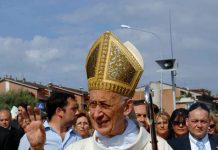
Abbot Nikodemus Schnabel, the German-born Benedictine monk who heads the Basilica of the Dormition on Mount Zion, does not mince words. In a wide-ranging interview with AsiaNews, he described the current situation as “difficult,” the Christian community as “under pressure,” and the present Israeli leadership as uniquely dangerous.
“For the first time,” he said, the government includes people “who hate Christians, who are notorious Christian haters.”
At the center of his concern is Itamar Ben-Gvir, Israel’s minister for National Security. “In 2015, we had a horrible arson attack in Tabgha,” the abbot recalled, referring to the burning of the Church of the Multiplication of Loaves and Fishes. “The lawyer who defended the arsonists was Itamar Ben-Gvir. This man, who hates Christians, who hates really Christianity, is now in charge of my security — and this is really horrible.”
The irony is personal. Abbot Schnabel himself has been spat upon by Jewish extremists. “The people who spat on me,” he said, “are now part of the Israeli government.”
The Numbers Behind the Violence
The escalation is not merely anecdotal. Documented figures show a 63 percent increase in hostile acts against Christians in Israel in 2025. The breakdown is striking in its range: spitting accounts for more than half of all incidents, followed by insults, shouting, or threats at 18 percent, attacks on religious symbols at 15 percent, physical violence at 5 percent, and desecration of sacred places at 3 percent.
The most recent high-profile case unfolded on April 28, when a 36-year-old man, Yonah Shreiber, attacked a French nun from behind near the Cenacle on Mount Zion, knocking her to the ground and kicking her. Security camera footage of the assault spread widely online. Shreiber was subsequently arrested and charged, with prosecutors citing “sectarian hatred” as the motive — the attack, they said, was triggered solely by the nun’s visible religious dress.
The Ideology Behind the Attacks
Abbot Schnabel traces the violence not simply to individual prejudice but to a coherent and reviving extremist worldview: Kahanist ideology, rooted in the far-right religious Zionist movement inspired by the late Rabbi Meir Kahane.
“Jewish extremism, this terrorist ideology,” he said, “admits no room or rights for other groups, including Christians.” Its logic, as he describes it, is territorial and total. Sensitive zones such as Mount Zion — site of the Last Supper, home to the Basilica of the Dormition, and adjacent to the Tomb of David — are claimed exclusively by nationalist and radical groups. “Our church has to be destroyed. The crosses have to be removed. Jerusalem is only for the Jews.”
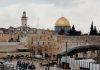
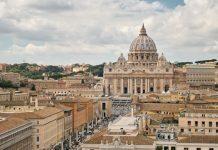
The very visibility of the Dormition Abbey — its dome a fixture of Jerusalem’s iconic skyline — makes it a target. “It’s very difficult not to see our church,” the abbot noted. “And for that reason, it has to be destroyed. They want to wipe out the Christian presence of Jerusalem.”
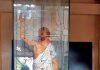
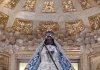
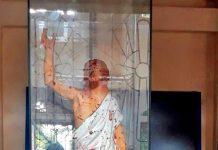
In the West Bank, the entirely Christian village of Taybeh faces what Schnabel describes as an existential threat from rising settler violence. In southern Lebanon, recently the site of Israeli military operations, a soldier used a sledgehammer to strike a cross bearing the figure of Jesus in the village of Debel. Separately, another soldier was photographed placing a cigarette in the mouth of a statue of the Virgin Mary.
A Community Contemplating Exodus
The psychological toll on Jerusalem’s Christian community is profound. Many believers, the abbot says, feel unwelcome in a city their faith has called home for two millennia.
“Christians have the feeling that there’s no place for us. We are not welcome. And this is really a big shift.”
Those with connections abroad — Christians from Nazareth or Haifa with family ties to Cyprus or Greece — are actively considering emigration. Schnabel fears a hollowing-out of indigenous Christian life, leaving behind only the institutional presence of religious orders from Europe.
“I fear a Christian Disneyland. Of course, the professionals — the German Benedictines, Italian Franciscans, French Dominicans — will remain. But I really fear that the local indigenous Christians will disappear.”
This demographic anxiety is compounded by the broader regional conflict. With ongoing wars in Gaza and against Iran having halted pilgrimage tourism, the Christian community’s smallness has become even more visible — and its vulnerability more acute.
“The focus of the world is now on the war, and nobody cares what the settlers are doing,” the abbot said. “In the shadow of war, people have the courage to be more open with their hatred. War is always a way to dehumanise the enemy.”
A Contrast Between Civil Society and the State
Schnabel is careful to distinguish between official Israel and the broader population. He speaks warmly of Jewish Israeli friends who are “very sad and unhappy and in fear with the development of their society,” and praises civil society organizations such as the Rossing Center for Education and Dialogue, which he credits with genuinely caring about the Christian presence.
“There are a lot of positive things to say,” he acknowledged. “But I see a difference between civil society — I feel them very supportive — and official Israel, who is not doing enough against the phenomenon of Jewish terrorism.”
The contrast he draws is between a government that once took pride in Israel’s religious pluralism — “They were proud that Israel was home to the holy places of Christianity, Islam, the Druze, the Bahá’í, the Jews” — and a present administration he views as ideologically hostile to that tradition.
“Now it’s really clear: Israel is for the Jews. And the minorities are maybe tolerated, but they should shut up.”
A Monk Who Refuses to Be Invisible
Born in Stuttgart in December 1978, Father Nikodemus Schnabel entered monastic life in 2003 and has spent many years in the Holy Land, becoming one of its foremost experts on the Eastern Church. Installed as abbot of the Basilica of the Dormition in May 2023, he has also served as patriarchal vicar for migrants under the Latin Patriarchate of Jerusalem.
He recounts being told by his attackers to “go home to Rome, go home to Italy” — a taunt that misidentifies his nationality but makes his persecutors’ true motive plain. “They hate me not because of my nationality. They hate me because I’m an abbot, because I’m Christian.”
Israeli authorities have on at least one occasion asked him to remove his cross near the Western Wall — a request he regards as emblematic of a deeper pressure on Christians to render themselves invisible in public space.
“Christians should not be visible,” he said, describing the attitude that permeates online commentary following attacks on clergy. “‘Why does he have to walk so provocatively through Jerusalem?’ If I walk in civilian clothes, it’s okay — but why should I provoke by being visible as a monk?”
The abbot’s answer, implicit in his continued presence and his willingness to speak publicly, is unambiguous. He will not disappear into the background of a city his order has called home for over a century — and he intends to make sure the world does not look away either.
- Raju Hasmukh with files from Asianews.it
Related Images: