















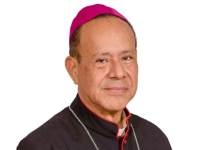


Cardinal Ouellet’s defamation trial in Montreal expands beyond personal claims, exposing deep moral divides within Canadian society.
Newsroom (11/03/2026 Gaudium Press) “I am not the person she is talking about. I can assure you, in the most complete and certain way, that I have never committed the acts she described.”
With those words, Cardinal Marc Ouellet sought to reaffirm his innocence in a case that has quickly evolved from a personal dispute into a cultural and moral flashpoint in modern Canada. The defamation trial, unfolding in a Montreal courtroom, was originally meant to settle a straightforward matter: a prelate defending his honor against an accusation he categorically rejects. Instead, as testimony accumulates and narratives widen, the proceedings have begun to echo far beyond the individuals directly involved.
A Trial Beyond Its Original Scope
The lawsuit was filed by Ouellet after a Quebec woman, Marie-Louise Moreau, alleged that he had behaved inappropriately during a 1992 encounter. The 84-year-old claimed he had “rubbed himself” against her — an accusation Ouellet calls entirely mistaken. In court, he insisted that the incident she described simply never happened.
The Cardinal’s lawyer, Dominique Ménard, argued that inconsistencies and gaps in the testimonies left their probative value “slim, if not nonexistent.” The judge himself appeared to share concerns about the case’s expanding scope, cautioning the plaintiff’s counsel against transforming the trial into a broader indictment of the Catholic Church. “I’m overwhelmed with your case,” the judge remarked sharply. “It’s going to stay a case.”
That statement underscored a growing perception: what began as a limited legal matter involving a single cleric is becoming, symbolically, a trial of the Church itself.
A Mirror of a Changing Society
Observers see in this courtroom drama a reflection of deeper tensions within Canadian society — particularly the widening cultural gap between the secular mainstream and a religious institution long at the center of national life. Canada’s journey toward secularization has been swift and, in the eyes of some, unforgiving. From the legalization and normalization of euthanasia to the near-complete retreat of Christian values from public policy, the nation’s religious landscape has been profoundly reshaped.
In this climate, accusations against Church leaders often become more than allegations of personal misconduct. They are interpreted as moral reckonings — a measure of public discomfort with an institution many have come to associate with authority, judgment, and sin. As a result, the presumption of innocence can struggle to survive the glare of public outrage.
Old Memories, New Meanings
Two women testified that Ouellet’s past behavior made them uncomfortable. One recounted a moment when he placed a $50 bill inside her sweater, describing it as a “clumsy” but well-intentioned act of charity. The other alleged inappropriate contact dating back to the early 1990s. There is, however, no suggestion of any act amounting to sexual assault, rape, or other recognized crime.
Such decades-old accounts raise challenging questions about memory, context, and timing. How can events recalled after thirty years carry the same weight as those examined closer in time? Why do some stories emerge only now, amid a broader cultural reckoning with the Church’s failings? None of these questions diminish the possibility of genuine distress — but they highlight the tension between empathy and legal rigor.
Justice Amid the Noise
In an era dominated by digital outrage, moral accusations quickly become viral trials in their own right. The Church, for many, has become an easy target — a symbol upon which public frustration with institutional power is projected. Yet true justice depends on discernment, evidence, and fairness. Courts must judge facts, not reputations.
Cardinal Ouellet insists he stands falsely accused and is exercising his right to seek redress through the law, not media debate. “Neither toward Ms. Moreau nor toward anyone else. Never,” he told the court, repeating his denial in absolute terms.
Symbol and Substance
The Ouellet case may ultimately be remembered less for its legal verdict than for what it revealed about a country’s uneasy relationship with its spiritual heritage. The trial sits at the intersection of faith, memory, and the modern hunger for moral accountability. In a society increasingly skeptical of religious authority, each clerical case becomes a litmus test of broader cultural values — sometimes fair, often not.
For now, the only certainty is that this is more than one man’s defense. It is a battle over how truth is determined, how faith is perceived, and whether justice can remain impartial when judged in the court of public opinion.
- Raju Hasmukh with files from Tribune Chretienne
Related Images: