






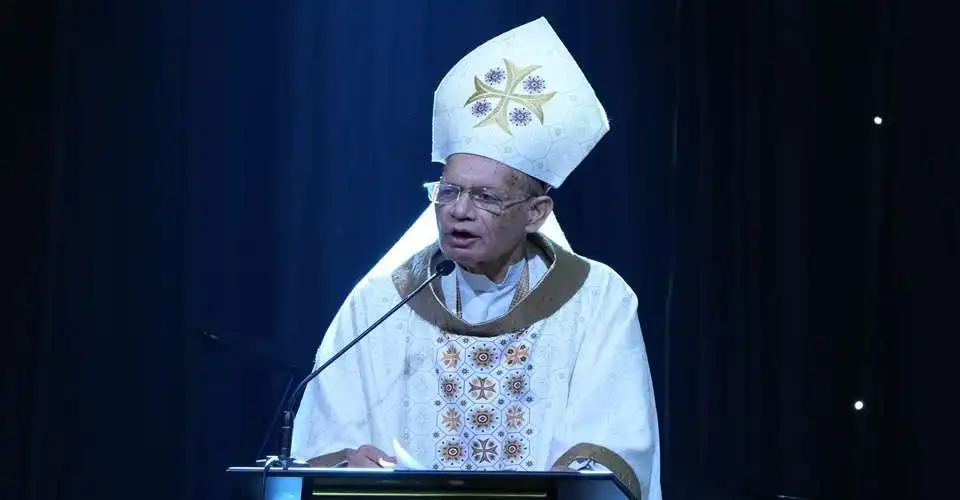
Cardinal Oswald Gracias urges Asian bishops to advance peace, reconciliation and dialogue through synodality at the FABC assembly.
Newsroom (22/07/2026 Gaudium Press ) Cardinal Oswald Gracias has called on the Catholic Church in Asia to respond to a world marked by conflict, division and social fragmentation by embracing its role as a force for peace, reconciliation and dialogue.
Speaking during the opening Mass of the 12th Plenary Assembly of the Federation of Asian Bishops’ Conferences (FABC) in Jakarta on July 21, the Indian cardinal, serving as Pope Leo XIV’s special envoy, challenged Church leaders to become “bridge-builders” capable of fostering unity in an increasingly polarized world.
“Our mission is to be bridge-builders, become bridges ourselves, to connect people, bring people closer together, to reconcile different situations, to resolve conflicts, and to bring peace to the world,” Cardinal Gracias said.
The weeklong gathering, held approximately every four years, has brought together more than 100 cardinals, bishops, priests, religious and delegates from across Asia under the theme, “The Call to Synodal Conversion and the Mission to Be Bridges and Bridge-Builders in Asia.”
Synodality as a Response to Division
A central focus of the assembly is synodality, a concept emphasizing listening, participation, discernment and shared responsibility within the Church. Cardinal Gracias described it as one of the Church’s greatest contributions to a fractured world.
According to the cardinal, the assembly is more than an institutional event. Rather, it is an opportunity for the Churches of Asia to discern contemporary challenges and identify how they can respond collectively.
Reflecting on current global realities, he pointed to conflict, violence and war as defining features of the international landscape.
“If we look at the world scenario,” he said, “the major element in world events today is conflict, violence, and war.”
Recalling Pope Francis’ characterization of global conflicts as “a Third World War fought in pieces,” Cardinal Gracias argued that the Church has a responsibility to promote harmony among religious communities and help cultivate what he described as a culture of peace in parishes, dioceses, nations and across the wider world.
Lessons from the Pandemic
The cardinal also reflected on the COVID-19 pandemic, describing it as one of the most significant challenges faced by the Churches of Asia in recent years.
While acknowledging the suffering caused by the crisis, he said the pandemic also highlighted resilience, solidarity and collegiality among communities and Church institutions. Those experiences, he suggested, demonstrated the value of working together during times of uncertainty and hardship.
He further argued that the principles of synodality have deep roots in Asian societies, where family bonds, communal values and mutual respect have long shaped social life.
“The world needs synodality. The world needs to learn to work together, to walk together, and to labor together for the common good,” he said.
Beyond Church life, Cardinal Gracias said authentic synodality can also play a role in addressing corruption and strengthening public institutions, calling it a critical element for ensuring good governance.
Listening to the Voices of Asia
Bishop Antonius Subianto Bunjamin, president of the Indonesian Bishops’ Conference, echoed the emphasis on listening and collaboration as he welcomed participants to the assembly.
He described the gathering as “more than a meeting of bishops” and characterized it as a sacred moment of attentiveness to the Holy Spirit, to one another and to people whose voices are often overlooked.
Among those he highlighted were women, the poor, marginalized communities, migrants and refugees.
Bunjamin said the assembly’s theme challenges the Churches of Asia to deepen their commitment to synodal conversion through listening, shared mission and cooperation while building bridges of dialogue, peace and reconciliation throughout the continent.
He also connected the current gathering to the fifth FABC Plenary Assembly held in Bandung, Indonesia, in 1990, which articulated a vision of a “new way of being Church in Asia.” That vision centered on dialogue with the poor, local cultures and other religions. In the decades since, dialogue with nature and environmental concerns has become an additional dimension of that mission, he said.
Celebrating Asia’s Diversity
The opening liturgy reflected the rich cultural diversity of the Asian Church.
Participants were welcomed through cultural presentations from Indonesian communities, while prayers were offered in multiple languages, including Javanese, Mentawai, Mandarin Chinese, Benawas Dayak and Sumbanese.
Bishops and delegates were greeted by participants dressed in traditional attire from North Sumatra’s Nias, Batak and Minangkabau communities. The celebration also included the Litany of the Saints, invoking holy men and women from across Asia and highlighting the continent’s Christian heritage.
A Global Gathering Focused on Unity
The assembly drew not only Asian Church leaders but also representatives from the Vatican, Africa, Europe, the Middle East, Oceania, the United States and the broader ecumenical community.
Many participants emphasized synodality as a pathway toward reconciliation in a deeply divided world.
Cardinal Mario Grech, secretary-general of the Synod of Bishops, said he came to Jakarta “to listen, to share and to learn,” underscoring the collaborative spirit at the heart of the gathering.
Cardinal Fridolin Ambongo Besungu of Africa described Asia and Africa as “sister continents” facing many of the same challenges, including poverty, inequality, migration, conflict and climate change.
Other Church leaders stressed that unity must not come at the expense of diversity. Archbishop Gintaras Linas Grušas of Vilnius called on Christians to resist the temptation to build walls in a polarized society, while Patriarch Raphael Bedros XXI Minassian said authentic Church unity should be understood as “a harmony of differences rather than uniformity.”
As discussions continue throughout the week in Jakarta, delegates are expected to explore how synodality can help the Church in Asia respond to contemporary social, cultural and political challenges while advancing a mission centered on dialogue, peace and reconciliation across one of the world’s most diverse regions.
- Raju Hasmukh with files form UCA News
Related Images:


