






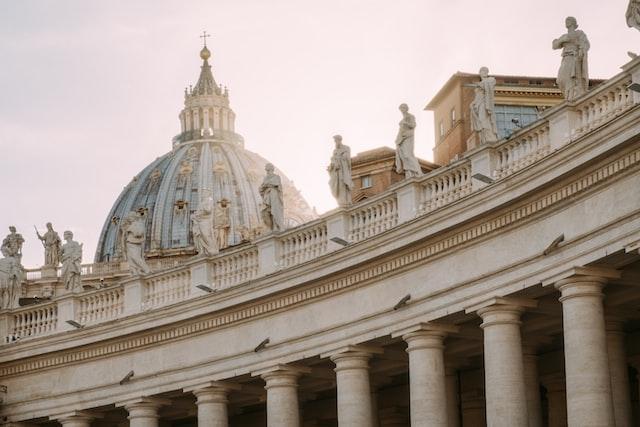
Archbishop Filippo Iannone explains bishop appointments, Church unity, synodality, and challenges facing diocesan leadership today.
Newsroom (17/07/2026 Gaudium Press ) Archbishop Filippo Iannone, Prefect of the Dicastery for Bishops, has offered a detailed look into the Vatican department responsible for overseeing dioceses and preparing episcopal appointments worldwide in his first major interview since Cardinal Robert Francis Prevost was elected Pope Leo XIV.
Speaking with the Croatian weekly Glas Koncila, Iannone addressed the process of selecting bishops, the challenges facing episcopal ministry, the role of synodality, and the Vatican’s ongoing efforts to respond to concerns raised by the faithful. He also revealed that Rome regularly receives letters from Catholics reporting difficulties within their dioceses and acknowledged that an increasing number of priests decline appointments to the episcopate.
Continuing the Direction Established by Cardinal Prevost
A central theme of the interview was continuity. Iannone emphasized that his leadership of the Dicastery for Bishops follows the path established by his predecessor, Cardinal Robert Francis Prevost, who now serves as Pope Leo XIV.
According to the prefect, having succeeded the current Pope in the role has provided a clear framework for the Dicastery’s ongoing work. He noted that Cardinal Prevost shaped the department’s direction during his tenure and that maintaining that course has made the transition smoother. Iannone also disclosed that he regularly meets with Pope Leo XIV to discuss matters related to the Dicastery’s responsibilities.
The close working relationship underscores the significance of the department, which plays a key role in the selection and oversight of bishops throughout the world.
Beyond Episcopal Appointments
While the Dicastery for Bishops is widely known for its role in preparing candidates for episcopal office, Iannone stressed that its responsibilities extend far beyond recommending names to the Pope.
The Dicastery oversees issues related to the establishment, life, and activity of dioceses, as well as the ministry exercised by bishops in their local churches. Its work involves constant collaboration with other Vatican departments and relies heavily on information provided by apostolic nuncios, who possess firsthand knowledge of the realities facing local Churches.
This network of cooperation allows the Vatican to evaluate diocesan situations comprehensively and maintain close contact with Catholic communities across different regions.
Listening to Concerns from the Faithful
In one of the interview’s most revealing observations, Iannone said the Dicastery regularly receives correspondence from lay Catholics who believe serious problems exist within their dioceses.
He explained that these letters are carefully evaluated to determine whether the concerns are justified or the result of misunderstanding. When issues are verified, the Dicastery seeks to intervene appropriately in order to restore peace and stability within the affected community.
Drawing on his previous experience as Prefect of the Dicastery for Legislative Texts, Iannone noted that appeals from the faithful to Rome are not uncommon. Catholics have long turned to Vatican authorities when they believe local decisions may conflict with the universal law of the Church.
His comments highlight the Vatican’s role not only as a governing body but also as a point of recourse for Catholics seeking assistance beyond the diocesan level.
The Qualities Sought in Future Bishops
Asked about the profile of bishops currently being appointed, Iannone indicated that Pope Leo XIV consistently emphasizes pastoral priorities such as evangelization, care for creation, prayer, collaboration, and attention to the poor and marginalized.
However, the prefect reduced the ideal to a more fundamental principle: the bishop must be modeled on Christ the Good Shepherd.
He explained that a bishop’s interior life, openness to others, readiness to work with collaborators, and commitment to serving those most in need remain essential qualities. These characteristics, he suggested, are not merely administrative requirements but foundational elements of authentic pastoral leadership.
Bishops as Guardians of Communion
Another major focus of the interview was the bishop’s responsibility to foster unity within the Church.
Referencing remarks made by Pope Leo XIV to ecclesial movements, Iannone warned against groups seeing themselves as self-contained realities. Instead, he stressed that every movement, association, and community exists as part of the broader diocesan Church and, ultimately, the universal Church.
According to the prefect, diversity within the Church is a source of richness only when it remains connected to communion. When groups become isolated or inward-looking, diversity can become harmful rather than constructive.
For this reason, he described the bishop as the father of the entire diocesan community, responsible for nurturing relationships among different groups and correcting situations that threaten ecclesial unity. The capacity to fulfill this paternal role, he said, remains one of the most important criteria in identifying candidates for the episcopate.
Growing Reluctance to Accept Episcopal Appointments
Iannone also acknowledged a trend that has become increasingly noticeable within the Church: some priests decline appointments as bishops.
While he had previously heard about the phenomenon, he said that he now encounters it directly in his current role.
Rather than attributing these refusals solely to the Church’s abuse crisis, the prefect pointed to broader challenges facing contemporary bishops. He described diocesan leadership as increasingly complex, citing greater administrative responsibilities, declining vocations, and the growing demands associated with overseeing clergy and diocesan life.
His comments challenge any perception of the episcopate as primarily a position of honor. Instead, he portrayed the office as a demanding form of service that places significant personal and pastoral burdens on those who accept it.
Iannone also urged Catholics to view bishops with greater understanding. While legitimate criticism remains appropriate when mistakes occur, he emphasized the importance of supporting bishops through prayer and practical assistance rather than focusing exclusively on criticism.
Rejecting Political Categories
Addressing debates about authority and participation in the Church, Iannone cautioned against interpreting ecclesial life through political frameworks.
He argued that political categories do not adequately reflect the Church’s nature and can lead to misunderstandings about its mission and structures.
At the same time, he reaffirmed the teaching of the Second Vatican Council regarding the responsibility of all baptized Catholics to participate in the Church’s mission. The faithful, he noted, possess both the right and, in certain cases, the duty to express concerns to their pastors through channels provided by canon law.
Synodality as Shared Responsibility
The prefect also offered a concise explanation of synodality, describing it not as a demand or ideological program but as a sense of belonging and shared responsibility within the Church.
In his view, the life of a diocese should not rest solely on the shoulders of the bishop. Rather, all members of the faithful are called to participate actively in the Church’s mission and contribute to its wellbeing.
He suggested that those who are deeply engaged in the life of faith speak with greater authority because their perspectives emerge from within the Church community rather than from an external standpoint.
“In Necessary Things, Unity”
Concluding his reflections, Iannone returned to the relationship between local Churches and the universal Church. Drawing on the teachings of the Second Vatican Council, he stressed that a local Church can only fully realize its identity when it remains in communion with other Churches and with the Successor of Peter.
As a guiding principle, he cited the maxim traditionally attributed to Saint Augustine: “In necessary things, unity; in doubtful things, liberty; in all things, charity.”
For Iannone, this formula provides a lasting framework for balancing respect for local traditions with the Church’s commitment to unity in faith, discipline, and sacramental life, while ensuring that charity remains the foundation of every ecclesial relationship.
- Raju Hasmukh with files from Infovaticana
Related Images:


