






Supreme Court hears petition seeking stronger safeguards against violence targeting Christians and protection of religious freedom rights.
Newsroom (20/07/2026 Gaudium Press ) The Supreme Court of India has taken up a petition seeking stronger measures to prevent violence against Christians and protect their constitutional right to freely profess, practise and propagate their faith. The matter, Most Rev. Peter Machado & Ors. vs. Union of India & Ors., commonly referred to as the “Violence Petition,” was heard on July 15, 2026, by a Bench comprising Justice P. S. Narasimha and Justice Alok Aradhe.
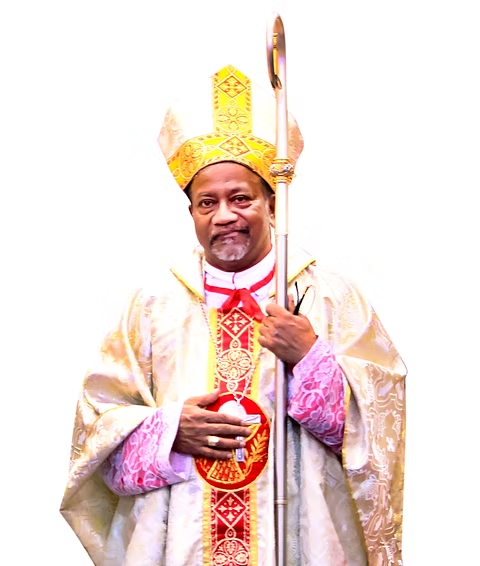
The petition has been filed by Archbishop Peter Machado of Bengaluru and other petitioners, who argue that recurring incidents of intimidation, disruption and violence directed at Christian communities across India require urgent judicial intervention. According to the petition, attacks on Christian prayer meetings, churches and worship gatherings have continued across multiple states, raising concerns about the protection of religious freedom and public order.
Allegations of a Continuing Pattern of Violence
Central to the petition is the claim that violence and disruptions targeting Christians have become a recurring phenomenon, particularly during significant Christian observances and festivals. The petition states that incidents frequently occur during periods such as Christmas, Lent, Good Friday and Easter, when larger numbers of worshippers gather for religious services and prayer meetings.
The petitioners contend that many of these incidents are carried out under the pretext of preventing alleged religious conversions. They argue that peaceful religious gatherings are often interrupted or disrupted based on such allegations, creating an atmosphere of fear and insecurity for Christian communities.
Statistics cited in the petition underscore the scale of the concern. According to the filing, more than 800 incidents of violence against Christians were documented in 2025, while 285 incidents were reported during the first six months of 2026. The petition argues that these figures demonstrate that the issue remains active and persistent rather than isolated or sporadic.
Focus on Narayanpur Displacement Cases
The petition also draws attention to events in Narayanpur district of Chhattisgarh, where violence linked to allegations of religious conversion in 2022 and 2023 reportedly led to the displacement of Christian families.
According to the petition, dozens of Christian families were forced to flee their homes following the unrest. It further alleges that some individuals who were victims of the violence later faced criminal charges themselves, rather than receiving protection from authorities.
The filing highlights the personal and social costs associated with these events, arguing that displacement, uncertainty and prolonged legal proceedings have had lasting consequences for affected families.
Acquittal of 38 Christians
The petition references legal developments involving Christians from the Narayanpur cases. With support from ADF India allied lawyers, 38 Christians were acquitted in February and April 2026 after courts concluded there was no basis for the charges brought against them.
While the acquittals provided relief for those involved, the petition argues that years of legal proceedings and displacement illustrate the broader challenges faced by communities caught up in allegations of religious conversion and related violence.
The petitioners contend that the experience of the acquitted individuals demonstrates the need for stronger safeguards to ensure that victims are not subjected to criminalisation while seeking protection under the law.
Constitutional Concerns Raised Before the Court
At the heart of the case is the argument that targeted attacks on Christians violate fundamental rights guaranteed by the Constitution of India. The petition maintains that such incidents undermine constitutional principles including secularism, fraternity and the rule of law.
The petitioners are seeking a series of measures aimed at preventing future incidents and strengthening accountability mechanisms. Among the reliefs sought are:
- Preventive policing through practical and enforceable court-directed measures.
- Greater accountability for vigilante violence.
- Fair and impartial application of criminal law so that victims are not criminalised.
- Enhanced protection for Christian communities during periods of heightened vulnerability, particularly around major religious festivals and public worship gatherings.
According to the petition, these steps are necessary to ensure that citizens can exercise their constitutional rights without fear of intimidation or violence.
Proceedings Before the Supreme Court
The petitioners were represented by Senior Advocate Colin Gonsalves, along with ADF India allied lawyers. During the July 15 hearing, written argument notes submitted by Gonsalves were placed on record for the Court’s consideration.
After hearing the matter, the Bench observed that additional time was required to examine the issues raised in the petition. The Court subsequently adjourned the proceedings.
The next hearing has been scheduled for August 21, 2026, subject to the matter being listed on that date.
Potential Significance of the Case
The case is being closely watched because of its potential implications for religious freedom and the protection of minority communities in India. Through the petition, the applicants are seeking judicial directions that they believe could strengthen safeguards against religiously motivated violence and ensure accountability where violations occur.
As the matter proceeds, the Supreme Court’s consideration of the issues raised in the petition could have broader significance for how constitutional protections relating to freedom of religion are implemented and enforced across the country. The Court’s next hearing in August is expected to determine how the case advances and whether further directions may be considered.
- Raju Hasmukh with files from Catholic Connect and ADF India
Related Images:


