






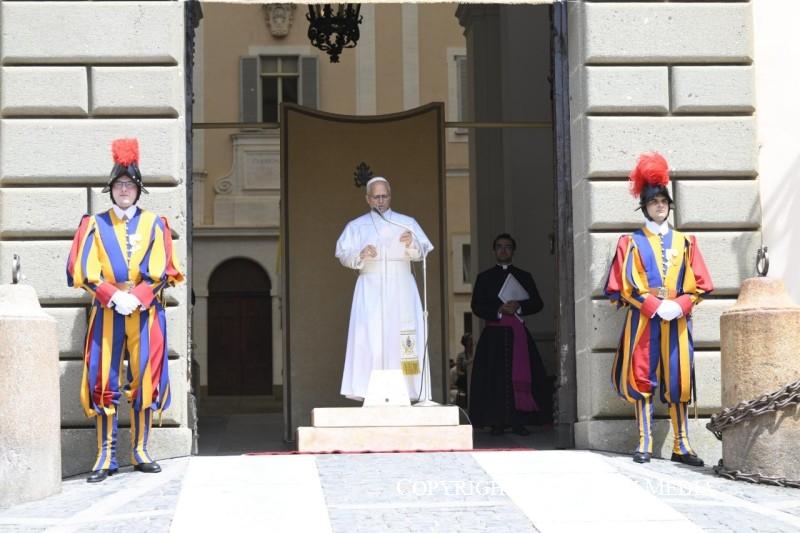
Pope Leo says God’s Kingdom grows through humility, patience and love, urging Christians to trust His hidden work and become Gospel seeds.
Newsroom (20/07/2026 Gaudium Press ) Pope Leo urged Christians to embrace humility, patience and service as the authentic path of discipleship, emphasizing that God’s Kingdom advances quietly through love rather than through displays of power or domination.
Speaking during his Angelus address in Liberty Square (Piazza della Libertà) in Castel Gandolfo, the Pope reflected on Jesus’ parables of the wheat and the weeds, the mustard seed, and the yeast in the dough from the Gospel of Matthew. Through these images, he said, Christ reveals how God acts in human history and within individual lives.
According to Pope Leo, the parables challenge common assumptions about divine power. Rather than presenting God as a force that imposes itself on humanity, Jesus shows a God who chooses “smallness” and works with discretion, allowing people the freedom to accept or reject His presence.
“The Kingdom of God grows quietly,” the Pope explained, noting that God’s love remains active even amid the presence of evil, symbolized by the weeds among the wheat. Like the smallest seed that eventually becomes a flourishing plant, and like yeast that transforms dough without drawing attention to itself, God’s action is often hidden but transformative.
A Challenge to Expectations of Power
Pope Leo acknowledged that many believers expect dramatic interventions from God, particularly in the face of suffering and injustice. People often hope for immediate solutions and decisive victories over evil, he said, imagining a powerful God who acts from above to eliminate wrongdoing instantly.
However, he warned that such expectations can also shape unhealthy attitudes within Christian communities. When believers model their faith on concepts of power, success and dominance, they risk misunderstanding the true nature of the Gospel.
Instead, the Pope called for a deeper spiritual vision capable of recognizing signs of goodness even in difficult circumstances. The Kingdom, he said, spreads “amidst the weeds,” requiring Christians to resist hasty judgments and remain attentive to the quiet growth of grace.
The message highlighted patience as a central Christian virtue. Just as a seed requires time to grow, believers must learn to accompany God’s work without demanding immediate results. The Pope encouraged the faithful to recognize God’s presence in everyday experiences and in the ordinary realities of life.
Faith Amid Apparent Absence
Another key theme of the address was perseverance in faith during moments when God seems distant.
Pope Leo compared God’s action to yeast working invisibly within flour. Although unseen, the process of transformation continues. In the same way, he said, God remains present even when His activity is not immediately evident.
This understanding, the Pope suggested, can free Christians from discouragement. Rather than interpreting challenges, delays or uncertainty as signs of God’s absence, believers are called to trust that divine love is constantly at work and always ready to help.
“God is always with us,” he stressed, underscoring the enduring presence of God’s love in every circumstance.

A Model for Christian Life and the Church
Pope Leo also applied the Gospel’s teaching to both personal discipleship and the broader mission of the Church.
Christians, he said, are called to mirror God’s method of acting by avoiding arrogance, condemnation and coercion. Rather than imposing themselves through force or superiority, they should adopt what he described as a Gospel-centered approach rooted in service and trust.
Referencing remarks made by the then-Cardinal Joseph Ratzinger in 2000, the Pope pointed to the “logic of the seed” as a model for Christian living. This logic, he explained, is not measured by success, influence or greatness. Instead, it is expressed through making oneself small and serving others.
By embracing this attitude, Christians can become “small seeds of the Gospel” and “leavens of love” that gradually transform society from within.
The Pope concluded the catechesis by entrusting the faithful to the intercession of the Blessed Virgin Mary, praising her as one who welcomed the seed of God’s word with humility and openness.
Prayer for Peace and Greetings to Pilgrims
Following the Angelus prayer, Pope Leo extended greetings and thanks to the residents of Castel Gandolfo while welcoming pilgrims from around the world during his period of summer rest.
He also renewed his concern for regions affected by war and violence, calling on the faithful not to forget those who continue to suffer and die in ongoing conflicts. Alongside prayers, he encouraged continued efforts aimed at achieving peace.
The Pope greeted numerous groups present for the occasion, including Mother Elvira’s Cenacolo Community gathered in Saluzzo for the Festival of Life, participants in the Focolari Movement’s International School, Mexican students attending the APRA Summer School, and members of the Catholic Worldview Fellowship.
Additional greetings were extended to young adults from Regnum Christi participating in an International Formators Course, pilgrims involved in “The Lion Pilgrimage” accompanied by Auxiliary Bishop Anthony Percy of Sydney, families and children assisted by the Sisters of Charity of the Assumption of Rome, young people from the Holy Savior parish in Jerusalem, a children’s group from Saint Augustine parish in Bovolenta, and pilgrims from the Liturgical Academy of Rzeszów.
Concluding the gathering, Pope Leo wished all those present “a peaceful Sunday,” reinforcing a message centered on trust, hope and confidence in God’s quiet but enduring work in the world.
- Raju Hasmukh with files from Vatican News
Related Images:


