






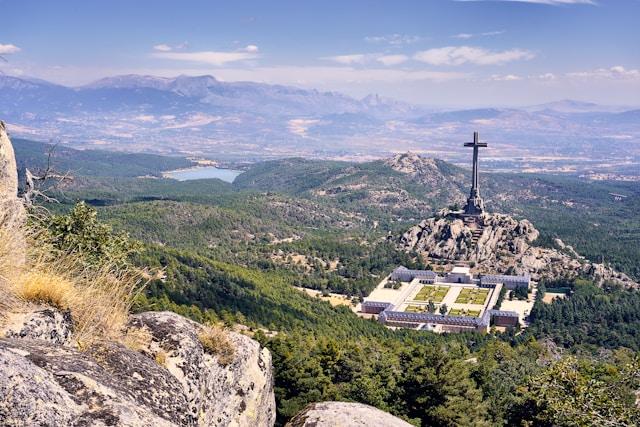
Professor Ramón de Meer warns Spain may seek Vatican approval to intervene in Valley basilica, raising legal, canonical, and religious concerns.
Newsroom (27/05/2026 Gaudium Press ) As Spanish Prime Minister Pedro Sánchez meets Pope Leo XIV today in a private Vatican audience—his first direct engagement with the pontiff since the beginning of the new papacy—controversy is mounting over what may unfold behind closed doors. While the official agenda includes global issues such as immigration, artificial intelligence, and ongoing conflicts in Ukraine and the Middle East, legal scholar Ramón de Meer warns that another matter could dominate discussions: the Spanish government’s contested plans to intervene in the Basilica of the Holy Cross at the Valley of the Fallen.
In an extensive interview, De Meer—a jurist and professor of Philosophy of Law, Theology, and Ancient and Medieval History—argues that the government may attempt to secure Vatican endorsement for a controversial reinterpretation project that critics say would alter the religious character of the basilica. The project is already facing nine legal challenges.
A Strategy of “Performative Communication”
De Meer describes what he calls a “performative communication strategy” by the Spanish executive—one designed to present an agreement with the Holy See as already in place or nearly finalized, despite the absence of any formal endorsement. According to the Spanish Episcopal Conference (CEE), no such agreement has been signed by Vatican representatives.
The controversy traces back to a document published in March 2025, signed by Cardinal José Cobo, Archbishop of Madrid, and Minister Félix Bolaños. While the government later minimized Cobo’s role to that of a “mere mediator,” it simultaneously maintained that a direct agreement with the Holy See existed. Bolaños reinforced this claim in a subsequent television interview.
For De Meer, this dual messaging reflects an attempt to establish a sense of inevitability. “It contributes to generating a perception that the outcome is settled,” he said, framing it as a classic “fait accompli” approach—setting political and media expectations before formal authorization is secured.
Legal and Canonical Obstacles
At the core of the dispute lies a fundamental question: can the state intervene in a consecrated place of worship without violating canonical and constitutional protections? De Meer argues the answer is clearly no.
He points to two major legal barriers. First, the Code of Canon Law, which strictly governs the use and protection of sacred spaces. Second, Spain’s constitutional guarantee of religious freedom, reinforced by agreements between the state and the Holy See that recognize the inviolability of places of worship.
These concerns have also been raised publicly by the Benedictine monks who oversee the basilica. In a recent statement, they emphasized both legal protections and their willingness to negotiate a mutually acceptable solution. However, according to De Meer, the government has shown little inclination to engage directly with them.
“The issue should never have left the sphere of dialogue between the monks and the relevant authorities,” he said, adding that elevating it to the level of a papal audience is both unprecedented and deeply problematic.
The Role of Church Leadership
A significant aspect of the controversy centers on the actions of Cardinals Cobo and Pietro Parolin, the Vatican’s Secretary of State. According to De Meer, these two figures—who would likely brief the Pope ahead of Sánchez’s visit—have played a decisive role in advancing the government’s position.
Cobo, in particular, has publicly defended the reinterpretation project, asserting that it does not affect the basilica’s sacred character. This claim appears to contradict both government planning documents and earlier statements from church officials, including the Archdiocese of Madrid’s own liturgical delegate, who had warned that intervention inside the basilica was impermissible.
De Meer suggests that Cobo’s earlier agreement with the government effectively redefined parts of the basilica—such as the atrium, nave, and dome—as non-liturgical areas, thereby opening the door to their repurposing. This, he argues, runs counter to canonical norms and raises serious theological and legal questions.
As for Cardinal Parolin, his role remains less clear. While he has not made public statements, De Meer notes that Cobo has claimed the Secretary of State was involved from the outset. This has fueled concerns that the Pope may be receiving partial or biased information prior to his meeting with Sánchez.
Fear of Misinformation at the Highest Level
Perhaps the most striking aspect of De Meer’s analysis is his suggestion that the Holy Father may not be fully informed about the true scope of the government’s plans.
“The decisive question is who has informed, or could inform, the Pope,” he said. If the briefings emphasize assurances that the basilica will remain unaffected, the pontiff could be led to approve a proposal that, in practice, alters its sacred character.
Such a scenario, De Meer warns, would create a profound contradiction between papal authority and canon law. He finds it difficult to imagine that Pope Leo XIV would knowingly endorse any measure that compromises the sanctity of a consecrated temple, given his emphasis on legal integrity and procedural respect.
What Happens Next?
Even if Sánchez were to leave Rome claiming papal support, De Meer insists that the legal battle would be far from over. The monks retain standing to challenge any intervention, and both canonical and civil legal avenues remain available.
In the event of formal Vatican authorization, the monks could appeal directly to the Pope or pursue hierarchical recourse within the Church’s judicial system, potentially reaching the Apostolic Signatura, the Vatican’s highest court.
The faithful themselves also have rights under Spanish law. Should the project impact the basilica’s religious use, individuals and communities could invoke constitutional protections of religious freedom.
A Broader Conflict
Beyond legal technicalities, De Meer frames the dispute as part of a broader pattern of political polarization. He criticizes the government’s approach as ideologically driven and warns against turning a sacred space into a battleground for historical reinterpretation.
“This is not primarily a political controversy,” he said. “It is about preserving the sanctity of a temple with wisdom, justice, and respect.”
For now, all eyes are on Rome. The outcome of Sánchez’s meeting with Pope Leo XIV could determine not only the future of the Valley basilica but also the balance of power between state authority and religious autonomy in Spain.
Whether this moment leads to resolution or escalation remains to be seen—but as De Meer cautions, the stakes could hardly be higher.
- Raju Hasmukh with files from INfocatholica
Related Images:


