






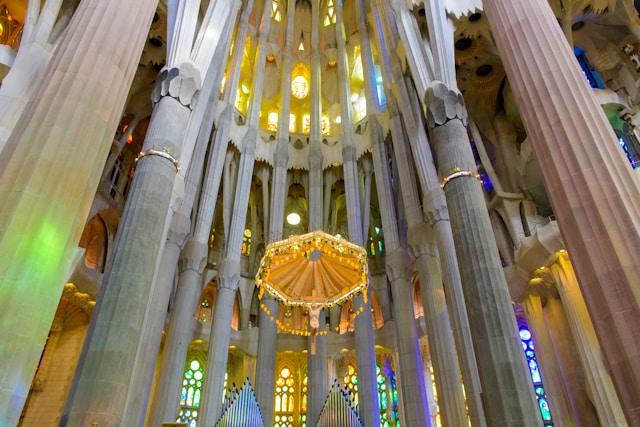
Explore how Dom Guéranger’s liturgical vision shaped Gaudí’s Sagrada Familia, transforming it into a profound catechism in stone.
Newsroom (09/06/2026 Gaudium Press )The upcoming visit of Pope Leo XIV to Barcelona, where he will inaugurate and bless the spire of Jesus Christ at the Sagrada Familia, draws renewed attention to a fundamental truth: the famed basilica is far more than a global tourist landmark. It stands as a monumental catechism in stone—a theological and liturgical vision rendered through architecture.
While Antoni Gaudí’s artistic genius is universally recognized, the spiritual sources that shaped his work remain less widely understood. According to Father Francesc Xavier Vila Morera, who is completing a doctorate on Gaudí, the Sagrada Familia is not merely inspired by faith but is a “masterful explanation of the liturgy,” effectively embodying the Liturgical Year in physical form.
Central to this vision is the profound influence of Dom Prosper Guéranger, the 19th-century Benedictine monk whose liturgical revival movement reshaped Catholic spirituality. Today, scholars such as Father Francesc Xavier assert that the connection is undeniable: spiritually speaking, the Sagrada Familia can be considered a “daughter” of Dom Guéranger.
Dom Guéranger’s Break with Individualism
To understand this connection, one must first grasp the religious landscape of the 19th century. At the time, Christian practice was largely dominated by individualistic piety, influenced by earlier traditions like the Devotio Moderna. Prayer was often experienced as a private, subjective act, while the Church’s official liturgy was seen as distant—merely a ritualistic spectacle detached from personal devotion.
Dom Guéranger challenged this paradigm. Rejecting the divide between personal prayer and communal worship, he championed a reintegration of the faithful into the liturgical life of the Church. His mission was clear: the liturgy should not be peripheral but central, becoming the primary and indispensable source of Christian life.
In doing so, he invited the laity to rediscover participation in the liturgy as both a communal and transformative experience. His work marked a decisive break with the individualism of his era, laying the groundwork for a renewed understanding of faith as something lived collectively through sacred rites.
“The Liturgical Year”: A European Phenomenon
Guéranger’s vision found its definitive expression in his monumental work, The Liturgical Year, published between 1841 and 1866. Spanning 15 volumes—six of which were completed by his disciple Dom Lucien Fromage—the series offered a daily engagement with the Church’s liturgical texts, guiding readers through the rhythms of the Christian calendar.
The impact of this work was extraordinary. Within sixty years, nearly 500,000 copies were sold in France alone. It was translated into numerous European languages, including Spanish, Latin, English, and German, becoming a foundational reference for Catholic spirituality well into the mid-20th century.
This success was not merely literary. At a time when rationalism and localized practices such as Gallicanism and Jansenism had fragmented liturgical unity—leading some dioceses to create their own missals stripped of symbolic richness—Guéranger advocated a return to the universal Roman Rite. He emphasized that the Church could not be understood apart from its liturgy, restoring a sense of mystery, coherence, and theological depth to worship.
The Bridge from Solesmes to Gaudí
The transmission of Guéranger’s ideas to Gaudí occurred through a vital intermediary: Monsignor Joan Baptista Grau i Vallespinós, Bishop of Astorga and a native of Reus, like Gaudí himself. Between 1889 and 1892, Grau mentored the architect, introducing him to sacred symbolism and, crucially, to The Liturgical Year.
The influence on Gaudí was transformative. Far from embracing a superficial or sentimental religiosity, he immersed himself deeply in Guéranger’s writings. The text became his constant companion—his “bedside book.” Mossèn Gil Parés, the first chaplain of the Sagrada Familia, recalled seeing Gaudí frequently kneeling in prayer in the crypt, holding liturgical texts. The volumes of Guéranger, worn from extensive use, testified to his devotion.
This intellectual and spiritual engagement shaped Gaudí’s entire architectural vision, embedding liturgical theology into every stone of the basilica.
The Apocalypse in Architecture
A shared fascination with the Book of Revelation crystallized the connection between Guéranger and Gaudí. For Guéranger, the Apocalypse represented the model of heavenly liturgy, illustrating how earthly Mass reflects the eternal worship of angels.
Gaudí translated this theology into architecture. As theologian Armand Puig explains, the Sagrada Familia is conceived as the New Jerusalem described in Revelation. Nowhere is this more vividly expressed than in the Glory façade.
This monumental structure narrates the history of salvation through a vertical progression. At its base lie earthly realities: human labor, biblical covenants, and the material world. Ascending upward, one encounters the purification of Purgatory. At the summit, eternal glory unfolds—Christ surrounded by saints and angels, capped by representations of the Holy Spirit and the Heavenly Father. The design mirrors the celestial vision described in the Apocalypse, embodying a theology of ascent and redemption.
A Living Legacy
The influence of Dom Guéranger extends far beyond Gaudí and the Sagrada Familia. Today, his enduring significance is recognized by the Church, with his Cause for Canonization officially underway. Many specialists believe that he may one day be declared a “Doctor of the Praying Church” for his profound contributions to liturgical life.
Efforts to promote his canonization also highlight his broader virtues and achievements, ensuring that his legacy continues to inspire new generations.
Conclusion: Faith Shaped by Liturgy
Long before the Second Vatican Council sought to deepen lay participation in liturgy, Dom Guéranger had already articulated its necessity. His work, echoed in Gaudí’s bold architectural vision, reminds modern Christians that faith is not an isolated experience. It is formed, nourished, and measured through the beauty and rhythm of communal prayer.
This insight is captured in the ancient adage: Lex orandi, lex credendi—the law of prayer is the law of belief.
As visitors gaze upon the soaring spires of the Sagrada Familia, they encounter more than a masterpiece of art. They are invited to enter a living liturgy and to shape their own lives according to its sacred measure.
- Raju Hasmukh with files from Zenit News
Related Images:


