






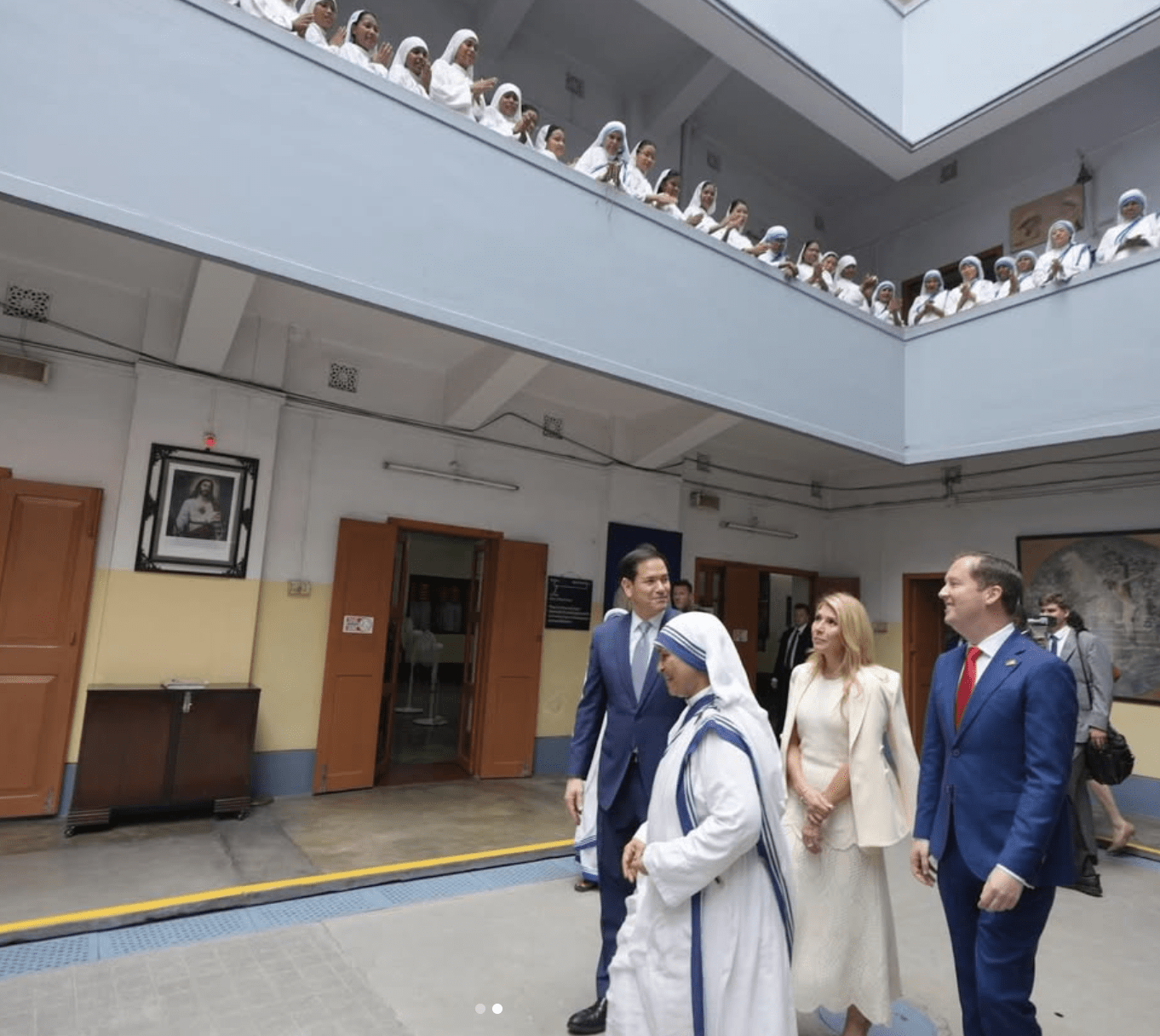
US Secretary Marco Rubio’s Kolkata visit to Mother Teresa’s mission raises debate on religious freedom, diplomacy, and India’s FCRA policies.
Newsroom (25/05/2026 Gaudium Press ) US Secretary of State Marco Rubio’s recent visit to the headquarters of Mother Teresa’s Missionaries of Charity in Kolkata has triggered a wave of reactions across India’s religious and political landscape, highlighting the complex intersection of faith, diplomacy, and domestic policy.
Rubio, a practicing Catholic, toured the Mother Teresa House and the Nirmala Shishu Bhawan on May 23, accompanied by his wife Jeanette and US Ambassador to India Sergio Gor. During the two-hour visit, he interacted with members of the congregation and observed their work caring for the elderly, destitute, and vulnerable children. He described Mother Teresa’s legacy as a “living example of the Catholic faith in action,” acknowledging both her enduring influence and the continuing role of the Missionaries of Charity.
Church leaders in Kolkata welcomed the visit as both symbolic and potentially consequential. Father Dominic Gomes, chancellor of the Archdiocese of Calcutta, described Rubio’s participation in a private Mass at the congregation’s headquarters as a powerful testimony of faith. He emphasized that the visit could deliver “a strong message on religious freedom,” reinforcing the importance of protecting faith-based institutions.
Beyond its religious significance, the visit has been interpreted by some Christian leaders as carrying political implications. Community figures suggested it may signal encouragement for India’s government to reconsider proposed amendments to the Foreign Contribution Regulation Act (FCRA), legislation governing foreign funding for non-governmental organizations.
The sensitivity surrounding FCRA is rooted in past events. Gomes recalled that in December 2021, India’s Ministry of Home Affairs declined to renew the Missionaries of Charity’s FCRA license, citing unspecified concerns. The decision temporarily cut off foreign funding, affecting hundreds of the organization’s shelters and clinics, before being reversed within weeks following strong domestic and international criticism.
For some observers, Rubio’s choice to spend significant time in Kolkata rather than focusing solely on diplomatic engagements in New Delhi carries added weight. Father Dominic Emmanuel, former spokesperson for the Catholic Bishops’ Conference of India, said the visit was “not just a flying visit” but an action that would resonate strongly within India’s political establishment, particularly the ruling Bharatiya Janata Party (BJP) and its ideological affiliate, the Rashtriya Swayamsevak Sangh (RSS).
Emmanuel framed the visit as a form of reassurance for India’s Christian minority, who make up about 2.3 percent of the population. He argued that the presence of a senior US official signaled recognition of concerns among Christians about restrictions and regulatory pressures they face.
These concerns have also been echoed internationally. A May 21 commentary by US Congressman Chris Smith urged Rubio to engage Indian officials on withdrawing the proposed FCRA amendments. Smith warned that such changes could restrict faith-based organizations and even lead to fears of asset nationalization. He also criticized earlier remarks by RSS chief Mohan Bhagwat, who had questioned the motivations behind Mother Teresa’s charitable work.
However, not all reactions have been favorable or optimistic. John Dayal, spokesman for the All-India Catholic Union, expressed skepticism that discussions between Rubio and Indian Prime Minister Narendra Modi addressed issues affecting Christians. He noted that some had hoped Rubio would raise concerns about FCRA amendments and the revocation of NGO licenses, but those expectations appeared unmet.
A senior Church official in New Delhi similarly suggested that the United States’ strategic priorities—particularly trade, defense cooperation, and broader geopolitical alignment—remain dominant in its engagement with India. In this reading, religious freedom concerns may not take precedence in bilateral discussions.
Meanwhile, voices aligned with Hindu nationalist perspectives have interpreted Rubio’s visit quite differently. The RSS-affiliated publication The Organizer described the trip as more than a gesture of personal faith or diplomatic courtesy. In its May 23 commentary, it argued that the visit occurred amid “politically charged” circumstances, including ongoing scrutiny of foreign-funded missionary activities and international criticism of India’s religious freedom record.
The publication framed the visit as part of a broader pattern of external pressure tied to proposed FCRA amendments and what it characterized as “Evangelical” influence on global discourse about India.
The Indian government, for its part, has defended the proposed FCRA amendments as measures aimed at ensuring transparency and proper use of foreign donations. Introduced in Parliament in March, the bill has been temporarily shelved but is expected to return for debate in an upcoming session.
In a country where religious identity intersects closely with politics and policy, Rubio’s Kolkata visit has underscored enduring tensions. To some, it represents solidarity and advocacy for religious freedom; to others, it reflects external interference or geopolitical signaling.
As India navigates its domestic legislative agenda and its evolving global partnerships, the reactions to this visit reveal the delicate balance between sovereignty, diplomacy, and the protection of minority rights.
- Raju Hasmukh with files from UCA News
Related Images:


