






Leo XIV’s Spain trip blended faith, migrants, beauty, and politics, revealing the priorities of his new papacy and vision for Europe.
Newsroom (16/06/2026 Gaudium Press ) The first apostolic journey of Leo XIV to Spain, carried out between June 6 and 12, 2026, was much more than a pastoral visit. At first glance, it was a traditional schedule: meetings with civil authorities, liturgical celebrations, visits to social works, and contact with the faithful. But, seen in depth, the trip revealed the central axes of the new pontificate and offered a kind of programmatic manifesto for the Church under Leo XIV.
The question Andrea Gagliarducci raised in his analysis for the Monday Vatican editorial ecosystem is precisely this: why Spain? The choice was not casual. Historically, Spain represents a synthesis of the tensions that today challenge the Church in Europe: accelerated secularization, political polarization, demographic crisis, mass immigration, deep Catholic memory, and, at the same time, growing religious distance. To begin there means speaking not only to the Spanish, but to all of Europe.
Spain as a laboratory of Europe
From his arrival in Madrid, Leo XIV insisted on a recurring theme: overcoming polarization. In a country divided by ideological disputes, regional nationalisms, and cultural tensions, the Pope asked leaders to abandon the logic of permanent confrontation. He spoke against the “feeding of the flames of polarization” and presented reconciliation as a social and spiritual necessity.
This language recalls Francis’s style, but with an important difference. While Francis usually emphasized social processes, Leo XIV seeks to associate reconciliation with a more explicit vision of moral truth and Christian identity. In other words, he seeks unity, but without relativizing doctrinal foundations.
According to analyses published by the American site Crux Now, this combination of social continuity and greater doctrinal clarity is becoming a hallmark of the new pontificate. The Pope seeks to build bridges, but does not seem willing to do so at the expense of Catholic identity.
The address to Parliament: the key moment

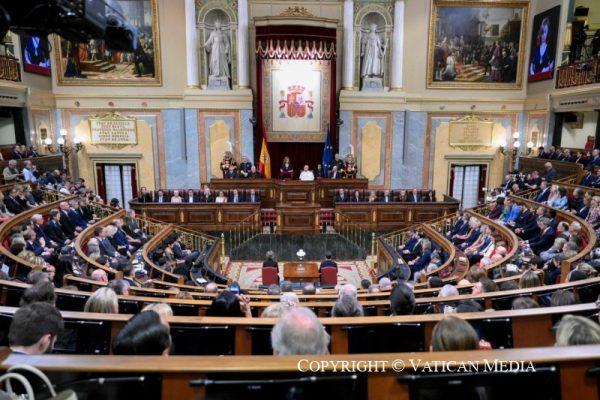
The most politically relevant point of the trip took place in Madrid, when Leo XIV became the first Pope to speak before the Spanish Parliament. There he presented a synthesis of his vision for contemporary society.
The Pope simultaneously addressed themes that are usually appropriated by opposite ideological camps. He defended the dignity of migrants, called for international solidarity, spoke of the need for welcome and the fight against social exclusion. But he also reaffirmed the protection of human life, religious freedom, and the centrality of the dignity of the person from conception.
This ability to escape conventional political categories may be one of the most interesting characteristics of Leo XIV. He seems interested in recovering what Benedict XVI called a “integral vision of the human person,” rejecting both secular progressivism and identity nationalisms.
Barcelona and the message of beauty
If Madrid represented the political dimension of the trip, Barcelona revealed its cultural and evangelizing dimension.
The culminating moment was the Mass at the Basilica of the Sagrada Família, during the celebrations of the centenary of the death of Antoni Gaudí and the inauguration of the Tower of Jesus Christ. Before more than one hundred thousand people, Leo XIV presented Gaudí’s work as a form of evangelization through beauty.
The message was not merely artistic. Vatican News highlighted that the Pope sought to show how faith can dialogue with contemporary culture without losing its identity. The Sagrada Família appeared as a symbol of a Church capable of speaking to modern man through art, transcendence, and beauty.
In this regard, the trip closely resembles the strategy of Saint John Paul II and Benedict XVI, for whom beauty was a privileged path for evangelization.
The theme of migrants: the heart of the trip
However, the true emotional center of the visit was not in Madrid or Barcelona, but in the Canary Islands.

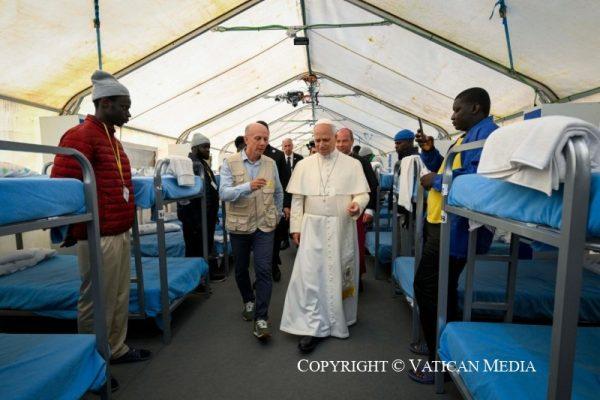
By including Gran Canaria and Tenerife in the itinerary, Leo XIV placed the migration issue at the center of his message. The Canaries have become one of the main entry points for migrants coming from Africa and represent one of the great humanitarian challenges of present-day Europe.
The Pope met with welcome organizations, visited migrant centers, and celebrated Masses in which he repeatedly insisted on the dignity of those who leave their homeland in search of safety and hope.
Andrea Tornielli, editorial director of Vatican News, summarized the logic of the trip by saying that it combined two great axes: evangelization and closeness to migrants. It was not just a matter of defending public policies, but of recalling an essential dimension of Christian anthropology: every person has inviolable dignity.
Pope Leo XIV coined a phrase of strong impact during his stay on the island: “Dignity has no passport.” The expression quickly became the symbolic mark of the visit. He then repeated a gesture deeply associated with Francis’s pontificate: he cast a wreath into the sea in memory of migrants who died trying to cross the Mediterranean in search of safety, work, and a more dignified life.
A synthesis between Francis and Benedict XVI?
Perhaps the most widespread interpretation after the trip was that Leo XIV is building a synthesis between the two previous pontificates.
Several observers noted that his social concerns — especially about migration, poverty, and exclusion — strongly recall Francis. At the same time, his theological language, his valuing of tradition, and his insistence on doctrinal foundations recall Benedict XVI.
The site The Pillar noted in recent months that the new Pope seems interested in reducing internal polarizations within the Church. Instead of governing through symbolic ruptures, he seeks to emphasize institutional continuity and stability. The trip to Spain reinforced this perception.
The result is a figure who does not fit easily into the labels of “progressive” or “conservative.” His project seems to be the restoration of ecclesial unity based simultaneously on social charity and doctrinal clarity.
The strategic meaning of the trip
What, after all, did Leo XIV go to Spain to do?
To reaffirm that the Church does not intend to abandon secularized Europe.
To remind people that evangelization remains possible in post-Christian societies.
To show that the migration issue is not merely a political problem, but a moral one.
To propose an alternative to the ideological polarization that dominates much of the West.
And to signal the profile of his own pontificate.
The choice of Spain condensed all these elements. Madrid represented politics; Barcelona, culture; the Canary Islands, the human periphery. Together, these three stages drew a map of Leo XIV’s governing program.
For this reason, the trip should not be read only as a pastoral visit. It was a strategic act. As suggested by the analyses of Andrea Gagliarducci, Crux, Vatican News, and other Vatican observers, Spain functioned as a stage where the new Pope presented his vision for the Church and for 21st-century Europe.
The answer, therefore, is simple: Leo XIV went to Spain to show who he is as Pope. And in doing so, he offered the first clear outlines of what his pontificate may become.
- By Rafael Ribeiro – Gaudium Press
Related Images:


