






When Marco Rubio handed Pope Leo XIV a crystal football and the pontiff responded with three syllables and a polite smile, something essential about the state of American diplomacy was caught on camera.
Newsroom (07/05/2026 Gaudium Press ) This morning at the Apostolic Palace in Vatican City, Secretary of State Marco Rubio handed Pope Leo XIV a crystal football paperweight bearing the seal of the United States Department of State — the same crystal football, by all accounts, that he gives every world leader he meets. The pope looked at it. Then, on camera, he paused.
“Wow,” he said. “Okay!”
Three syllables. Delivered live. No diplomatic readout could approximate them. That small, gracious, slightly bewildered utterance — “Wow. Okay.” — is, in many ways, the entire story of this morning’s Vatican audience.

The Language of Olive Wood
After the football was produced, Pope Leo had made his own offering with considerable deliberation. He presented Rubio with a pen carved from olive wood and a book of sacred art — objects chosen, it was clear, with theological intent. As he handed them over, the pope explained: “Olive is the plant of peace.”
The symbolism requires no decoding. The olive tree is among the most weighted images in the Christian tradition: the Garden of Gethsemane, where Christ prayed before his arrest, stood on the Mount of Olives. Catholic social teaching — running from the Hebrew prophets through Pope John XXIII’s 1963 encyclical Pacem in Terris — has returned to the olive branch again and again as the language of reconciliation and the refusal of war.
The gift Pope Leo handed Rubio was a teaching as much as an object — written in the wood of an olive tree, accompanied by sacred art the Vatican uses to instruct visitors to seek peace.
Pope Leo XIV, the moral leader of 1.4 billion Catholics, chose these objects deliberately. He chose them while watching an American administration drop ordnance on Iranian civilians. Then he placed them in the hands of the American Secretary of State.
Rubio handed back a crystal football.
A Trinket for the World’s Leaders
Rubio, to his credit, acknowledged the mismatch in real time. “You’re a baseball guy,” he told the pope — Pope Leo XIV is famously a Chicago White Sox fan — “but it has the seal of the State Department.” He then offered this explanation for his gift selection: “What do you get someone who has everything?”
Why Rubio Was Sent to Rome
In March 2026, Pope Leo XIV publicly condemned the U.S. bombing of Iran as “a scandal for humanity.” The denunciation landed as a direct rebuke of the Trump administration at a moment when relations between Washington and the Holy See were already strained.
President Trump subsequently accused the Holy Father on Hugh Hewitt’s radio program of wanting Iran armed with nuclear weapons. Two days before the Vatican audience, Trump repeated the smear, claiming the pope was “endangering a lot of Catholics.” Vice President JD Vance, who has carried the rebukes of two popes, had spent eighteen months suggesting to media outlets that the American bishops are corrupt.
Cardinal Pietro Parolin, the Vatican’s chief diplomat, described the campaign as “a bit strange.” It was the breach Rubio was dispatched to repair.
The man who “has everything,” the answer to Rubio’s rhetorical question, is the spiritual leader of more than a billion people — a man who, weeks before this meeting, demanded that the bombing of Iran stop, called it a scandal against humanity, and watched it continue. What he wants is not difficult to identify. He said so.
Rome’s Formula for a Failed Meeting
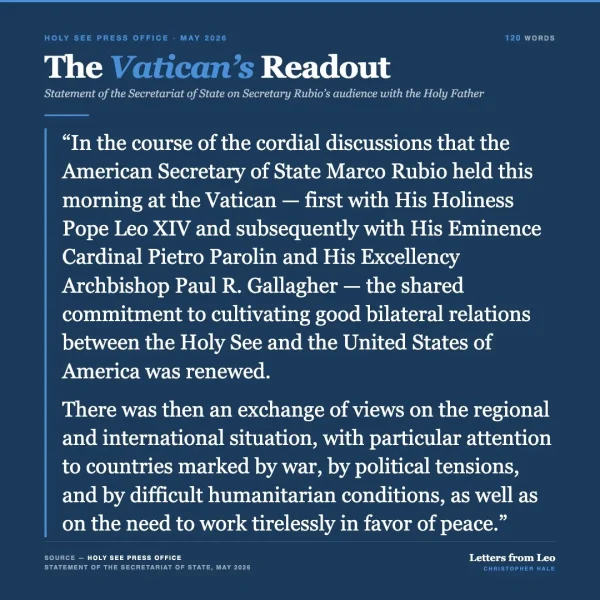
The diplomatic record matched what the cameras had already captured. The Vatican’s official readout of the meeting ran to 120 words and described what passed between Pope Leo and Rubio as an “exchange of views” — the formula Rome reaches for when a meeting has failed to find common ground.

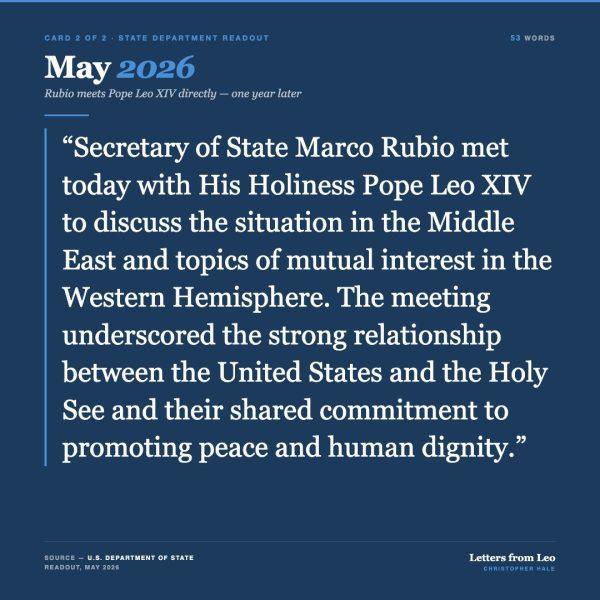
The State Department’s readout was shorter still: 53 words. The Middle East received a single sentence; “topics of mutual interest in the Western Hemisphere” received a phrase. There was nothing else to say.

There is a thing Rome does when an American visitor hands the Holy See something unserious. The pope smiles politely, says nothing of substance, and moves on. That is precisely what the world watched this morning.
The Vatican’s “exchange of views” — Rome’s diplomatic formula for a meeting that found no common ground — told the fuller story that neither readout would.
Rubio’s One Job
Until today, the political damage with the Vatican was principally the administration’s problem — Trump’s for ordering the bombing and then smearing the pope on talk radio; Vance’s for his protracted war with the American bishops. Marco Rubio could plausibly present himself as the steadying force: the practicing Catholic in the cabinet, the man who could walk into the Apostolic Palace and quietly reset the relationship, who could make the administration’s case with visible seriousness and appropriate humility.
He brought a football.
The bombing of Iran has not stopped. Trump continues his attacks on the Holy Father in the media. The crystal paperweight now sits on the Vatican’s gift table, alongside the war that the administration traveled to Rome hoping the pope would bless. Pope Leo kept them both.
The olive-wood pen will end up somewhere in the corridors of the State Department’s seventh floor at Foggy Bottom. Both objects — the pen and the football — now belong to Marco Rubio to carry, along with the diplomatic failure they represent.
This is, at its core, a story about a man who was sent to do something serious and did not understand why it was serious. The most gracious pontiff in recent memory gave the American Secretary of State every possible opening. He offered olive wood and sacred art. He spoke of peace. He paused, and waited.
And for those watching, the defining moment of the meeting was not found in official statements or policy language, but in a brief, unscripted reaction.
“Wow. Okay.”
- Raju Hasmukh with files from Letters from Leo
Related Images:


