





















Pope Leo XIV calls for AI to serve truth and the common good, urging communicators to uphold human dignity and responsibility.
Newsroom (29/07/2026 Gaudium Press ) Pope Leo XIV has called on communicators to ensure that artificial intelligence and other technological tools remain firmly “at the service of truth and the common good,” highlighting the need for ethical responsibility as the Church continues to reflect on the profound opportunities and challenges presented by emerging technologies.
The Pope’s message, signed by Cardinal Secretary of State Pietro Parolin, was addressed to participants attending the Seventh International Seminar on Church Communication, held on 27-28 July at the Pontifical Catholic University of Chile in Santiago. The gathering brought together communicators, pastoral workers, academics, and Church representatives from across Latin America and the Caribbean.
Under the theme The Challenges of Artificial Intelligence, the seminar focused on the ethical, cultural, and religious implications of AI, drawing inspiration from Pope Leo XIV’s encyclical Magnifica humanitas. Discussions explored how the Church can engage with rapidly advancing technologies while safeguarding the dignity of the human person and strengthening its mission in the digital age.
Wisdom and Responsibility in the Age of AI
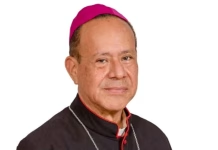
In his message to Archbishop René Osvaldo Rebolledo Salinas, President of the Chilean Bishops’ Conference, Pope Leo XIV expressed hope that participants would advance a model of communication capable of meeting contemporary technological challenges without compromising essential human values.
He encouraged communicators to embrace the opportunities created by technological development while ensuring that every tool is directed toward the promotion of truth and the common good. The Pope emphasized that innovation must remain rooted in respect for human dignity rather than becoming an end in itself.
Entrusting the seminar to the guidance of the Holy Spirit, he also prayed that participants would approach the challenges posed by artificial intelligence with “wisdom and responsibility.” Such an approach, he said, would enable ecclesial communication to foster meaningful encounters between people and contribute more effectively to the proclamation of the Gospel.
Social Media as Human Spaces
Opening the seminar, Cardinal Fernando Natalio Chomalí Garib, Archbishop of Santiago de Chile, reflected on the growing influence of social media and digital platforms in contemporary life.
Rather than viewing social networks purely as technological systems, he described them as deeply human spaces that mirror the emotions, relationships, and conflicts experienced in everyday life.
“Everything that happens to us also happens there,” the Cardinal observed, underscoring the importance of approaching digital communication with a strong ethical foundation.
To guide communication in this environment, Cardinal Chomalí proposed four essential criteria: truth, goodness, beauty, and usefulness. These principles, he suggested, provide a framework for responsible engagement in digital media and for navigating the complexities introduced by artificial intelligence.
Human Dignity at the Center
Cardinal Chomalí stressed that Magnifica humanitas should not be interpreted solely as a reflection on technology. Although artificial intelligence remains a central theme, he argued that the encyclical’s primary concern is the protection of human dignity and the pursuit of truth.
According to the Archbishop, contemporary discussions often focus heavily on technological capabilities while overlooking their impact on the human person. He suggested that the Church’s response to AI must therefore remain grounded in an understanding of the intrinsic value of every individual.
This emphasis on human dignity was echoed throughout the seminar, reinforcing the idea that technological advancement should always serve humanity rather than redefine it.
Building “Jerusalem, Not Babel”
Cardinal Chomalí linked ethical communication directly to the strengthening of community life, particularly in societies increasingly marked by individualism and social fragmentation.
Communication rooted in truth, goodness, beauty, and usefulness, he said, has the potential to encourage dialogue and fraternity. Such an approach can help build stronger relationships and foster greater social cohesion.
Reflecting on the wider implications of communication in the age of AI, he argued that responsible engagement can contribute to a more united society. “We will promote dialogue, we will promote fraternity; in the end, we will build Jerusalem, not Babel,” he said.
The same themes emerged during the Eucharistic celebration that followed the opening session. In his homily, Cardinal Chomalí described Magnifica humanitas as a “Christological” encyclical and called for communication marked by discernment. He also reiterated his hope that artificial intelligence would always remain at the service of human dignity.
A Shared Journey for the Church
Other speakers on the seminar’s opening day included Juan Carlos de la Llera, Rector of the Pontifical Catholic University of Chile, and Archbishop Rebolledo Salinas.
Archbishop Rebolledo characterized the gathering as a tangible expression of synodality and the Church’s commitment to a shared journey of reflection and discernment. He noted that the publication of Magnifica humanitas has added new depth to the Church’s pastoral consideration of emerging technologies.
For the Archbishop, the central principle guiding both technological development and scientific progress must remain unchanged.
“The inviolable dignity of the human person must constitute the principle, the criterion and the ultimate goal of both technological development and scientific progress,” he said.
As Church leaders, academics, and communication professionals continue their discussions, the seminar’s message remains clear: artificial intelligence presents significant possibilities, but its development and use must always be guided by truth, responsibility, and an unwavering commitment to human dignity.
- Raju Hasmukh with files from Vatican News