

















St. Thomas Aquinas tells us that the Eucharist, rather than transforming Christ into our substance, He transforms us into His.
Editorial Staff (28/07/2026, Gaudium Press) One hundred years ago, precisely in 1925, Pius XI canonized St. Thérèse of the Child Jesus, whom he called “the star of his pontificate.” And thirty years ago, in 1997, on the centenary of the saint’s death, John Paul II declared her a Doctor of the Church. On that occasion, Pope Wojtyła stated:
“Her teaching is not only in harmony with Scripture and the Catholic faith, but also stands out for the depth and sapiential synthesis it achieves. (…) Perhaps in the writings of Thérèse of Lisieux we do not find, as in those of other doctors, a scientifically elaborated presentation of the things of God, but in them we can discover an enlightened testimony of faith which, while embracing with trusting love the merciful condescension of God and salvation in Christ, reveals the mystery and holiness of the Church.”
That is no small praise!
Among the writings of our Doctor are poems of sublime depth expressed with candid simplicity. One of her poems bears the title “My Heaven” (Mon ciel à moi in French). There she formulates notions concerning the Eucharist that we wish to highlight. We reproduce only a few stanzas, first in the original language and then in Spanish, a language of which another Teresa, also a Doctor of the Church, Teresa of Ávila, is a distinguished exponent.
Mon ciel, il est caché dans la petite hostie
ou Jésus, mon Époux, se voile par amor.
A ce foyer divin je veux puiser la vie;
Et là, mon doux Sauveur m’ecoute nuit et jour.
Oh! Quel hereux instant, lorsque dans ta tendresse
Tu viens, mon Bien-Aimé, me transformer en toit!
Cette union d’amour, cet ineffable ivresse,
Voilá mon Ciel a moi!
The translation follows:
My heaven is hidden in the little host
Where Jesus, my spouse, hides Himself out of love.
From that divine fire I go to draw life;
There, my sweet Savior hears me night and day.
Oh! What a happy moment, when in Your tenderness
You come, my most beloved, to transform me into You!
This union of love, this ineffable passion,
That is my heaven!
Every linguistic translation alters, to some extent, and sometimes “to a great extent,” the precision of a text; perhaps some purist familiar with the French language will not be satisfied upon reading this transcription. As for the rhyme, it has flown out the window. But in these verses we are not so concerned with literary quality; we want to emphasize the substance and, above all, this notion that the Carmelite saint expresses in these heartfelt words:
“Tu viens, mon Bien-Aimé, me transformer en toi!”
(“You come, my Beloved, to transform me into You!”)
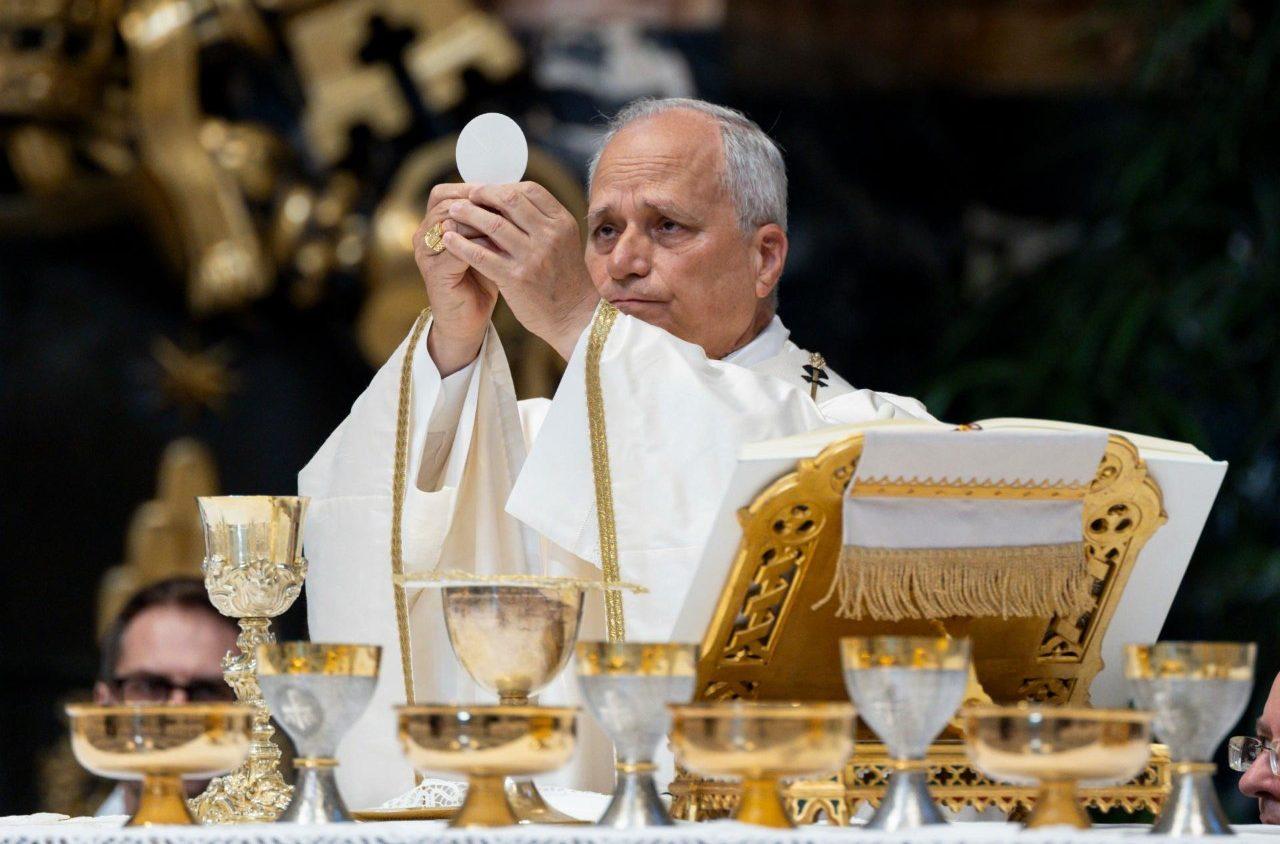
St. Thomas Aquinas tells us that the Eucharist, rather than transforming Christ into our substance, is He who transforms us into His.
Do not the rain, dew, air, gases, fertilizer, heat, and so forth, when in contact with the plant they enrich with their various properties, become transformed into the plant itself? Of course they do. And the foods and liquids we consume, together with the various phenomena that take place during digestion, do they not become converted into our own flesh and blood? Evidently.
The effect of sacramental Communion is to transform us into that which we assimilate. This is one of the most impressive prerogatives of the Eucharistic Bread. What an advantageous change in our poor mortal nature!
We have cited a teaching of St. Thomas, the Angelic Doctor. Let us now hand the pen to the Eagle of Hippo, the great St. Augustine:
“Know,” Jesus told him in a revelation, “that when you receive Me in Communion, I do not change into you, but you are transformed into Me.”
St. Thérèse of the Child Jesus had this truth firmly established in her soul. She engraved it artistically in her poetry and, above all, bore witness to it through her life, so exemplary and fruitful.
“The Eucharist and the Divinization of Man” is the title of a Canonical Licentiate thesis in Theology by Rev. Fr. David Ritchie of the Heralds of the Gospel. We borrow that same title for this modest reflection.
Allow us a brief parenthesis: the word “man” here refers to the human race as a whole, without excluding women. The customary use of the term throughout history was persistently understood in this way, peacefully and without drama. Now it seems that the turbulent twenty-first century had to arrive for the word to lend itself to ambiguity and potentially discomfort some imaginative people… But let us return to our subject.
Fr. Ritchie writes:
“Living in a competitive society, in which the dignity proper to each human being is confused with rivalry and the desire to dominate the weaker, there is an exalted value, accessible to all, offered by Jesus Christ in a special way in the Eucharist: the divinization of the human creature. By making man a participant in His own life, God desires to lead him to the maximum union with Himself, in which true dignity consists. This is the ultimate effect of the Eucharist, as St. Augustine affirms: ‘God became man so that man might become God.’”
Man… and, properly understood, woman as well.
Our spiritual life would be extraordinarily strengthened if we kept this truth in mind; we would approach the Eucharistic banquet with greater piety and renewed enthusiasm. It is for this very reason that the Eucharist is called the “Bread of Life” and also the “Bread of Heaven.” The Eucharist is already Heaven on Earth insofar as it fosters that transforming union.
“To transform” means to change or modify the form of something. Yes, the Eucharist received in Communion transforms us; it divinizes us.
By Fr. Rafael Ibarguren, EP
(Originally published at www.opera-eucharistica.org)
The post “The Eucharist and the Divinization of Man” appeared first on Gaudium Press Español.