






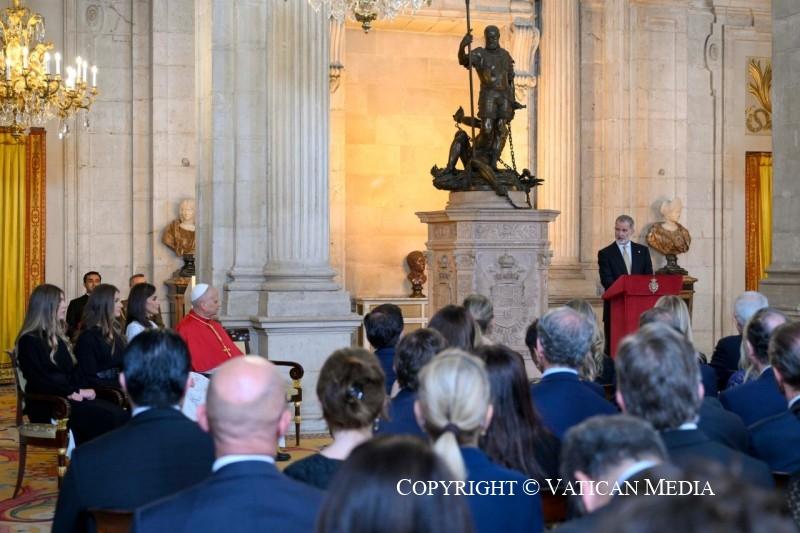
Pope urges unity, dialogue, and human dignity in Spain, highlighting history, faith, and education as keys to peace and resisting polarization
Newsroom (08/06/2026 Gaudium Press ) Addressing Spain’s political leadership, civil society, and diplomatic corps at the Royal Palace of Madrid, the Pope delivered a sweeping appeal for unity, dialogue, and renewed commitment to human dignity in an era marked by conflict and polarization.
Speaking before King Felipe VI, Queen Letizia, and a wide assembly of national and international representatives, the Pontiff framed his Apostolic Journey as a mission to “affirm, encourage and instill a renewed fidelity to the Gospel,” while also promoting reconciliation across the country’s diverse social and political landscape.
A Nation Shaped by Faith and History
The Pope emphasized Spain’s deep-rooted Christian heritage, tracing its origins to the apostolic age. He noted that the longstanding link between faith and national identity has shaped Spain’s culture in enduring ways, from its artistic and musical traditions to its vibrant expressions of popular piety.
These traditions, he said, reflect a “fruitful encounter” between faith and daily life, offering a moral and cultural foundation at a time when societies face growing uncertainty. Yet he underscored that this identity should not be reduced to a single dimension, but appreciated in its full historical and cultural complexity.
Against Polarization: “A Culture of Encounter”
Central to the address was a warning against rising societal polarization. The Pope cautioned that the temptation to gain influence by deepening divisions threatens both democratic stability and human dignity.
Instead, he advocated for what he described as a “culture of encounter,” urging leaders and citizens alike to resist ideological rigidity and engage in genuine dialogue. Echoing the teaching that “realities are greater than ideas,” he stressed the need to ground political and social discourse in lived experience rather than abstract rhetoric.
“The message of peace,” he said, “is welcomed by those who remain open to truth,” even when it challenges preconceived positions.
Spiritual Insight for Modern Crises
Drawing on Spain’s own spiritual heritage, the Pope invoked the teachings of Saint John of the Cross and Saint Teresa of Ávila. He used their mystical writings to illuminate contemporary struggles, particularly the uncertainty and fear that accompany rapid social change.
Referencing the concept of the “dark night,” he suggested that periods of confusion and crisis can become opportunities for renewal when approached with discernment and trust. In public life, he said, societies need leaders capable of “perceiving light in the darkness,” guiding others toward new beginnings.
Similarly, he highlighted Teresa of Ávila’s metaphor of the “interior castle” as a vision of human development rooted in truth, openness, and spiritual depth. This inward journey, he argued, is not escapism but a path toward greater solidarity and understanding.
Education, Freedom, and Human Dignity
The Pope placed particular emphasis on the importance of education, culture, and freedom of conscience. He warned that new technologies and digital environments risk amplifying prejudice and weakening critical thinking, making it even more urgent to invest in “free quality education” and intellectual formation.
He also called for the protection of religious freedom as an essential component of human dignity, arguing that societies flourish when individuals are free to seek truth and meaning.
Lessons from Spain’s Multicultural Past
Highlighting Spain’s historical experience as a crossroads of civilizations, the Pope pointed to periods of coexistence among Christians, Muslims, and Jews as evidence that dialogue across differences is not only possible but fruitful.
He cited the School of Translators under Alfonso X as a model of collaboration, where scholars from diverse traditions worked together to preserve and disseminate knowledge. Cities such as Toledo and Córdoba, he noted, stand as enduring symbols of intellectual and cultural exchange.
This legacy, he argued, offers a powerful lesson for modern Europe: complexity should be embraced, not feared, and differences can become a source of renewal rather than division.
A Broader Appeal to Europe and the World
Extending his message beyond Spain, the Pope described a broader vocation for Europe to promote unity and understanding on the global stage. He urged the continent to resist identity-based divisions and instead offer its rich historical experience as a “gift to the entire human family.”
He also emphasized practical steps for leaders, including responsible economic planning, investment in education and research, inclusion of vulnerable populations, and ethical oversight of technological development.
Toward a Future of Peace
Closing his address, the Pope praised Spain’s commitment to international law and multilateral cooperation, while encouraging continued efforts to foster dialogue within the nation itself.
He called for greater attention to the perspectives of the poor and the young, as well as a balance between regional autonomy and national unity.
Ultimately, his message was one of hope: that through dialogue, discernment, and a renewed commitment to truth, societies can overcome division and build a future grounded in justice and peace.
“God bless Spain,” he concluded, leaving a message that resonated as both a reflection on the past and a vision for the future.

- Raju Hasmukh with files from Vatican News
Related Images:


