






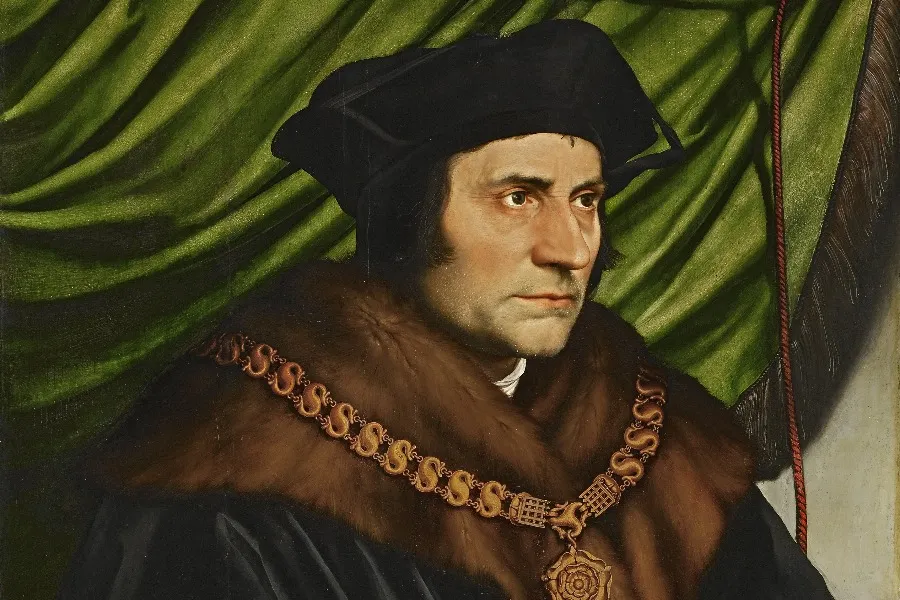
German Catholic youth group keeps Thomas More as patron while acknowledging controversies, highlighting debate over saints and modern values.
Newsroom (03/06/2026 Gaudium Press ) The Katholische Junge Gemeinde (KjG), one of Germany’s largest Catholic youth organizations, has voted to retain St. Thomas More as its patron while formally recognizing and critically engaging with the more controversial aspects of his historical record. The decision, reached at the group’s national assembly from May 27 to 31, reflects a broader struggle within contemporary faith communities to reconcile tradition with evolving moral and historical perspectives.
Founded in 1970 and now counting around 50,000 members, the KjG affirmed More’s patronage but emphasized the need for a nuanced understanding of the 16th-century English statesman, saint, and martyr. The resolution states that members should both appreciate his legacy and remain aware of what it describes as “problematic aspects of his life.”
A Divided Historical Legacy
Thomas More, who served as Lord Chancellor of England from 1529 to 1532, is widely remembered for refusing to support King Henry VIII’s break with the Roman Catholic Church. His refusal to swear allegiance recognizing the king as head of the Church led to his execution in 1535. Canonized in 1935 and named patron saint of statesmen and politicians in 2000, More has long been upheld as a model of moral integrity and fidelity to conscience.
At the same time, his historical image has been sharply contested. He has been depicted as a principled hero in the 1960 play A Man for All Seasons, yet portrayed as a rigid and ruthless figure in the 2009 novel Wolf Hall. This duality shaped the KjG’s internal debate.
The organization’s resolution identifies several critical concerns, including More’s “disparaging and polemical attitude” toward the Reformation and his role in the persecution of individuals deemed heretics. It specifically references executions and burnings at the stake carried out during his tenure in government. The document also criticizes his “rigid adherence to Church structures” even as he recognized the need for reform within them.
A Structured Review Process
The decision follows a two-year internal review process triggered by a local initiative. In February 2024, the KjG branch in the Diocese of Münster passed a resolution urging reconsideration of More’s suitability as a patron. The motion—titled “Thomas More — not such a nice guy!”—passed overwhelmingly and cited concerns raised during a 2022 educational trip to London, where members encountered historical critiques of More’s actions and positions.
In May 2024, the national assembly voted decisively to create a committee to evaluate the issue. That committee reported its findings at the 2026 assembly, where delegates ultimately opted for continuity tempered with critique.
The final resolution acknowledges the broader difficulty of applying traditional concepts of sainthood in a modern context. It notes challenges arising from both theological perspectives and individual relationships members have with historical figures. As a result, the KjG reaffirmed its commitment to presenting “diverse images of God, role models, and saints” to accommodate different paths of faith.
Affirming Positive Contributions
Despite its criticism, the KjG also highlighted qualities that continue to make More relevant as a patron. The resolution praises his “fidelity to conscience,” his humanist ideals, and his advocacy for education, including access for all genders. It also points to his enduring intellectual legacy, especially his 1516 work Utopia, and notes his well-known sense of humor.
According to the KjG’s official profile, More serves as a model encouraging young people to think critically, act responsibly, and balance conviction with reflection. His life, the organization suggests, demonstrates the importance of decision-making grounded in conscience rather than conformity or indecision.
A Broader Christian Perspective
The KjG’s critical stance, even while retaining More as patron, may surprise those who view him as an uncontested icon of Christian virtue. Beyond his veneration in the Catholic Church, More has also been widely respected in Protestant circles. The Church of England commemorates him as a “martyr of the Reformation,” and he has been praised by figures such as Anglican cleric Jonathan Swift, who described him as a person of exceptional virtue.
When Pope St. John Paul II declared More the patron of statesmen and politicians in 2000, he emphasized the saint’s unwavering moral integrity, intellectual depth, and commitment to justice. The pope highlighted More’s dedication to serving the vulnerable, his rejection of personal gain at others’ expense, and his steadfast refusal to compromise his conscience.
John Paul II also framed More’s example as particularly relevant to modern political and public life, describing him as a model for ethical leadership in times of complex challenges and responsibilities. His life, the pope argued, demonstrated that governance is fundamentally an exercise in virtue.
Looking Ahead
The KjG plans to publish the results of its review online and promote discussion through social media, aiming to foster deeper engagement among its members. Rather than offering a single definitive interpretation, the organization seeks to encourage individuals to form their own understanding of Thomas More and his relevance today.
In doing so, the KjG’s decision highlights a broader shift within religious communities: an increasing willingness to examine revered figures critically while still recognizing their contributions. The result is not the rejection of tradition, but its reinterpretation—an effort to ensure that historical role models continue to speak meaningfully to contemporary faith and ethical life.
- Raju Hasmukh with files from The Pillar
Related Images:


