






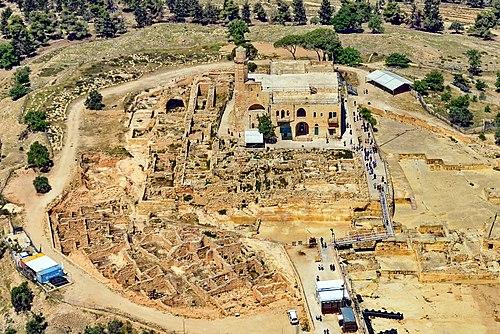
Israel’s move to expropriate Nabi Samuel land sparks outrage, raising fears of annexation and escalating tensions over sacred heritage sites.
Newsroom (03/06/2026 Gaudium Press ) The Israeli government’s decision to seize the revered tomb of the Prophet Samuel (Nabi Samuel), located north of Jerusalem, has ignited a new and contentious phase in the long-running struggle over land, identity, and cultural heritage in the occupied West Bank. The move, which includes the expropriation of 28 acres surrounding the historic site, is being framed by Israeli authorities as a measure for “public utility” and preservation. However, Palestinian groups, activists, and even Israeli critics interpret it as part of a broader strategy aimed at consolidating control over contested territory.
The site, positioned between Jerusalem and Ramallah, has been administered by the Islamic Waqf and holds deep significance for Muslims, Christians, and Jews alike. The expropriation order (H/02/26), issued by Israel’s Civil Administration, marks what observers describe as an unprecedented step: the direct takeover of a Waqf-controlled religious site in the occupied West Bank.
Peace Now, an Israeli anti-occupation organization, emphasized the historical significance of the move, warning that it represents a shift from land seizures and settlement expansion to the appropriation of religious sites themselves. Critics argue that such actions risk inflaming tensions in already sensitive areas and deepening the perception that the conflict is increasingly shifting from political to religious dimensions.
Heritage, Religion, and Territorial Control
Israeli authorities justify the decision as part of a development initiative aimed at preserving the archaeological integrity of the Nabi Samuel site. Yet Palestinian analysts contend that archaeology is being deployed as a political tool to undermine Palestinian claims to land and identity. The site’s layered history underscores its importance: a Byzantine church commissioned by Emperor Justinian once stood there, while later Islamic periods under Ayyubid and Mamluk rule added elements that remain visible today, including a mosque revered as the burial place of the prophet.
The strategic and symbolic value of the location is equally significant. Situated atop a hill 885 meters above sea level, historically known to Crusaders as the “Mount of Joy,” the site provides extensive views of the surrounding region, further enhancing its geopolitical relevance.
The expropriation of Nabi Samuel follows other recent actions by Israeli authorities. In November, 444 acres around the archaeological site of Sebastia were seized, and shortly thereafter, Palestinian control over the Ibrahimi Mosque in Hebron was curtailed. These developments have reinforced concerns among Palestinian observers that Israel is systematically targeting cultural and religious landmarks as part of a broader territorial agenda.
Political Tensions and Legal Challenges
The controversy surrounding Nabi Samuel coincides with domestic tensions within Israel’s own academic and legal communities. Sixty Israeli archaeologists have petitioned the High Court of Justice, seeking to block the appointment of a new director-general at the Israel Antiquities Authority (IAA). The appointment, backed by Heritage Minister Amichay Eliyahu, has raised fears about the politicization of archaeological management.
At the same time, a controversial bill advancing through the Knesset proposes the creation of a new authority tasked with overseeing heritage sites in the West Bank. Presented by Likud lawmaker Amit Halevi, the legislation would grant sweeping powers, including land confiscation, excavation rights, and law enforcement authority. While it passed an initial reading, Prime Minister Benjamin Netanyahu has temporarily halted its progress, reportedly deeming the current draft “unpresentable” to the international community.
Despite the pause, amendments are under consideration, suggesting that the government remains committed to advancing the proposal in a more diplomatically palatable form.
Regional Implications and Fears for Al-Aqsa
For Palestinian officials and civil society organizations, the implications extend far beyond Nabi Samuel. Many believe that the ultimate objective of Israeli hardliners is to assert control over the Al-Aqsa Mosque compound in Jerusalem, Islam’s third holiest site.
The Palestinian Authority has warned that ongoing expropriation efforts could destabilize the region, particularly if they challenge the longstanding status quo governing religious sites in Jerusalem. The compound is currently administered under the custodianship of Jordan, a role dating back to 1924 and reaffirmed in the 1994 Israel-Jordan peace treaty.
Recent statements by Israeli officials and political figures have heightened these concerns. Finance Minister Bezalel Smotrich, for instance, has openly questioned Palestinian control over sites such as the Pools of Solomon, signaling an ideological commitment among some factions to reshape governance over key heritage locations.
Palestinian authorities argue that any attempt to alter the status of Al-Aqsa would have far-reaching consequences for regional stability. They emphasize that Jordanian custodianship serves as a critical safeguard for preserving the site’s Islamic identity and maintaining a delicate balance that has endured for decades.
A Conflict Expanding Into Culture and Faith
The battle over Nabi Samuel reflects a broader evolution in the Israeli-Palestinian conflict—one that increasingly encompasses not only territory and governance but also history, culture, and religious identity. As Israel moves to consolidate its control over archaeological and sacred sites, critics warn that the consequences may extend well beyond the immediate political arena.
What has long been a geopolitical dispute risks becoming a deeply entrenched religious conflict, with each side viewing the other’s actions as an existential threat to its heritage and identity. With legislative initiatives pending and tensions rising, the future of contested sites like Nabi Samuel—and potentially Al-Aqsa—remains uncertain, but undeniably central to the trajectory of the conflict.
- Raju Hasmukh with files from Zenit News
Related Images:


