






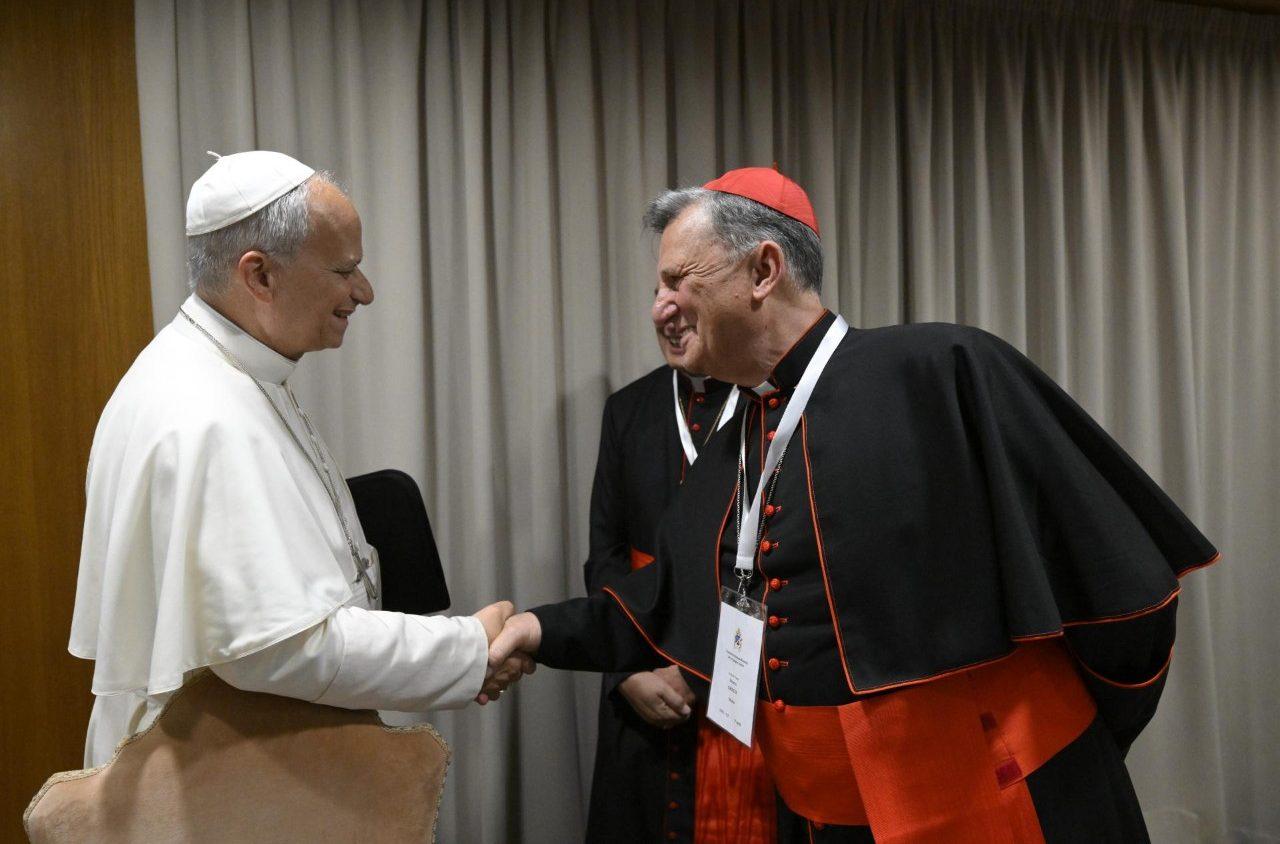
Cardinals at the Consistory examine synod implementation, priesthood renewal, and risks of overcomplex consultation in Church governance.
Newsroom (28/06/2026 Gaudium Press ) The fourth session of the Extraordinary Consistory opened Saturday afternoon in the Aula del Sinodo, bringing cardinals into focused reflection on the evolving synodal journey and the future of the Catholic priesthood. Moderated by Cardinal Joseph William Tobin, the session centered on how the Church can advance its mission without becoming encumbered by the very processes designed to renew it.
At the heart of the discussion was a dual concern: how to sustain the momentum of synodality while ensuring that its structures do not “weigh down” the Church at a time when clarity of witness is urgently needed. Cardinals also emphasized the need to present a renewed image of the priesthood—one described as “beautiful, creative, evangelical, and at the same time not clerical.”
Cardinal Mario Grech, Secretary General of the Synod, opened the session with a wide-ranging address that framed the Synod on Synodality as an ongoing spiritual and ecclesial process rather than a completed event. Since its launch in 2021, he noted, the synod has exceeded expectations in both scope and participation. Communities across the globe—many engaging for the first time—have entered into processes of listening and discernment, often navigating fatigue and resistance while discovering a shared desire to “walk together.”
Grech underscored that the Church is now entering a decisive implementation phase. This stage, he explained, is not merely about applying conclusions but about allowing the insights gathered to mature organically within local communities. These communities, in turn, are called to deepen dialogue both internally and across geographical and cultural boundaries.
Central to this process is what Grech described as “conversation in the Spirit,” a method that goes beyond thematic discussion. It is rooted in a shared openness to the presence of the Risen Lord, transforming dialogue into a space of mutual discernment shaped by the Holy Spirit. This distinction, he suggested, has been one of the most significant developments of the synodal experience.
Looking ahead, the General Secretariat of the Synod has outlined a structured path leading to an ecclesial assembly in October 2028. This roadmap aims to gradually embed synodal insights into the life of the Church while fostering deeper exchange among diverse communities. However, Grech cautioned that such integration will not occur uniformly, as different cultures and contexts will interpret and implement these insights according to their own rhythms.
The implementation phase is organized around four key actions: to remember, to interpret, to orient, and to celebrate. These verbs describe a process that begins with receiving what has already emerged, moves through discernment of shared experiences, opens new directions for the Church, and ultimately culminates in a renewed sense of unity.
Throughout the session, cardinals returned repeatedly to the importance of maintaining balance. While synodality encourages broad participation, there was concern that increasingly complex consultation mechanisms could hinder rather than help the Church’s mission. This tension reflects a broader challenge: how to remain faithful to a participatory vision of governance without losing clarity, agility, or evangelical focus.
At the same time, the role of bishops was reaffirmed as essential in guiding this process. Working alongside synodal teams, clergy, religious, and lay members—including families and young people—bishops are tasked with ensuring that the synodal journey remains rooted in communion and oriented toward mission.
The discussions also highlighted the valuable contribution of Eastern Catholic communities, whose longstanding synodal traditions offer practical and theological insights for the wider Church. Their experience was recognized as a significant resource as the global Church navigates this period of transition.
Grech further reflected on the relationship between the Consistory and the Synod, describing them as complementary expressions of the same ecclesial communion. The Consistory embodies collegial governance among the Church’s leadership, while synodal assemblies represent the broader participation of the People of God. Together, they form what he called “two operative dimensions of the same communion.”
As the session concluded, attention turned to the responsibility shared by all cardinals—whether serving in local dioceses or within the Roman Curia—to safeguard unity and support the Church’s mission. In a world marked by rapid change and mounting complexity, synodality was presented as a “missionary resource,” enabling the Church to listen more attentively to humanity and to discern its path forward collectively.
The first part of the session ended after an hour, with participants preparing to reconvene for a dialogue with Pope Leo XIV, during which each cardinal would have the opportunity to contribute briefly to the ongoing discussion.
- Raju Hasmukh with files from Vatican News
Related Images:


