






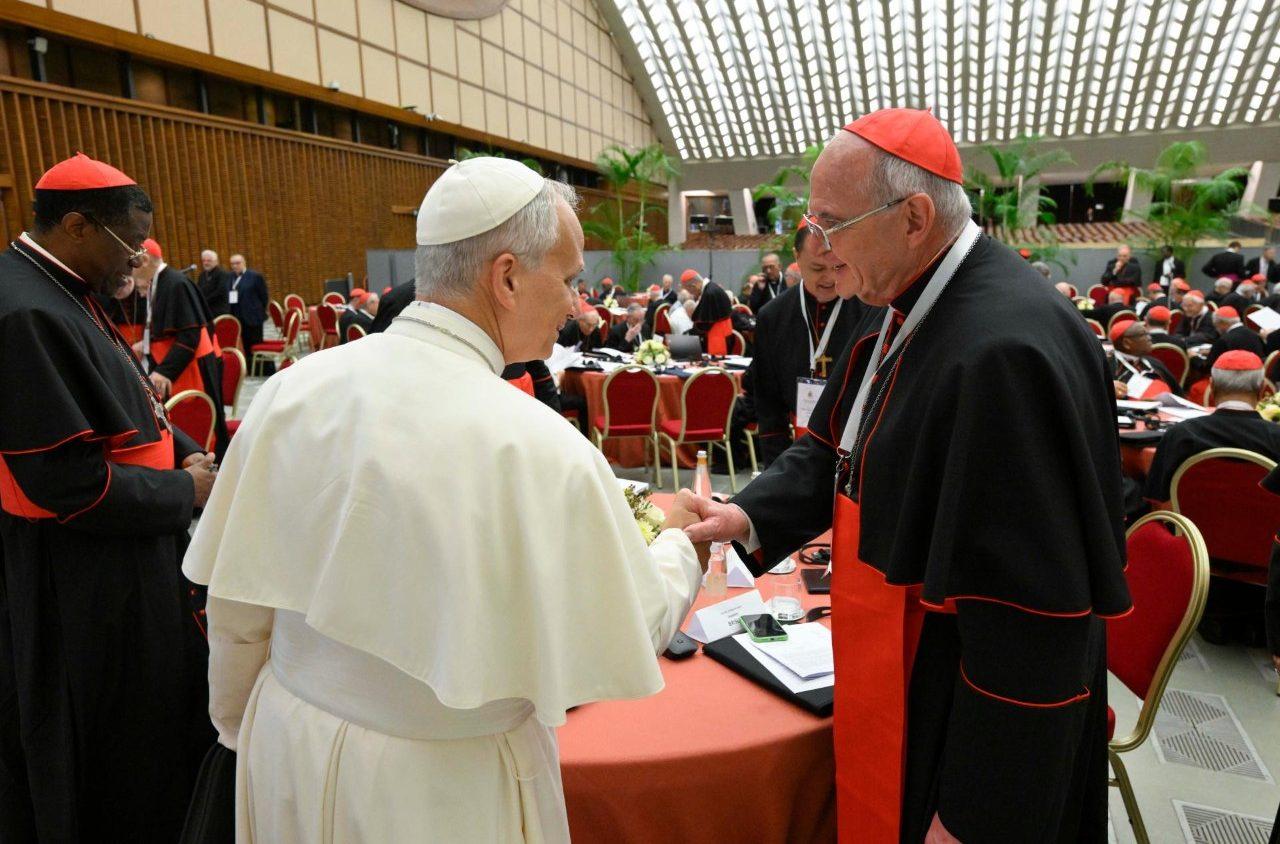
Cardinals at the Vatican highlight Gospel hope, synodality, and human dignity as key responses to rising individualism and global fractures.
Newsroom (28/06/2026 Gaudium Press ) The third session of the Extraordinary Consistory unfolded Saturday morning with a clear and urgent message: in a world increasingly shaped by individualism and fragmentation, the Gospel offers a path toward unity, dignity, and hope.
The Holy See Press Office detailed a day that began with Mass in St. Peter’s Basilica, celebrated by Cardinal Giovanni Battista Re, Dean of the College of Cardinals. The proceedings then moved to the Paul VI Hall, where Pope Leo XIV joined the Cardinals in prayer, opening the session with the Adsumus.
Cardinal Protase Rugambwa of Tabora, Tanzania, moderated the gathering, relaying the Pope’s gratitude for the Cardinals’ support of his appeals for peace. He urged them to carry that commitment into their local Churches, transforming shared concern into a unified global voice.
Theological Vision Meets Modern Challenges
Cardinal Stephen Brislin, Archbishop of Johannesburg, set the intellectual and spiritual tone of the session with a reflection on “Building for the common good: the building sites of our time.” His address centered on Pope Leo XIV’s encyclical Magnifica humanitas, presenting it as a framework for understanding humanity’s current trajectory.
Brislin highlighted the encyclical’s opening and conclusion as its theological anchors. The text begins with pressing questions about how humanity constructs its future and ends with a distinctly Christian response rooted in faith, charity, hope, and prayer.
A central image in the encyclical contrasts the biblical cities of Babel and Jerusalem. Both represent collective human effort, yet their outcomes diverge sharply. Babel symbolizes self-reliance detached from God, leading to fragmentation. Jerusalem, by contrast, reflects a humanity aligned with divine purpose, where intelligence serves the dignity of every person.
This contrast, Brislin noted, is especially relevant in an era defined by unprecedented technological power. The question is no longer simply what humanity can build, but whether such progress is guided by responsibility or contributes to new forms of exclusion.
Technology, Responsibility, and the Human Person
Artificial intelligence and emerging technologies featured prominently in the session’s reflections. Cardinals emphasized that technical tools are never neutral; they are shaped by political, economic, and social systems that ultimately determine whether they serve or undermine human dignity.
Participants warned against reducing individuals to data points, stressing the importance of naming and recognizing each person as inherently valuable. They also underscored the need to preserve an authentic sense of human limitation—something technological culture often resists—and to defend the dignity of work.
Brislin introduced what he described as a “grammar of building,” composed of four elements: desire, limitation, shared responsibility, and discernment. Together, these principles offer a way to navigate modern complexity while remaining grounded in human and spiritual truth.
Desire must be oriented toward genuine happiness, limitation accepted as a sign that life is a gift, responsibility shared according to the principle of subsidiarity, and discernment guided by the Church’s social teaching.
Synodality and the Common Good
Throughout the session, the concept of synodality emerged as a key response to contemporary challenges. Defined as a path of listening, dialogue, and shared responsibility, it was presented as the Church’s way of entering history without fear.
Group discussions revealed a consistent concern about deep fractures affecting the modern world—between nations, within societies, and even inside families. These divisions, participants noted, disproportionately harm the poor, the young, and those lacking guidance or purpose.
Many Cardinals pointed to a growing crisis of meaning and identity, exacerbated by what they described as exaggerated individualism. This mindset fosters the illusion that others exist primarily for personal success, eroding the foundations of community and solidarity.
In response, the common good was reaffirmed as both a challenge and a necessity. Yet achieving it requires more than policy; it demands what several groups called a “language of the heart,” capable of overcoming corruption, conformism, and despair.
Faith, Politics, and a Shared Future
The discussions also emphasized the role of faith in sustaining a commitment to the common good. Faith, participants argued, enables individuals to transcend self-interest, build authentic relationships, and engage meaningfully with those outside the Christian tradition.
Politics was identified as a crucial arena for this effort, alongside the Church’s responsibility to form future leaders grounded in its social doctrine. Such formation was described as a “medicine for divisions,” equipping public servants to address societal fractures with integrity and vision.
Despite the gravity of the issues discussed, the session was marked by a sense of cautious hope. Cardinals noted that many of these challenges are shared across regions and cultures, and that communion with Christ provides a foundation that transcends fear of public opinion.
The Gospel as Antidote
Ultimately, the session converged on a clear conclusion: the Gospel itself is the antidote to the individualism and fragmentation of the present age.
This vision calls for a Church that offers belonging, heals wounds, and avoids the extremes of polarization and rigid ideology. It envisions Christians not as passive observers but as active participants—“wise architects” engaged in rebuilding a fractured world.
The session concluded with the Angelus prayer led by Pope Leo XIV, bringing to a close a morning of reflection that sought to align the Church’s mission with the urgent needs of the contemporary world.
- Raju Hasmukh with files from Vatican News
Related Images:


