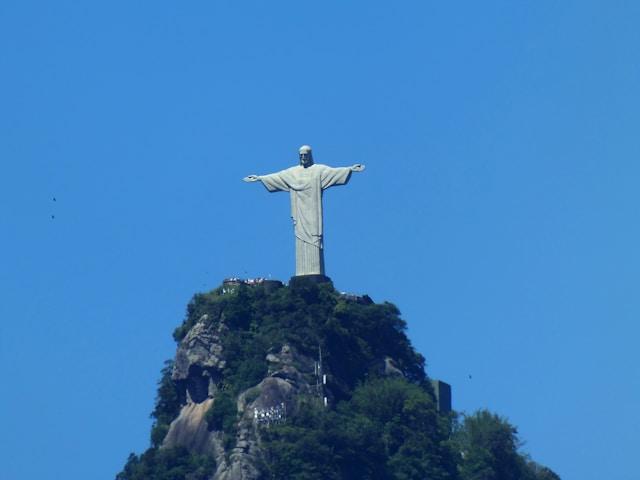
Christ the Redeemer launches the “Towards 100 Years” seal, marking the countdown to its 2031 centenary with heritage, faith, and legacy.
Newsroom (28/07/2026 Gaudium Press ) The Christ the Redeemer Sanctuary has officially begun the journey toward one of the most significant milestones in the history of Brazil’s most recognizable monument. During a ceremony held at Obra Social Leste Um – O Sol in Rio de Janeiro’s Jardim Botânico district, sanctuary leaders unveiled the commemorative “Towards 100 Years” seal, marking the countdown to the centenary of Christ the Redeemer, which will be celebrated on October 12, 2031.
The launch signals the start of a multi-year program of activities, preservation initiatives, and institutional projects designed to celebrate the monument’s legacy while strengthening its international profile. The visual identity will now accompany official documents and initiatives of both the sanctuary and the Sustainable Christ Consortium.
“Our Redeemer deserves the best,” said Father Omar Raposo, rector of the sanctuary. He described the seal’s presentation as the first step in a coordinated effort that combines technical expertise and long-term planning to honor what he called “the great symbol of our country.”
A Visual Identity Rooted in History
The “Towards 100 Years” seal was developed by Agência Arcanjo, a company specializing in Catholic marketing, in collaboration with Gustavo Gigio, digital coordinator of the Christ the Redeemer Sanctuary.
At the center of the design is the number 100, with a golden image of Christ the Redeemer placed within the first zero. According to its creators, the symbol emphasizes Christ as the focal point of both the sanctuary’s liturgical celebrations and its social outreach activities.
The design also incorporates imagery inspired by the monument’s iconic soapstone tesserae. These small triangular pieces, assembled into a mosaic across the statue’s exterior, are among its most distinctive architectural features. Beyond creating the monument’s unique texture, the tesserae protect the structure from weather conditions.
The history of the tesserae remains closely linked to the monument’s origins. During construction, volunteer women carefully attached the pieces to fabric strips by hand. Many reportedly inscribed the names of relatives, loved ones, or donor families on the reverse sides before they were placed on the monument.
Gigio explained that the seal’s typography references the approaching centenary, while the tesserae create a sense of movement from the monument’s 95th anniversary toward its 100th. The connection between the two zeros also evokes the concept of infinity, symbolizing a journey that began long before the current celebrations and is expected to continue far into the future.
The color palette combines deep blue and gold, reflecting both tradition and aspiration. According to sanctuary officials, blue represents the monument’s permanence, spirituality, and imposing presence, while gold signifies celebration, light, and the approach of the centenary. Additional tones of blue and gray were selected to communicate balance, serenity, and contemporary relevance.
More Than a Monument
The ceremony included the presentation of an institutional video portraying the sanctuary as a center of faith, culture, hospitality, and social responsibility. Organizers emphasized the growing role of Christ the Redeemer as a hub for charitable, environmental, cultural, and religious initiatives.
The event also addressed one of the most persistent misconceptions surrounding the monument: the belief that it was a gift from France. Sanctuary representatives reaffirmed that Christ the Redeemer was funded primarily through donations made by Brazilian Catholic faithful, highlighting the widespread national fundraising effort that made the project possible.
The Long Road to Corcovado
A significant portion of the event was devoted to recounting the monument’s origins.
Raphael Fritz, secretary of the Redemptor Institute for matters related to the centenary, traced the idea back to the 19th century and the aspirations of French Lazarist priest Father Pedro Maria Bos.
From 1859 onward, Bos viewed Corcovado Mountain from the Church of the Immaculate Conception College in Botafogo and imagined a religious monument atop the peak. His vision was later recorded in the prologue to a 1903 edition of The Imitation of Christ, where he described Corcovado as the ideal pedestal for an image of Jesus visible to all people regardless of language or education.
Princess Isabel, who knew Father Bos and his dream, played an indirect role in the monument’s story. Following the abolition of slavery in 1888, some proposed erecting a statue of the princess on Corcovado because she had become known as a “redeemer.” Isabel rejected the idea and instead suggested that any monument honor the Sacred Heart of Jesus, whom she considered the true redeemer of humanity.
Political changes soon interrupted the project. Following the Proclamation of the Republic in 1889 and the separation of Church and State, plans for a monument stalled.
The dream was revived in 1921 as Brazil prepared to mark the centenary of its independence. The Catholic Circle, an association of Catholic laypeople, launched a campaign to construct a national religious monument. Engineer Heitor da Silva Costa won the design competition, although his original proposal underwent substantial changes.
At the request of Archbishop Dom Sebastião Leme, da Silva Costa developed a more visible and spiritually powerful concept. Inspired by giant communications antennas atop Corcovado, he envisioned Christ with outstretched arms, forming a monumental cross visible across Rio de Janeiro.
One of Dom Sebastião Leme’s specific requests was that the Sacred Heart of Jesus be incorporated into the statue. As a result, a heart was molded within Christ’s chest, becoming the only internal element covered with soapstone.
Constructed from reinforced concrete and clad with soapstone tesserae, the completed monument rises 30 meters above an eight-meter pedestal, while its arms extend 28 meters from fingertip to fingertip.
When the monument was inaugurated on October 12, 1931, Dom Sebastião Leme formally consecrated Brazil to Christ the King.
A Sanctuary with a Growing Mission
The significance of Christ the Redeemer has evolved beyond that of a tourist attraction.
In 2006, on the 75th anniversary of its inauguration, Cardinal Eusébio Oscar Scheidt established the Archdiocesan Sanctuary of Christ the Redeemer of Corcovado. Since then, religious activity at the site has grown steadily.
According to figures presented during the event, the sanctuary hosted more than 3,000 liturgical celebrations and pilgrimages in 2025, including baptisms, weddings, masses, and devotional gatherings. Officials said the increase reflects the monument’s original vocation as a sacred place of worship and pilgrimage.
Looking Ahead to 2031
This October 12, Christ the Redeemer will celebrate its 95th anniversary, the first milestone in the six-year countdown to the centenary.
Father Omar announced that a special calendar of events will commemorate the anniversary while highlighting themes of faith and global sustainability. He described the monument as a messenger of faith, hope, and love.
The launch of the “Towards 100 Years” seal also marks the beginning of a broader effort to strengthen Christ the Redeemer’s international presence and build a lasting legacy ahead of 2031.
Among the initiatives already planned is the development of the Christ the Redeemer Museum at the Paineiras Visitor Center, according to sanctuary marketing director Carlos Lins. He also confirmed that a new restoration project for the monument is expected to take place this year, complementing the ongoing maintenance work that has preserved the structure for nearly a century.
Reflecting on the approaching milestone, Lins noted that Christ the Redeemer has witnessed decades of social transformation in Rio de Janeiro and across Brazil. He said the upcoming celebrations aim to ensure that the monument’s symbolic heart continues to shine as a legacy for both the nation and the world.
The ceremony concluded with the signing of the Joint Internal Guideline Term governing the use of the “Towards 100 Years” seal. Signatories included Father Omar Raposo, institutional communication coordinator Leanna Scal, Sustainable Christ Consortium social projects coordinator Silvia Gonzaga, and Redemptor Institute executive secretary Marcos Matos, formally laying the groundwork for the centenary journey that will culminate in 2031.
- Raju Hasmukh with files from ACI Digital