






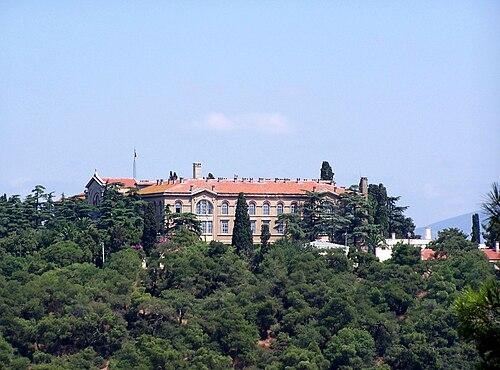
Turkey advances talks to reopen Halki Theological School before September, reviving a key Orthodox institution closed since 1971.
Newsroom (30/06/2026 Gaudium Press ) Turkey has taken a significant step toward restoring academic activity at the historic Halki Theological School, one of the most symbolically important institutions in the Orthodox Christian world. President Recep Tayyip Erdoğan has instructed the Council of Higher Education (YÖK) to continue negotiations with the Ecumenical Patriarchate of Constantinople, aiming to complete the process before September, when restoration work on the seminary complex is expected to conclude.
The development was disclosed by Metropolitan Emmanuel of Chalcedon following a meeting between Ecumenical Patriarch Bartholomew I and Erdoğan at the presidential complex in Ankara. The discussions come amid growing diplomatic interest from the United States and renewed tensions between Turkey and Greece over issues in the Aegean Sea.
More Than an Academic Institution
The reopening of Halki carries profound religious and geopolitical significance. For generations, the seminary served as the primary institution for training clergy of the Ecumenical Patriarchate, the spiritual center of global Orthodoxy and the “first among equals” within the Orthodox communion, which encompasses approximately 300 million believers worldwide.
Since its closure in 1971, the Patriarchate has been forced to rely on theological institutions abroad, particularly in Thessaloniki, Greece, and Boston, United States, to educate future clergy. The inability to train priests at its historic headquarters has long been viewed as a major obstacle to the institutional continuity of the Patriarchate.
Over the decades, Halki has become a powerful symbol of broader concerns regarding religious freedoms and the treatment of non-Muslim minorities in Turkey. Its status has repeatedly appeared in international assessments, including discussions surrounding Turkey’s relations with Western partners.
A New Phase of Negotiations
The recent Ankara meeting brought together Patriarch Bartholomew, Metropolitan Emmanuel—widely regarded as a key aide to the Patriarch—and Bishop Kasianos of Arabisos, abbot of the Holy Trinity Monastery at Halki.
According to a statement from the Ecumenical Patriarchate, the talks took place in a cordial atmosphere and focused on long-standing issues affecting the Greek Orthodox community in Istanbul. Particular attention was given to practical measures needed to revive the seminary.
Metropolitan Emmanuel stated that Erdoğan had instructed YÖK to continue discussions with a Patriarchate-appointed committee. While no formal timetable has been publicly announced, he emphasized that meaningful progress is finally being made after decades of stagnation.
Two major tasks remain before reopening can occur: completion of the renovation of the historic campus and agreement on the legal and academic framework under which the institution will operate.
Notably, Turkish authorities have yet to issue an official public statement detailing the outcome of the meeting.
September Emerges as a Target Date
Patriarch Bartholomew has indicated that restoration work is expected to be completed by September, making that month a potential milestone for the seminary’s return to educational activity.
According to the Patriarch, Erdoğan tasked Education Minister Yusuf Tekin in 2024 with evaluating options for reopening the institution. Tekin subsequently visited the seminary in May of that year, initiating what Bartholomew described as constructive discussions involving the Ministry of Education, YÖK, and representatives of the Patriarchate.
The Orthodox leader has stated that he is now awaiting the necessary authorization from Turkish authorities to allow the school to resume operations once restoration work is finished.
International Pressure and Strategic Considerations
The renewed momentum surrounding Halki cannot be separated from the broader geopolitical environment.
The issue reportedly featured in discussions between U.S. President Donald Trump and Erdoğan during their meeting at the White House in September 2025. On that occasion, Erdoğan indicated a willingness to address the matter and said he would discuss it further with Patriarch Bartholomew upon returning to Turkey.
For many observers, Halki has evolved into a diplomatic issue that extends well beyond religious education. The United States has repeatedly raised concerns regarding the seminary, while European institutions have viewed its reopening as a positive indicator of Turkey’s commitment to religious rights and minority protections.
As a result, the future of the seminary has become intertwined with Turkey’s relationships with Western allies and its broader international image.
A Seminary With Deep Historical Roots
The origins of the Halki complex date back to 1772, when permission was granted during the Ottoman era to establish a center of learning. Although fire damage delayed development, the theological school eventually began operating in 1844.
After the original structure was destroyed in the 1894 Istanbul earthquake, the institution was rebuilt with authorization from Sultan Abdulhamid II and reopened in 1896. The current complex, designed in the shape of the Greek letter Pi, occupies approximately 2,360 square meters on Heybeliada, one of the Princes’ Islands in the Sea of Marmara.
Before its closure, Halki was considered among the most prestigious Orthodox theological schools in the world. Numerous church leaders studied there, including Patriarch Bartholomew himself.
The Legacy of the 1971 Closure
The seminary ceased operations in 1971 after a Turkish Constitutional Court ruling required private higher education institutions to come under state control. Due to legal constraints linked to its status and the requirements imposed by the Turkish educational system, the Patriarchate was unable to continue operating the school under the new framework.
Since then, only the Halki Greek High School for Boys has remained active on the monastery grounds.
The closure severely limited the Patriarchate’s capacity to train future generations of clergy. Bartholomew has repeatedly described the decision as a serious injustice and has made reopening the institution one of the defining objectives of his patriarchate since assuming office in 1991.
Caught Between Ankara and Athens
The Halki issue has also been influenced by the often-complex relationship between Turkey and Greece.
For years, Ankara has linked potential reopening efforts to questions concerning the Turkish Muslim minority in Western Thrace, Greece. Turkish officials have called for greater recognition of the community’s identity, broader authority in selecting religious leaders, and solutions to disputes involving minority educational and religious institutions.
Patriarch Bartholomew, however, has consistently argued that minority communities should not become instruments in bilateral disputes. He has emphasized that Greek Orthodox citizens of Turkey seek equal treatment and full participation in national life rather than being viewed as second-class citizens. He expressed the belief that members of Greece’s Muslim minority share similar aspirations.
A Potential Turning Point
If negotiations succeed and authorization is granted, the reopening of the Halki Theological School would mark the end of a closure that has lasted more than half a century. Beyond restoring a historic center of learning, the move would represent a significant gesture toward the Ecumenical Patriarchate, the broader Orthodox world, and Turkey’s international partners.
With restoration work nearing completion and discussions reportedly advancing, September may emerge as a decisive moment in one of the longest-running religious and diplomatic issues in modern Turkish history.
- Raju Hasmukh with files form INfocatholica
Related Images:


