






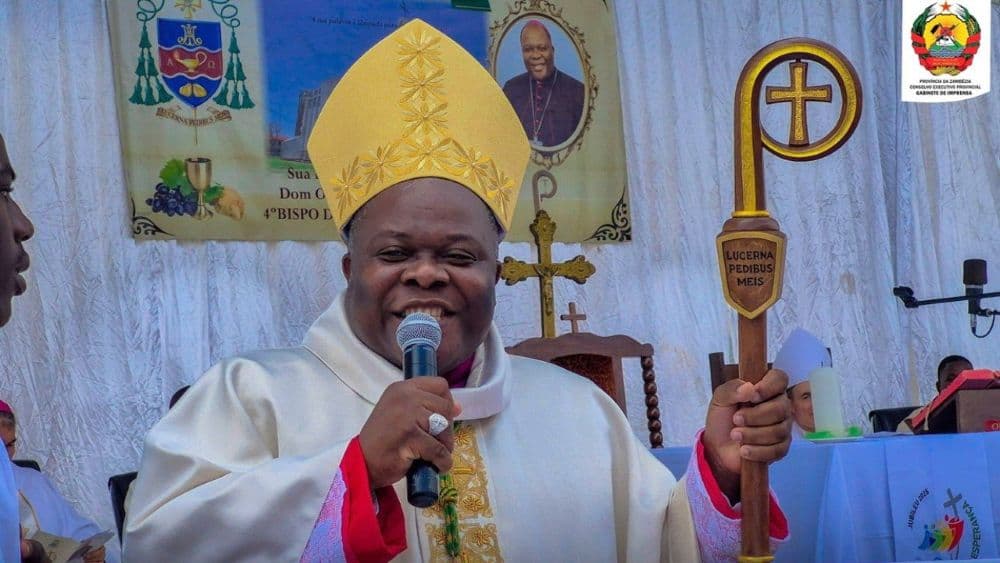
African Catholic leaders condemn the killing of Bishop Osório Afonso in Mozambique, urging swift justice and greater protection for clergy.
Newsroom (08/06/2026 Gaudium Press ) The violent killing of Bishop Osório Citora Afonso in Mozambique has sent shockwaves across the Catholic Church in Africa, prompting widespread condemnation and urgent calls for justice, security, and the protection of religious freedom.
Bishop Afonso, who served as Bishop of Quelimane and Apostolic Administrator of the Archdiocese of Beira, was shot dead in the early hours of Saturday, June 6, 2026. According to information from Mozambique’s National Criminal Investigation Service, attackers reportedly scaled the walls of his residence, disabled security systems, and opened fire using an AK-M assault rifle.
The Archdiocese of Beira confirmed the killing in a statement marked by grief and disbelief. “With deep sorrow and consternation,” it announced the “sudden passing” of the bishop, describing the circumstances as both tragic and unexpected.
Archbishop Inácio Saúre of Nampula, president of the Catholic bishops’ conference of Mozambique, revealed that Afonso’s body had been found “lifeless and in strange circumstances that have yet to be clarified.” He urged the faithful to respond with “serenity of faith and fraternal solidarity” in the face of the tragedy.
Mozambique’s President Daniel Chapo also expressed “deep sorrow and consternation,” reflecting the national significance of the loss and the gravity of the attack.
Continental Outrage and Calls for Accountability
The Episcopal Conference of Africa and Madagascar (SECAM) issued a strongly worded statement condemning the killing. Signed by its president, Cardinal Fridolin Ambongo of the Democratic Republic of the Congo, the statement described the act as a “heinous” and “barbaric crime.”
“We strongly and unequivocally condemn this barbaric crime,” the statement declared, emphasizing that no religious leader should ever be targeted with violence. The bishops highlighted Bishop Afonso’s role as a shepherd devoted to reconciliation, solidarity, education, and the common good, arguing that such individuals deserve protection rather than persecution.
SECAM called for an “immediate, thorough, transparent, and independent investigation” into the killing, urging Mozambican authorities to identify and prosecute all those responsible, including perpetrators, accomplices, and masterminds. The conference stressed that both the national and international communities “deserve the truth.”
Calls for Security and Protection Intensify
Beyond justice, African bishops also called for broader measures to safeguard religious figures and institutions. Cardinal Ambongo urged the Mozambican government to strengthen protections for clergy, places of worship, and those engaged in pastoral and humanitarian work.
The statement framed religious freedom as “a fundamental human right and a cornerstone of every democratic and peaceful society,” adding that the state carries a “solemn responsibility” to ensure citizens can practice their faith without fear of violence or intimidation.
Mozambique’s President, Daniel Chapo, echoed the Church’s grief, expressing “deep sorrow and consternation” at the bishop’s murder, reflecting a broader sense of national mourning.
Global Church Reacts with Prayer and Solidarity
The Vatican also responded to the tragedy. According to the Holy See Press Office, Pope Leo XIV expressed sorrow over the “serious act of violence,” joining the faithful in prayer during what was described as a time of “bewilderment.” The Pope prayed for consolation for the Mozambican people and called for an end to violence, asking God “to stay the hand of the violent.”
SECAM conveyed condolences to the clergy, faithful, and family of Bishop Afonso, remembering him as a “faithful pastor whose life was dedicated to the service of Christ and His Church.” The organization expressed hope that the tragedy would serve as a renewed call for justice, peace, respect for human life, and the protection of religious freedom across Africa.
A Life of Service Across Continents
Born on May 6, 1972, in Ribaue, Nampula, Bishop Afonso dedicated his life to religious service and intellectual formation. He was ordained a priest in 2002 for the Consolata Missionaries after completing studies in Mozambique, the Democratic Republic of Congo, and Rome.
His academic background included a licentiate in Sacred Scripture from the Pontifical Biblical Institute in Rome, supplemented by studies in Jerusalem. His ministry spanned multiple countries, with roles in Kinshasa, Rome, and Italy, where he served in formation, administration, and pastoral leadership.
From 2017 to 2023, he worked at the Vatican’s Dicastery for Evangelization, contributing to the Section for First Evangelization and the New Particular Churches, reflecting his close ties with the Holy See.
In August 2025, he was appointed Bishop of Quelimane, filling a vacancy that had persisted since 2023, while simultaneously serving as Apostolic Administrator of Beira—positions that placed him at the forefront of Church leadership in Mozambique.
Bishop Afonso was also widely recognized for his advocacy for the canonization of the “Martyrs of Guiúa,” a group of Mozambican catechists and their families killed in 1992 during a period of persecution.
Unanswered Questions and a Renewed Call for Justice
As investigations continue, key questions remain about the motive and perpetrators behind the attack. Church leaders and government authorities alike face mounting pressure to ensure accountability and restore confidence in public safety.
For many, the killing of Bishop Osório Afonso represents more than an isolated act of violence. It has become a profound test of the country’s commitment to justice, stability, and religious freedom.
In the words of African bishops, the tragedy stands as both a moment of mourning and a call to action—one demanding truth, accountability, and renewed efforts to protect those who dedicate their lives to serving others.
- Raju Hasmukh with files from Crux Now
Related Images:


