






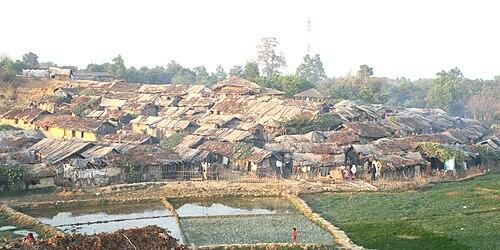
Bangladesh bishop warns Rohingya refugee crisis is worsening as aid declines, camps expand, poverty grows and no lasting solution emerges.
Newsroom (02/07/2026 Gaudium Press ) The humanitarian crisis facing more than 1.2 million Rohingya refugees in Bangladesh is becoming increasingly severe as international funding declines, humanitarian agencies scale back operations, and prospects for a lasting solution remain distant, according to Auxiliary Bishop Subroto Boniface Gomes of the Archdiocese of Dhaka.
Describing the situation as one of the world’s most protracted and complex refugee crises, Bishop Gomes warned that both refugees and host communities are struggling under mounting economic and social pressures.
“The situation facing the Rohingya is extremely difficult,” the bishop told the Fides news agency. “International funding is decreasing day by day, and some non-governmental organizations have been forced to suspend their activities in the refugee camps.”
Caritas continues to play a significant role in relief efforts, he noted, but worsening conditions are creating new challenges. Refugee camps are experiencing rapid population growth, while restrictions on employment prevent many Rohingya from supporting themselves.
“The birth rate is very high, yet the Rohingya are not allowed to work freely,” Bishop Gomes said. “People living in the refugee camps are unhappy, while the cost of basic necessities continues to rise.”
A Stateless People
The Rohingya, a predominantly Muslim ethnic minority from Myanmar, remain one of the largest stateless populations in the world. Their status stems from Myanmar’s 1982 Citizenship Law, which excluded them from the country’s officially recognized ethnic groups and effectively stripped them of citizenship rights.
After fleeing widespread persecution in Myanmar, hundreds of thousands crossed into Bangladesh during the mass exodus of 2017. The Vatican newspaper recently recalled that the refugees escaped “systematic atrocities,” including massacres, summary executions, torture, mass rape, and the destruction of entire villages and places of worship.
Although Bangladesh has sheltered the Rohingya on humanitarian grounds, authorities officially classify them as “Forcibly displaced Myanmar nationals.” As a result, refugees have no pathway to Bangladeshi citizenship, face restrictions on movement outside the camps, and are barred from legal employment opportunities.
Growing Pressure on Host Communities
Bishop Gomes emphasized that the refugee crisis is also taking a toll on local Bangladeshi communities, particularly in Cox’s Bazar, home to the world’s largest refugee settlement.
“Local communities are themselves living in poverty,” he said. “They work hard to support their families and are witnessing increasing pressure on already scarce resources. Managing the Rohingya presence is becoming an ever more difficult challenge for Bangladesh.”
The crisis has now entered its ninth year since the 2017 exodus. Despite Bangladesh’s official closed-border policy, more than 150,000 additional refugees have reportedly fled Myanmar’s Rakhine State to camps in Cox’s Bazar in recent months, pushing the total refugee population beyond 1.2 million.
Humanitarian Conditions Worsen
Aid organizations are struggling to meet growing needs amid severe funding shortages. The United Nations High Commissioner for Refugees (UNHCR) and partners involved in the Joint Response Plan have appealed for $710.5 million to support humanitarian operations in 2026.
However, funding gaps have already forced reductions in assistance. Food support has reportedly fallen to approximately $7 per person per month, contributing to increasing child malnutrition throughout the camps.
Humanitarian agencies warn that further cuts could jeopardize essential services, including healthcare, shelter, education, food distribution and protection programs. More than 235,000 Rohingya children remain without access to formal education, while healthcare facilities are operating under intense strain.
UNHCR has cautioned that, without urgent international support, conditions are likely to deteriorate significantly in the coming months.
No Clear Path Forward
Despite discussions about repatriation, Bishop Gomes said current conditions in Myanmar make any large-scale return impossible.
“The Myanmar government has expressed its willingness to repatriate some of the refugees, many of whom wish to return to their homeland,” he explained. “However, the continuing instability in western Myanmar makes this impossible. We are therefore facing a crisis for which no viable solution can currently be identified.”
The government of Bangladesh continues to maintain that safe, voluntary and dignified repatriation to Myanmar remains the only sustainable long-term solution. To advance that goal, Bangladesh and Malaysia have launched consultations aimed at increasing diplomatic pressure on Myanmar through bilateral and ASEAN channels.
Yet ongoing conflict in Myanmar’s Rakhine State remains a major obstacle. Fighting between Myanmar’s military and the Arakan Army continues, leaving many Rohingya trapped in the conflict zone. Those who remain in the region reportedly face forced recruitment, extortion, movement restrictions and other abuses.
At the same time, Myanmar is grappling with a worsening food crisis affecting more than 12 million people, further diminishing hopes for a safe return.
Desperation Drives Dangerous Journeys
As opportunities shrink and living conditions worsen, increasing numbers of Rohingya are risking dangerous sea voyages in search of safety and opportunity.
Hundreds continue to board overcrowded and makeshift boats bound primarily for Malaysia and Indonesia. The consequences have been deadly. In April 2026, a vessel sank in the Andaman Sea, leaving approximately 250 people missing. Nearly 900 Rohingya reportedly died in several maritime disasters during 2025 alone.
These tragedies underscore the desperation felt by a population that remains caught between displacement, statelessness and uncertainty.
A Crisis Without Resolution
Nearly a decade after the mass displacement that shocked the world, the Rohingya crisis remains unresolved. International aid is shrinking even as humanitarian needs continue to grow, host communities face increasing strain, and violence in Myanmar prevents meaningful repatriation.
For Bishop Gomes, the situation represents a humanitarian emergency with no immediate answer. As refugees remain confined to camps and deprived of legal status, the world’s attention—and support—appears increasingly challenged by competing global crises.
The continuing plight of the Rohingya is also the subject of the recently published book On Both Sides of the Border: Rohingya, Chronicles of a Persecuted People by Italian journalists Giuliano Battiston and Emanuele Giordana. Their work chronicles the suffering of a people who remain among the most marginalized in the world—without a homeland, citizenship or the fundamental protections that accompany both.
- Raju Hasmukh with files from Fides News
Related Images:


