






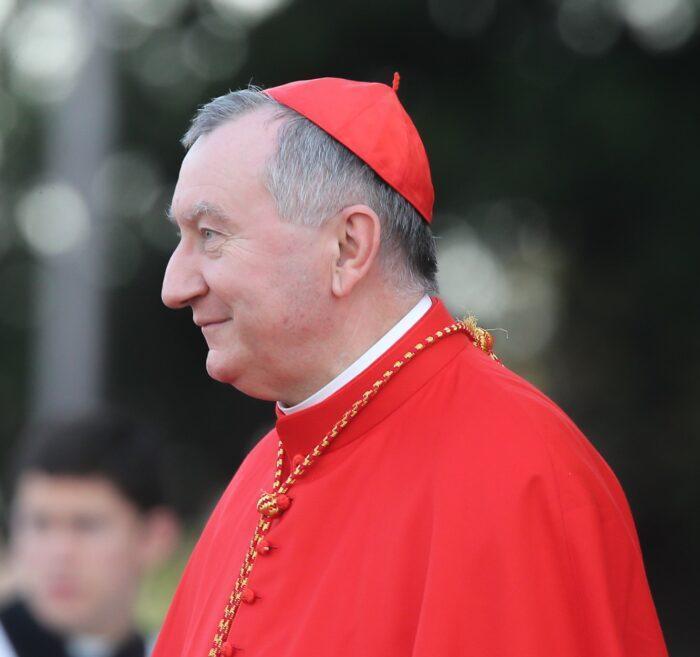
Cardinal Pietro Parolin expresses deep sorrow over SSPX bishop consecrations, warning the act wounds Church unity and may lead to excommunications.
Newsroom (02/07/2026 Gaudium Press ) Cardinal Pietro Parolin has emerged as the Vatican’s leading voice following the controversial consecration of four bishops by the Priestly Society of Saint Pius X (SSPX), expressing “deep sorrow” over the act and signaling that formal excommunications could follow.
Speaking to journalists on Wednesday, the Vatican secretary of state delivered one of the Holy See’s strongest responses yet after the traditionalist group proceeded with episcopal consecrations at its seminary in Écône, Switzerland, despite direct opposition from Pope Leo XIV.
“Deep sorrow – I wish to express deep sorrow,” Parolin said. “Because, when speaking of the unity of the Church, an act of this kind deeply wounds that unity.”
His remarks underscored the Vatican’s view that the SSPX decision represents not merely a disciplinary violation but a direct challenge to ecclesial communion. For Parolin, the central issue is the unity of the Catholic Church, which he said is damaged when bishops are ordained without papal authorization.
The SSPX consecrations were carried out by Bishop Alfonso de Galarreta, himself a figure with a long history in the movement’s disputes with Rome. Yet Parolin made clear that the Vatican’s concern extends beyond individual personalities.
“We know that episcopal ordinations performed without a papal mandate break the unity of the Church and incur very specific sanctions,” he said. “Fundamentally, excommunication.”
While Parolin stopped short of announcing immediate penalties, his comments strongly suggested that the Holy See is considering formal measures against those involved. He acknowledged that he did not know the timing or manner in which any excommunications would be imposed but emphasized that Church law provides clear consequences for such actions.
More significantly, the cardinal described the consecrations as “an act that is schismatic in itself,” highlighting the seriousness with which Vatican authorities are treating the event.
Parolin’s intervention came just one day after Pope Leo XIV publicly appealed to the SSPX not to proceed with the consecrations. In a letter addressed to the society, the pontiff warned that the planned action would harm the spiritual welfare of the faithful attached to the group and could affect their access to the sacraments.
Despite that appeal, the consecrations went ahead as scheduled, creating a fresh crisis in the Vatican’s decades-long relationship with the traditionalist society.
Yet Parolin’s comments suggested that Rome’s concerns run deeper than questions of liturgical preference. While debates surrounding the SSPX are often associated with the traditional Latin Mass and older forms of Catholic worship, the cardinal pointed instead to the Second Vatican Council as the fundamental point of contention.
“[T]he history of the Church continues,” Parolin said, describing the 1962-1965 Second Vatican Council as “a milestone in that history – one that must be accepted and properly implemented.”
The statement reflects a longstanding Vatican position that full reconciliation requires acceptance of Vatican II and its teachings. For Church leaders, the issue is not solely liturgical practice but adherence to the Church’s understanding of its post-conciliar development.
Even as he delivered a firm warning, Parolin also struck a conciliatory tone regarding the future. Rather than closing the door on engagement, he expressed hope that dialogue with the SSPX could continue despite the latest rupture.
“I hope,” he said, “that – building on the dialogue efforts already undertaken in the past with the Society of Saint Pius X – we can move forward despite this serious wound and find a way to resolve the problem.”
That appeal reflects years of Vatican attempts to normalize relations with the society. Although the SSPX has remained in what the Holy See calls a “canonically irregular” situation, successive popes have pursued avenues of dialogue. Pope Benedict XVI lifted the excommunications of four SSPX bishops in 2009, while Pope Francis granted important pastoral concessions, including recognition of the society’s faculties to hear confessions and celebrate marriages.
Now, however, Parolin faces the challenge of balancing the Vatican’s commitment to Church unity with its longstanding desire for reconciliation.
His remarks leave little doubt about the gravity with which the Holy See views the latest consecrations. At the same time, they reveal a Vatican still unwilling to abandon dialogue entirely, even as it considers sanctions against those responsible.
For Cardinal Parolin, the SSPX consecrations represent a painful setback. But his message was clear: preserving the unity of the Church remains the Vatican’s overriding priority, and any path forward will require addressing what he described as a serious wound to that unity.
- Raju Hasmukh with files from Crux Now
Related Images:


