






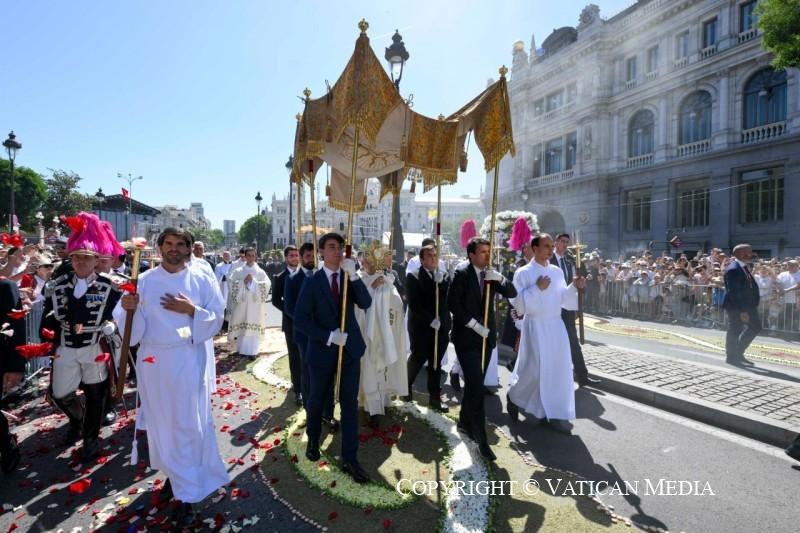
Pope Leo XIV’s Spain visit drew 2.5 million people, boosting the economy and faith, despite protests and a flight delay.
Newsroom (17/06/2026 Gaudium Press ) Despite logistical challenges and isolated disruptions, organizers have characterized Pope Leo XIV’s recent weeklong visit to Spain as a resounding success, highlighting both vast public participation and far-reaching spiritual and economic effects.
At a press conference held June 16 in Madrid, Archbishop Luis Argüello of Valladolid, president of the Spanish Bishops’ Conference, reflected on the scale and significance of the visit. “The visit has overwhelmed us in our expectations and in what we have lived,” he said, emphasizing the depth of engagement witnessed across the country.
Archbishop Argüello framed the trip as fundamentally pastoral and apostolic. “The trip had a heart, which was seeing the evangelization of the Church in action,” he noted. “It was an apostolic journey in which the Word was proclaimed, the liturgy was celebrated, and the charity of the Church was exalted with harmony in the various places where the visit took place.”
Millions Gather Across Spain
Organizers Yago de la Cierva and Fernando Giménez Barriocanal reported that approximately 2.5 million people participated in events spanning Madrid, Barcelona, and the Canary Islands. The turnout underscores the enduring influence of the Catholic Church in Spain, as well as the continued ability of papal visits to mobilize large-scale public engagement.
Beyond attendance figures, the visit also generated a significant economic ripple effect. While the total cost of organizing the trip was estimated at 26 million euros (approximately $30.1 million), projections suggest that its economic impact could exceed 150 million euros ($174 million).
Giménez highlighted that the Madrid region alone expects to generate roughly 120 million euros ($139.2 million) in economic activity tied to the visit. This figure served as the basis for broader national projections, demonstrating the substantial financial return associated with large religious gatherings.
Yet organizers were quick to stress that monetary metrics only tell part of the story.
“There are still no metrics to evaluate all the contributions to the common good made by the Holy Father,” Giménez said. “These undoubtedly result in a social benefit that is not measured in GDP.” He added that the pope’s speeches and presence carried a value that extends well beyond economic indicators.
Security Measures Thwart Protest
While the visit proceeded largely without incident, authorities discreetly intervened to prevent a planned political disruption during a high-profile event in Barcelona.
According to Archbishop Argüello, a group of choir members sympathetic to Catalan independence attempted to stage a demonstration at the June 10 inauguration of the Tower of Jesus Christ at the Sagrada Familia basilica. The individuals allegedly planned to replace their sheet music with displays of the “Estelada,” the Catalan separatist flag, before calling for independence and singing the regional anthem “Els Segadors” in front of the pope and Spain’s King Felipe VI.
The plan was foiled after other choir members alerted authorities. Police subsequently removed the individuals involved in an operation so discreet that most attendees remained unaware of the incident until later.
“Some members of the choir were the ones who alerted authorities,” Argüello said, underscoring the quiet efficiency of the response. The episode, though politically sensitive, did not disrupt the ceremony itself and had minimal visible impact on the broader visit.
Flight Disruption Alters Final Day
The only major logistical setback occurred at the conclusion of the trip, when a mechanical failure grounded the papal flight scheduled to return to Rome on June 12.
Engineers were given a brief window — approximately 30 minutes — to assess the aircraft but ultimately determined it was unsafe for travel. The unexpected delay prompted King Felipe VI to offer Pope Leo XIV a seat aboard his royal Falcon jet, allowing the pontiff to depart later that day.
However, journalists and Vatican personnel traveling on the official papal flight were required to remain in Tenerife overnight, eventually arriving in Rome in the early morning hours the following day aboard a replacement aircraft.
The disruption also led to the cancellation of the pope’s customary in-flight press conference — a moment typically anticipated by journalists covering papal trips.
“Iberia has compensated all the journalists who arrived very late and, above all, who lost the opportunity that all reporters look forward to at the end of the trip,” de la Cierva said, referring to the missed press interaction as “something priceless.”
Despite the inconvenience, organizers praised the airline’s handling of the situation. De la Cierva commended Iberia for prioritizing safety above all else, stating that refusing to proceed under uncertain conditions demonstrated responsible judgment.
“If they had to tell the pope, ‘We can’t fly,’ it deserves a ‘chapeau bas’ — a tip of the hat — to put the most important thing of the trip first, which is safety,” he said.
A Lasting Impact
In the final assessment, organizers emphasized that the visit’s lasting importance lies less in its logistical execution than in its broader message. Through public liturgies, speeches, and symbolic gatherings, Pope Leo XIV’s presence reinforced the Church’s mission while fostering a sense of unity and shared purpose.
Even with minor disruptions, the visit appears to have strengthened both Spain’s religious life and its public image as a destination for global events — leaving an imprint that, as organizers suggest, cannot be fully measured.
- Raju Hasmukh with files from OSV
Related Images:


